
 Need help?
Do you have a question about the SUNSTONE Orion i Series and is the answer not in the manual?
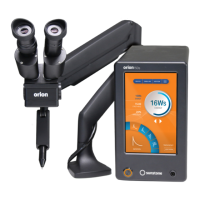
Lists all the components included in the welder package.
Details different methods for securing the microscope arm assembly to a table.
Instructions for unpacking and positioning the microscope arm assembly.
Provides instructions for bolting the arm assembly to a table surface.
Details mounting the arm assembly to a vertical surface.
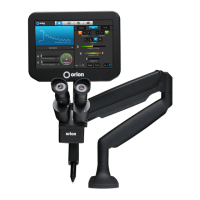
Steps to secure the screen case onto the microscope arm.
Explains how to adjust the spring tension of the microscope arm.
Guide to connecting accessories like eyepiece covers and shutter cables.
Instructions for removing, inserting, and positioning the welding stylus.
Steps to fine-tune the microscope's focus for clear viewing.
Guidance on mounting the power supply unit using brackets.
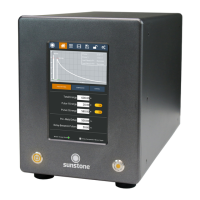
Details connecting cables and ports on the back of the power supply unit.
Instructions for connecting the front panel and powering on the unit.
Step-by-step guide for properly installing a tungsten electrode into the welding stylus.
Advice on applying correct pressure to avoid electrode contamination.
Procedure for sharpening the electrode tip using a diamond disk for better arc initiation.
Instructions for creating a flat or blunt tip on the electrode for specific metal types.
Important safety rules for handling pressurized gas tanks and preventing hazards.
Guide to securely fastening the gas tank and connecting the regulator and tubing.
Explains the function of the LCD shutter for eye protection and unobstructed view.
Steps to practice positioning the work-piece and electrode for welding.
Describes the main screen with Waveform, Parameter Selection, and Mini-Screen areas.
Details controls for Waveform, Ignition, Agitation, Energy, Length, and Weld Speed.
Explains Classic/Triangle/Square waveforms and Standard/Standard+/Adaptive ignition.
Covers power/energy sliders, length adjustments, and tack weld settings.
Details footer controls (Weld ON/OFF, Undo, Redo, Reset) and Mini-Screen customization.
Overview of Agitation, Gas, Dynamic Energy, Save/Load, and other parameter settings.
Adjustments for volume, brightness, language, theme, and agitation profiles.
Controls for gas flow delays, calibration, and weld timing adjustments.
Manages default settings, memory, software updates, and system information.
Controls the welding state between ON and OFF for creating welds.
Guide to attaching clips, selecting basic settings, and initiating an arc weld.
Procedure for performing resistance tack welds using alligator clips and Tack mode.
Guidance on experimenting with settings for optimal weld results based on application.
Recommendations for using waveforms, energy, agitation, and ignition for best results.
Explains electrode placement relative to the workpiece for weld quality.
Identifies ignition modes (Standard+, Adaptive) based on the waveform display.
Explains how Classic, Triangle, and Square waveforms represent energy discharge.
Describes how agitation spikes affect the waveform and weld quality.
Explains how weld discharge length influences energy and heat input.
Details how energy discharge relates to heat, spot size, and penetration.
Indicates compliance with European directives for electromagnetic compatibility and safety.
 General
| Model | Orion i Series |
|---|---|
| Category | Welding System |
| Manufacturer | SUNSTONE |
| Foot Pedal Control | Yes |
| Touchscreen Interface | Yes |
| Welding Modes | AC, DC |
| Pulse Frequency Range | 0.1-20 Hz |
| Cooling System | Air-cooled |
| Input Voltage | 100-240 VAC |

 To Next Page