OWNERS MANUAL
18
TIRES AND TUBES
Bicycle tires are available in many designs and specications, ranging
from general purpose designs to tires designed to perform best under
very specic weather or terrain conditions. If, once you have gained
experience with your new Surface604 bike, you feel that a dierent tire
might better suit your riding needs, your dealer can help you select the
most appropriate design.
Changing to a tire which is a larger or smaller width will alter the han-
dling characteristics of your bicycle and in some cases may make it
unsafe to ride. With your dealer’s help, be sure to select an inner tube
that correctly corresponds with the size of the new tire.
In some cases, particularly when you select a larger diameter tire, you
may nd that the clearance between the tire and the bicycle frame is
reduced. This may cause damage to other parts of the bicycle, in par-
ticular, the frame. Furthermore, this is potentially dangerous and may
cause injury. It may also void your warranty.
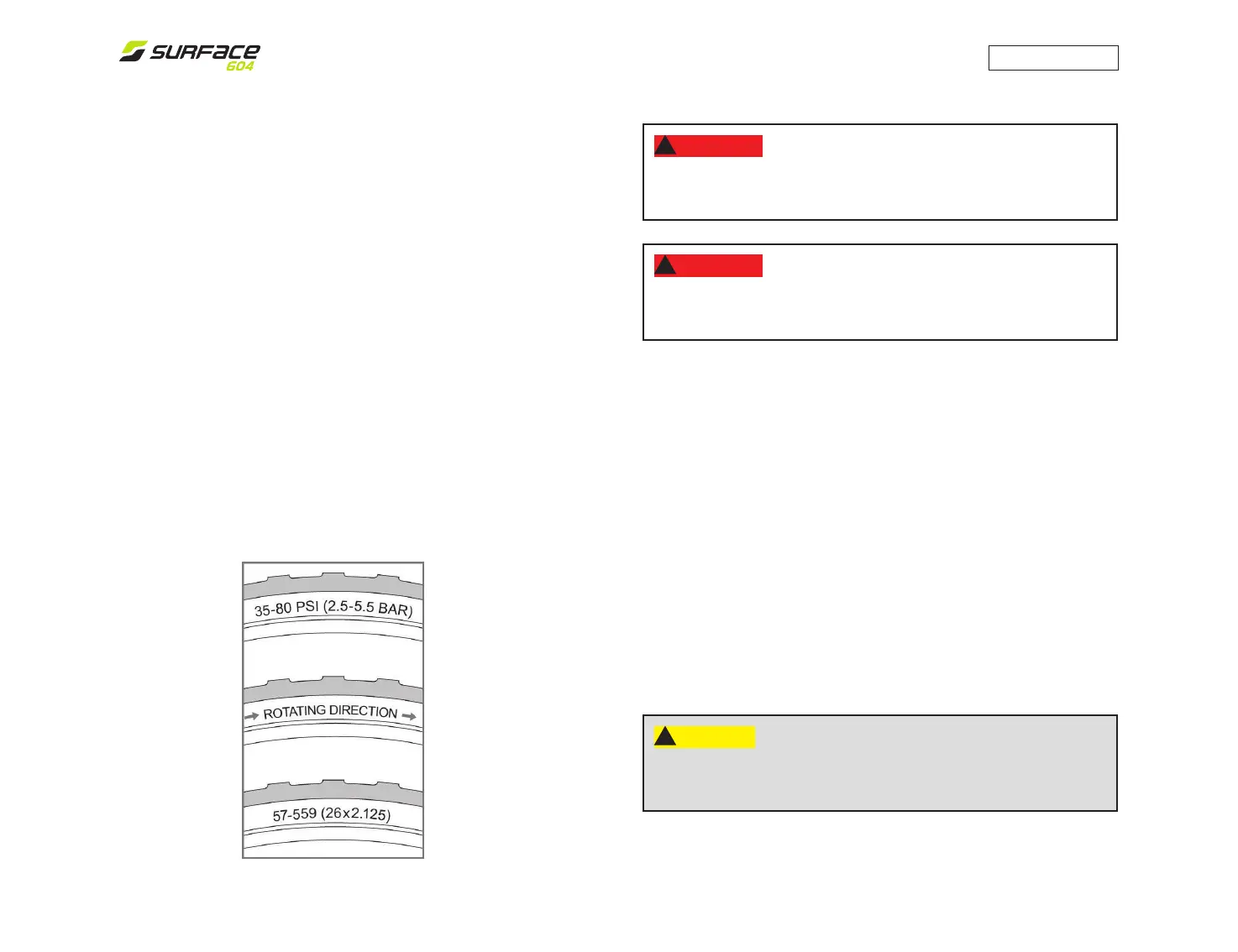
The size, pressure rating, and on some high- performance tires, the
specic recommended use, are marked on the sidewall of the tire. It is
important to know the tire pressure for the tire you are using.
The best and safest way to inate a bicycle tire to the correct pressure
is with a bicycle pump, which has a built-in pressure gauge.
Tire pressure is given either as maximum pressure or as a pressure
range. How a tire performs under dierent terrain or weather condi-
tions depends largely on tire pressure. Inating the tire slightly near its
maximum recommended pressure gives the lowest rolling resistance,
but also produces the bumpiest or most sensitive ride depending on the
type of terrain you ride.
Tire pressure that is too low for your weight and the riding conditions
can cause a puncture of the tube by allowing the tire to deform enough
to pinch the inner tube between the rim and the riding surface.
High pressures work best on smooth, dry pavement. Very low pres-
sures, at the bottom of the recommended pressure range, give the best
performance on smooth, slick terrain such as hard- packed clay, and on
deep, loose surfaces such as deep, dry sand.
Ask your dealer to recommend the best tire pressure for the kind of
riding you will most often do and have the dealer inate your tires to
that pressure. Some tires may need to be brought up to pressure every
week or two.
WARNING:
!
Never inate a tire beyond maximum pressure
marked on the tire’s sidewall. Exceeding the recommended
maximum pressure may blow the tire o the rim, which could
cause damage to the bike and injury to the rider and bystanders.
WARNING:
!
There is a safety risk in using gas station air
hoses or other air compressors. They are not made for bicycle tires.
They move a large volume of air very rapidly and can quickly raise
the pressure in your tire, which can cause the tube to explode.
CAUTION:
!
Pencil type automotive tire gauges can be
inaccurate and should not be relied upon for consistent, accurate
pressure readings. Instead, use a high-quality dial gauge obtained
from your local bike dealer.


 To Next Page