EasyManua.ls Logo

Swann MARK II - Tuning Procedures; Initial Tuning Setup; Tuning Cautions

Swann MARK II
10 pages
Print Icon
To Next Page IconTo Next Page
To Previous Page IconTo Previous Page
Loading...
BLACK
WIRE
To
my
te
BRASS
PRONG
r
GREEN
WIRE
TO
<—
TINNED
PRONG
(NEUTRAL)
=P
—~—e
WHITE
WIRE
To
BRASS
PRONG
3
COND.
POWER
LINE
CABLE
ied
From
MARK
IL
PowER
suppLy
COMMON
TYPE,
ZIOVAC
PLUS
SLACK
WIRE
am
AX
TO
FLAT
PRONG
WHITE
WIRE
TO
FLAT
PRONG
)
S_
GREEN
WIRE
TO
GROUND
PIN
3
COND.
POWER
LINE
CABLE
FROM
MARK
IT
POWER
SUPPLY.
COMMON
TYPE
117
VAC
PLUG
WITH
GROUND
PIN.
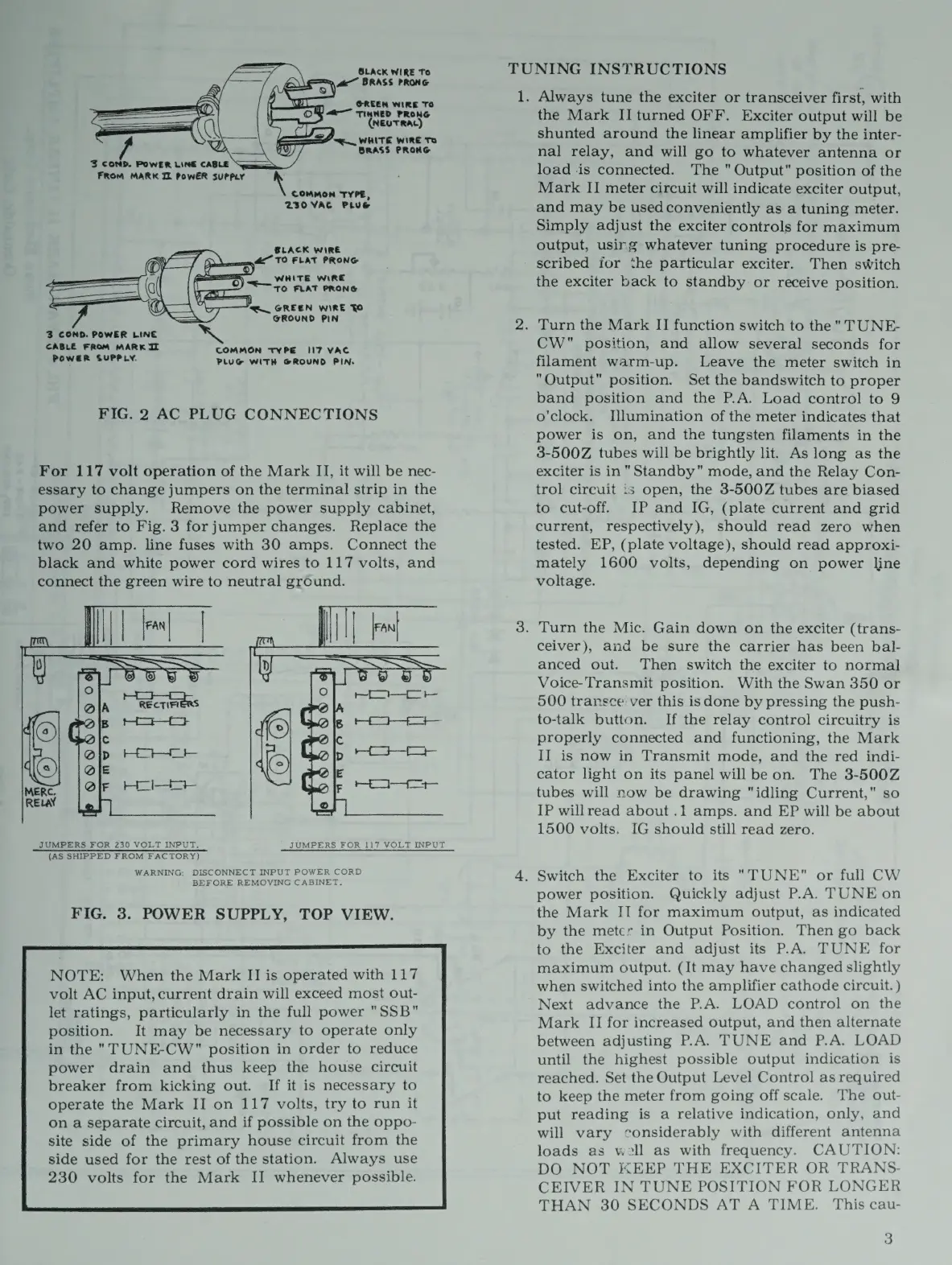
FIG.
2
AC
PLUG
CONNECTIONS
For
117
volt
operation
of
the
Mark
II,
it
will
be
nec-
essary
to
change
jumpers
on
the
terminal
strip
in
the
power
supply.
Remove
the
power
supply
cabinet,
and
refer
to
Fig.
3
for
jumper
changes.
Replace
the
two
20
amp.
line
fuses
with
30
amps.
Connect
the
black
and
white
power
cord
wires
to
117
volts,
and
connect
the
green
wire
to
neutral
ground.
JUMPERS
FOR
230
VOLT
INPUT.
(AS
SHIPPED
FROM
FACTORY)
WARNING:
DISCONNECT
INPUT
POWER
CORD
BEFORE
REMOVING
CABINET.
FIG.
3.
POWER
SUPPLY,
TOP
VIEW.
NOTE:
When
the
Mark
II
is
operated
with
117
volt
AC
input,
current
drain
will
exceed
most
out-
let
ratings,
particularly
in
the
full
power
"SSB"
position.
It
may
be
necessary
to
operate
only
in
the
"TUNE-CW'"
position
in
order
to
reduce
power
drain
and
thus
keep
the
house
circuit
breaker
from
kicking
out.
If
it
is
necessary
to
operate
the
Mark
II
on
117
volts,
try
to
run
it
on
a
separate
circuit,
and
if
possible
on
the
oppo-
site
side
of
the
primary
house
circuit
from
the
side
used
for
the
rest
of
the
station.
Always
use
230
volts
for
the
Mark
II
whenever
possible.
JUMPERS
FOR
117
VOLT
INPUT
TUNING
INSTRUCTIONS
1.
Always
tune
the
exciter
or
transceiver
first,
with
the
Mark
II
turned
OFF.
Exciter
output
will
be
shunted
around
the
linear
amplifier
by
the
inter-
nal
relay,
and
will
go
to
whatever
antenna
or
load
is
connected.
The
"Output"
position
of
the
Mark
II
meter
circuit
will
indicate
exciter
output,
and
may
be
usedconveniently
as
a
tuning
meter.
Simply
adjust
the
exciter
controls
for
maximum
output,
usirg
whatever
tuning
procedure
is
pre-
scribed
for
the
particular
exciter.
Then
switch
the
exciter
back
to
standby
or
receive
position.
2.
Turn
the
Mark
II
function
switch
to
the
"TUNE-
CW"
position,
and
allow
several
seconds
for
filament
warm-up.
Leave
the
meter
switch
in
"Output"
position.
Set
the
bandswitch
to
proper
band
position
and
the
P.A.
Load
control
to
9
o'clock.
Illumination
of
the
meter
indicates
that
power
is
on,
and
the
tungsten
filaments
in
the
3-500Z
tubes
will
be
brightly
lit.
As
long
as
the
exciter
is
in"
Standby”
mode,
and
the
Relay
Con-
trol
circuit
:s
open,
the
3-500Z
tubes
are
biased
to
cut-off.
IP
and
IG,
(plate
current
and
grid
current,
respectively),
should
read
zero
when
tested.
EP,
(plate
voltage),
should
read
approxi-
mately
1600
volts,
depending
on
power
line
voltage.
3.
Turn
the
Mic.
Gain
down
on
the
exciter
(trans-
ceiver),
and
be
sure
the
carrier
has
been
bal-
anced
out.
Then
switch
the
exciter
to
normal
Voice-Transmit
position.
With
the
Swan
350
or
500
transce
ver
this
is
done
by
pressing
the
push-
to-talk
button.
If
the
relay
control
circuitry
is
properly
connected
and
functioning,
the
Mark
II
is
now
in
Transmit
mode,
and
the
red
indi-
cator
light
on
its
panel
willbe
on.
The
3-500Z
tubes
will
now
be
drawing
"idling
Current,"
so
IP
willread
about
.1
amps.
and
EP
will
be
about
1500
volts.
IG
should
still
read
zero.
4.
Switch
the
Exciter
to
its
"TUNE"
or
full
CW
power
position.
Quickly
adjust
P.A.
TUNE
on
the
Mark
II
for
maximum
output,
as
indicated
by
the
meter
in
Output
Position.
Then
go
back
to
the
Exciter
and
adjust
its
P.A.
TUNE
for
maximum
output.
(It
may
have
changed
slightly
when
switched
into
the
amplifier
cathode
circuit.
)
Next
advance
the
P.A.
LOAD
control
on
the
Mark
II
for
increased
output,
and
then
alternate
between
adjusting
P.A.
TUNE
and
P.A.
LOAD
until
the
highest
possible
output
indication
is
reached.
Set
the
Output
Level
Control
as
required
to
keep
the
meter
from
going
off
scale.
The
out-
put
reading
is
a
relative
indication,
only,
and
will
vary
considerably
with
different
antenna
loads
as
wll
as
with
frequency.
CAUTION:
DO
NOT
KEEP
THE
EXCITER
OR
TRANS-
CEIVER
IN
TUNE
POSITION
FOR
LONGER
THAN
30
SECONDS
AT
A
TIME.
This
cau-
3

Related product manuals