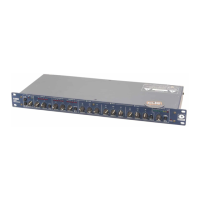
628
17
How Expanders Increase Usable Dynamic Range
The lower limit restriction of a system is the noise floor. Keep in mind that while the signal levels
may change greatly, the noise usually remains at a constant level. The action of the expander
increases the dynamic range of all signals below threshold. This action increases the apparent
loudness of signals above the expanders threshold, while decreasing the apparent loudness of the
noise.
An expander operating at a ratio of 1:2 causes an input signal that falls 10 dB below threshold to
fall 20 dB at its output. The downward action of the expander reduces the noise floor by the same
ratio applied to the signal. Since the relationship between the signal and the noise stays the same,
the noise drops 20 dB by the action of the expander, which responds to the signals 10 dB drop at
the 1:2 ratio.
De-essers
The de-esser is another dynamic range controller specially designed to regulate high frequency
content. The de-essing technique was developed for motion picture dialogue recording. Speech
sounded more natural and pleasing with the reduction of sibilants. By sensing and limiting certain
selected frequencies, the de-esser provides specific control over some of the higher frequency
vocal sounds which may become overemphasized when the speaker or vocalist is close to the
microphone.
The 628s de-esser controls excessive sibilant vocal sounds which can often range 12 dB louder
than the rest of the spectrum. Its a frequency conscious compressor/limiter. The de-esser
operates only on the problem frequencies. Unlike brute force equalization, the de-esser can reduce
the offending sounds without sacrificing intelligibility. Because it operates dynamically, a de-esser
removes only sounds that are disproportionately loud, and only those falling within the selected
control range.
De-essers include knobs that allow the operator to control which frequencies are compressed, and
how much attenuation is applied. The 628s DE-ESSER controls are FREQUENCY (800 Hz to
12 kHz) and THRESHOLD which may be set from 0 dB to -60 dB.
Equalization
Equalization is the most powerful tool available to the audio engineer. It is routinely the first
signal modification device that most people experience.
The parametric equalizer of the 628 allows both creative and corrective frequency shaping. It can
create a more pleasing sound and correct frequency response problems. The term parametric
refers to the fact that the primary operating parameters of the equalizer may be altered by the user.
The adjustable parameters are: center FREQUENCY (expressed in kHz), BANDWIDTH, or Q
(expressed in octaves), and the amount of CUT or BOOST (expressed in dB).
The center frequency is the frequency (kHz) in the middle of the bell shaped response curve formed
by a tuned filter. Bandwidth defines the width of the bell shaped curve, measured between its -3
dB points. The measure of bandwidth in audio equalizers is expressed in octaves or parts of an
octave. We express amounts of cut or boost in decibels at the center frequency of the bell curve.
Equalization is selective amplification, or reduction, of a signal based on frequency. Audio signals
consist of combinations of fundamental signals and their harmonics. Changes to the spectral
balance of a signal involves altering the relationship of the fundamental to its harmonics. Each
harmonic makes up one aspect of the audible character of a signal. Knowing these relationships
allows you to quickly zero-in on the correct frequency range of the signal and apply boost or cut to
enhance or correct what you are hearing.


 To Next Page