
 Need help?
Do you have a question about the Synology DiskStation DS218 and is the answer not in the manual?
Lists items included in the product package for verification.
Identifies and describes the ports and indicators on the Synology DiskStation.
Provides crucial safety guidelines for using the device to avoid harm or damage.
Details necessary tools and drive requirements for drive installation.
Step-by-step instructions for installing hard drives into the DiskStation bays.
Instructions for powering on and connecting the DiskStation to the network.
Guide to installing DiskStation Manager software using the Web Assistant tool.
Information on where to find additional resources and support for your DiskStation.
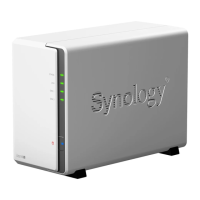
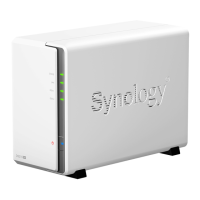
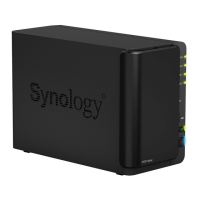
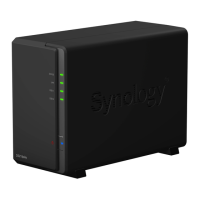
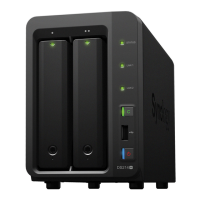
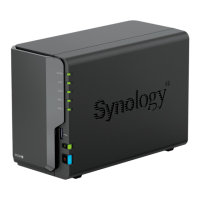
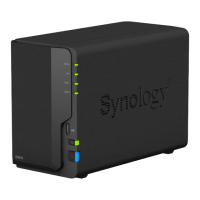
The Synology DiskStation DS218 is a network-attached storage (NAS) device designed for home and small office use, providing a centralized solution for data storage, sharing, and management. It functions as a personal cloud server, allowing users to access their files from anywhere with an internet connection. The device supports two hard drives, offering flexibility in storage capacity and data redundancy options.
At its core, the DS218 serves as a robust file server, enabling users to store a wide variety of data, including documents, photos, videos, and music, in a secure and organized manner. It supports various file systems for both internal and external drives, such as ext4, ext3, FAT, NTFS, HFS+, and exFAT (with an optional package), ensuring compatibility with different operating systems and devices. The device is powered by Synology's DiskStation Manager (DSM), a browser-based operating system that provides an intuitive and feature-rich interface for managing the NAS.
Beyond simple file storage, the DS218 offers advanced data management capabilities. Users can configure RAID volumes (Basic, JBOD, RAID 0, RAID 1, and Synology Hybrid RAID) to optimize for performance or data protection. RAID 1, for instance, mirrors data across two drives, providing fault tolerance in case one drive fails. Synology Hybrid RAID (SHR) simplifies RAID management by automatically optimizing storage capacity and redundancy based on the installed drives. The device also supports HDD hibernation and scheduled power on/off, contributing to energy efficiency and extending drive lifespan.
The DS218 is equipped with multiple connectivity options to facilitate its functions. It features a 1GbE RJ-45 LAN port for network connection, allowing it to integrate seamlessly into an existing network infrastructure. For connecting external devices, it includes two USB 3.0 ports and one USB 2.0 port. These ports can be used to attach external hard drives for backup or additional storage, or other USB devices like digital cameras. A dedicated copy button on the front panel simplifies the process of copying data from a connected USB device to the internal drives, making it convenient for quick backups of photos or other media.
The device's status is communicated through a series of LED indicators on the front panel. These include a Status Indicator for system health, a LAN Indicator for network connection status, and Disk Indicators for the installed drives. These LEDs provide quick visual cues about the device's operational state, such as whether the volume is normal, degraded, or not created, if the network is connected or active, and if drives are ready, accessing data, or experiencing errors.
Setting up the DS218 involves a straightforward hardware installation followed by software configuration via Web Assistant. The hardware setup requires users to install 3.5" or 2.5" SATA drives into the drive trays. For 3.5" drives, fastening panels secure the drive in place, while 2.5" drives are secured with screws in a designated area of the tray. The drive trays are designed for easy insertion and removal, clicking into place when properly seated. Once the drives are installed and the drive bay cover is replaced, the device is connected to the network via the LAN cable and powered on using the AC adapter.
The software installation is initiated through Synology's Web Assistant, a built-in tool that helps download and install the latest version of DSM. By accessing find.synology.com or diskstation:5000 in a web browser on a computer connected to the same local network, users can discover the DiskStation and proceed with the setup. The Web Assistant guides users through the installation process, and upon completion, the DiskStation becomes online and detectable from network computers. The default administrative account is "admin" with a blank password if the installation process is interrupted.
The DS218 is designed to be user-friendly, with a focus on ease of access and management. The DSM interface, accessible via a web browser, allows for comprehensive control over the NAS. Users can create shared folders, manage user accounts and permissions, set up backup tasks, install various applications from the Package Center (e.g., for media streaming, surveillance, or productivity), and monitor system performance. The ability to install DSM with Web Assistant simplifies the initial setup, making it accessible even for users with limited networking experience.
The copy button on the front panel is a notable convenience feature. When a USB storage device is connected, the button lights up, and pressing it initiates a data copy operation to the internal drives. This is particularly useful for photographers or anyone needing to quickly offload data from a USB drive without having to log into the DSM interface.
The DS218 incorporates several features to ensure reliable operation and facilitate maintenance. The fan system is crucial for dissipating excess heat and cooling the internal components. If the fan malfunctions, the DiskStation will emit a beeping sound, alerting the user to a potential issue that needs attention. This proactive alert helps prevent overheating and potential damage to the drives or other components.
The LED indicators serve as important diagnostic tools. For example, if a Disk Indicator shows an orange static light, it signifies a drive error or a disabled port. In such cases, the manual suggests restarting the DiskStation or re-inserting the drive(s). Users can then run the HDD/SSD manufacturer's diagnostic tool or the built-in S.M.A.R.T. test within DSM to check the health status of the drive(s). This guidance helps users troubleshoot and address drive-related issues efficiently.
The RESET button on the back panel offers two levels of reset functionality. A short press and hold (until a beep sound) restores the default IP address, DNS server, and passwords for the admin account, which can be useful if network settings are misconfigured or the admin password is forgotten. A longer press and hold (until three beep sounds) returns the DiskStation to an "Not installed" status, allowing DSM to be reinstalled. This is a powerful recovery option for severe software issues or when preparing the device for a fresh installation.
The device also supports scheduled power on/off and HDD hibernation, which are not only energy-saving features but also contribute to the longevity of the hard drives by reducing their operational hours. Regular software updates, provided by Synology, ensure that the DSM operating system remains secure and performs optimally. These updates often include bug fixes, security patches, and new features, which are essential for maintaining the device's health and functionality over time.
For physical security, the DS218 includes a Kensington Security Slot, allowing users to attach a compatible lock to deter theft. The safety instructions emphasize placing the product right side up, away from direct sunlight, chemicals, and liquids, and unplugging the power cord before cleaning. These guidelines are crucial for preventing damage and ensuring the long-term reliability of the device.
 General
| Chassis type | Desktop |
|---|---|
| Cooling type | Active |
| Fan diameter | 92 mm |
| Product color | Black |
| LED indicators | HDD, LAN, Power, Status |
| Number of fans | 1 fan(s) |
| Cable lock slot | Yes |
| Cable lock slot type | Kensington |
| Operating system installed | DiskStation Manager |
| Mac operating systems supported | Mac OS X 10.11 El Capitan, Mac OS X 10.12 Sierra |
| Other operating systems supported | Android, iOS |
| Windows operating systems supported | Windows 10, Windows 7 |
| Type | NAS |
| Noise level | 19.3 dB |
| Device class | Home & Home Office |
| Backup features | Cloud, iSCSI LUN |
| Number of users | 2048 user(s) |
| Browser supported | Firefox, Internet Explorer 10+, Safari, Chrome |
| Security algorithms | HTTPS, SSL/TLS |
| Processor cores | 4 |
| Processor model | RTD1296 |
| Processor family | Realtek |
| Processor frequency | 1.4 GHz |
| Processor operating modes | 64-bit |
| Internal memory | 2 GB |
| Internal memory type | DDR4 |
| RAID levels | 0, 1, JBOD |
| Storage drive size | - \ |
| Storage drive capacity | 0 GB |
| Supported file systems | FAT, HFS+, NTFS, ext3, ext4 |
| Storage drive interface | - |
| Storage drives installed | No |
| Storage drive sizes supported | 2.5, 3.5 \ |
| Supported storage drive types | HDD & SSD |
| Total installed storage capacity | 0 TB |
| Maximum supported storage capacity | 24 TB |
| Number of storage drives installed | 0 |
| Number of storage drives supported | 2 |
| Supported storage drive interfaces | Serial ATA, Serial ATA II, Serial ATA III |
| Ethernet LAN data rates | 10, 100, 1000 Mbit/s |
| Supported network protocols | SMB, AFP, NFS, FTP, WebDAV, CalDAV, iSCSI, Telnet, SSH, SNMP, VPN (PPTP, OpenVPN, L2TP) |
| USB 2.0 ports quantity | USB 2.0 ports have a data transmission speed of 480 Mbps, and are backwards compatible with USB 1.1 ports. You can connect all kinds of peripheral devices to them. |
| Ethernet LAN (RJ-45) ports | 1 |
| AC input voltage | 100-240 V |
| AC input frequency | 50 - 60 Hz |
| Power supply location | External |
| Power consumption (typical) | 14.99 W |
| Power consumption (HDD standby) | 5.78 W |
| Power supply unit (PSU) capacity | 60 W |
| Operating altitude | 0 - 5000 m |
| Storage temperature (T-T) | -20 - 60 °C |
| Operating temperature (T-T) | 0 - 40 °C |
| Operating relative humidity (H-H) | 5 - 95 % |
| Certification | FCC B, CE B, BSMI B |
| Sustainability certificates | RoHS |
| Cables included | AC, LAN (RJ-45) |
| Harmonized System (HS) code | 84714100 |
 Weight and Dimensions
| Depth | 233.2 mm |
|---|---|
| Width | 108 mm |
| Height | 165 mm |
| Weight | 1300 g |

 To Next Page