button. The following test parameters are
shown on the screen: test mode, test duration,
test cycles (completed or remaining), turntable
speed, and vacuum suction level (%).
60 / 72 RPM Turntable Rotation Speed*
Models 5135 and 5155 offer both 60 rpm and 72
rpm turntable rotation speed. This enables the
operator to select the speed referenced in the
test standard.
NOTE: The turntable speed on previous versions of
the Taber Abraser was dependent on the electrical
line frequency. At 60Hz, the turntable speed was 72
rpm and at 50Hz the turntable speed was 60 rpm.
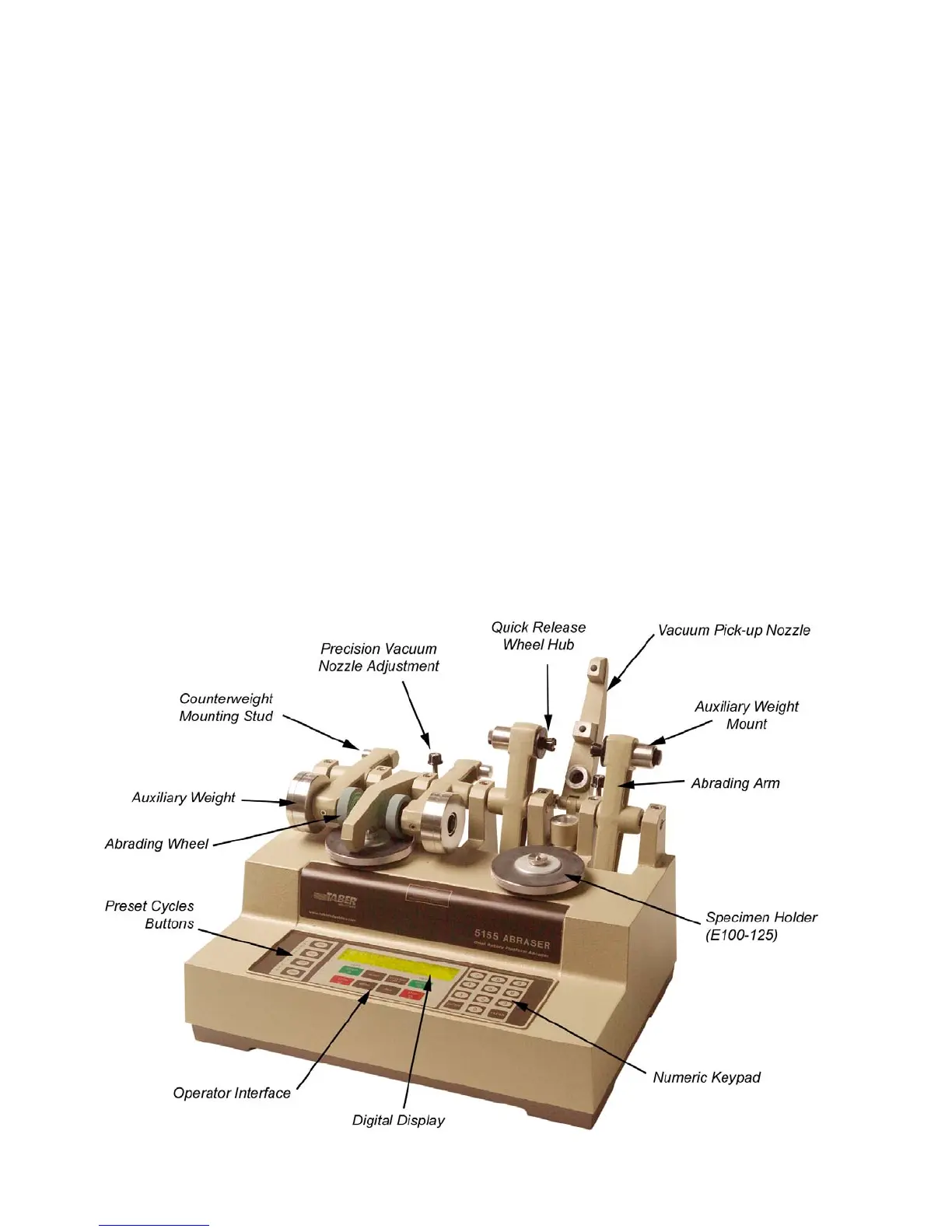
Preset Cycles Buttons*
The operator interface includes four commonly
used preset cycles buttons. This enables the
operator to automatically program 100, 500,
1000 or 2500 test cycles. The buttons may also
be used to “add to” the cycle count by the
corresponding incremental values.
Abrading Head Assemblies
Models 5135 and 5155 have independent
abrading arms of forged aluminum alloy that
pivot on ball bearings. The forward end of the
arm has a quick release wheel-mounting hub to
which the abrading wheel is mounted. The arms
are precision balanced to ensure exacting
results. Each arm applies 250 grams force
against the specimen with the wheel mounting
assembly in place (exclusive of the mass of the
wheels itself).
The outer end of the abrading head assembly
allows the auxiliary weight to be mounted
concentric with the abrading wheel. A stud on
the rear end of the abrading arm may be used to
carry a counterweight when it is desired to
reduce the wheel load to less than 250 grams
when testing delicate materials. It may also be
used to hold an abrading wheel as a
counterweight to compensate for the mass of
the working wheel.
Quick Release Mounting Hub*
An expanding collet hub design with push-button
operation permits quick wheel mounting, without
the need of a locking nut. A spring loaded,
beveled retaining nut provides a positive locking
force on the hub retaining lip making certain the
wheels remain securely fastened until
disengaged. The increased clearance results in
a larger viewing area of the test specimen.
4 5135 / 5155 Operating Instructions ver 1.1



 To Next Page