Need help?
Do you have a question about the TAJIMA TFMX-IIC and is the answer not in the manual?
Essential guidelines for preventing accidents and ensuring safe operation.
Detailed safety warnings and instructions applicable to UL and CSA specified machines.
Identifies and explains the meaning of various warning labels affixed to the machine.
Procedures for inspecting and checking machine parts before commencing work.
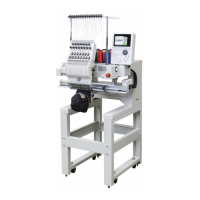
Identifies and labels the main components of different machine models (TFMX-C, TWMX-C, etc.).
Explains the operation and function of various machine parts and controls.
Details the various elements and information displayed on the machine's main and sub-screens.
Explains the condition data and messages displayed by the machine during operation.
Instructions on how to properly power on the embroidery machine, including switch types.
Procedures for correct thread path setup and fabric mounting on the embroidery frame.
Steps for transferring embroidery designs into the machine memory via USB or PC.
How to select designs and configure color sequences for embroidery.
Methods for checking design size and setting the correct starting position for embroidery.
Important checks related to maximum speed and embroidery head settings before starting.
Procedures for starting, stopping, and managing frame movement during embroidery.
Manual procedure for changing the color on a specific needle bar.
Manual and automatic methods for trimming threads, including ATH settings.
Adjusting minimum revolution, revolution limits, and maximum speed settings.
Methods for stopping the machine automatically based on set values or frame limits.
Performing enlargement, rotation, and reversion of designs using Data Conversion.
Settings for repeating designs horizontally, vertically, or at the same location.
Adjusting backlash, stitch length, auto jump, thread tension, and other finishing parameters.
Settings for needle bar lowering, jump code combination, and frame travel speed.
Procedures for modifying, inserting, or deleting stitches within a design.
Instructions for changing or canceling the machine's password protection.
Accessing information like total stitch count, needle bar colors, software version, and language.
Switching between Frame Back and Frame Forward modes, and executing them via stop codes or stitch counts.
Changing frame types and performing design rotation for cap frames.
Manual offset and automatic return to original positions after manual frame travel or power interruptions.
Manually or automatically returning the frame to the design's starting point.
Automatic frame movement at the start and end of embroidery using offset positions.
Registering frame positions, such as the table offset position, for easier threading.
Operations for deleting, moving, copying, renaming designs, and sorting them in memory.
Procedures for deleting and sorting designs stored on a USB memory device.
Settings to enable Sequin Device, Automatic Lubrication, Network, Lochrose, Cording, Boring, and Bobbin Changer.
Detailed settings for Sequin Device III and Sequin Device IV, including feed amounts and jump insertion.
Air compressor activation, sequin color reversal, and Lochrose counter functions.
Explains normal and abnormal stops, and how to restore the machine based on stop codes.
Common troubleshooting steps for issues like thread breakage, needle breaks, and bad sewing finish.
Critical safety precautions and warnings regarding high voltage and general maintenance practices.
Daily and weekly cleaning procedures for key machine parts like ATH, rotary hook, head, and drive system.
Lubrication points and cycles for the rotary hook, head, cylinder bed, and slim cylinder bed.
Specifies greases and greasing points for the head, rotary hook base, cylinder bed, and ATH cam/gear.
Routine inspection points and safety guidelines for machine repair.
Provides power supply specifications and ambient noise level measurements for the machine.
Lists function codes that can be edited or are for display only, used in design data.
Shows the electrical connections and components for single-head and multi-head machines.
Defines technical terms and abbreviations used throughout the manual.
 General
| Model | TFMX-IIC |
|---|---|
| Type | Multi-head Embroidery Machine |
| Stitch Type | Lockstitch |
| Needle System | DBxK5 |
| Weight | Varies depending on head configuration |
| Maximum Embroidery Area | Varies depending on head configuration (e.g., 450mm x 520mm) |
| Thread Break Detection | Yes |
| USB Port | Yes |
| Needle Distance | 360 mm |
| Display | LCD Touch Screen |
| Power Requirements | AC 200-240V, 50/60 Hz |
| Number of Needles | 6, 9, 12 or 15 |
| Needle Count | 6, 9, 12 or 15 |


 To Next Page