Need help?
Do you have a question about the TAJIMA TLMX Series and is the answer not in the manual?
General safety guidelines for operating the embroidery machine to prevent accidents and injuries.
Details about warning labels attached to the machine and their meaning for safe operation.
Procedure for inspecting machine parts before starting embroidery work, including cleaning and lubrication.
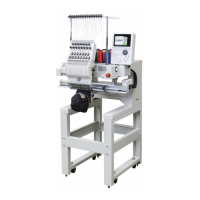
Identification and description of the main parts of the TLMX series embroidery machine.
Explanation of how to operate and use various components and controls of the embroidery machine.
Details on the functions and operation of the 17-inch and 6.5-inch specification operation panels.
Description of different embroidery methods and attachments available for the machine.
Overview of four different embroidery methods: Taping, Zigzag Swing Stitch, Coiling, and Tuck.
Guidance on selecting an embroidery design and managing color change sequences within the machine.
How to check design size and settings, and adjust the frame to the correct start position.
Essential checks before starting embroidery, including maximum speed settings and embroidery head status.
Instructions on how to start and stop the embroidery process, including frame back and completion procedures.
Detailed procedures for operating and setting the M-axis, including manual rotation and origin return.
Instructions for operating and setting the nipple, including manual up/down movement and stroke adjustment.
Procedures for setting embroidery conditions, such as thread tension, zigzag swing stitch, and tuck embroidery.
Manual operations for color change and switching between right and left heads on the embroidery machine.
Instructions for trimming thread manually and automatically using FM and LM heads.
How to limit and adjust embroidery speed based on stitch length and other parameters.
Procedures for stopping the machine automatically based on preset values or when the needle gets stuck.
Using Data Conversion to perform enlargement, rotation, and reversion of embroidery designs.
Setting up repeat patterns for horizontal and vertical repetition and automatic restarting after data set.
Techniques for adjusting finishing elements like frame backlash, stitch length, and fine stitches.
Methods to improve embroidering efficiency, such as adjusting needle bar lowering and jump stitch combinations.
Detailed instructions on editing design data, including modifying, inserting, and deleting stitches.
Procedures for changing, setting, and canceling the machine's password for security.
Miscellaneous functions like checking stitch count, needle bar color, and software version.
Operations for moving the frame backward or forward, including execution via operation panel or switches.
Essential steps to perform after replacing the embroidery frame, such as changing the drive mode.
How to return the frame to its original position manually (Manual Offset) or automatically after manual travel.
Manual and automatic methods to return the frame to the design start position, especially after stopping the machine.
Setting and executing automatic frame movement at the start, middle, and end of embroidery (Automatic Offset).
Registering the frame position (Table Offset Position) to facilitate easier threading.
Operations for managing designs stored in the machine's memory, including deleting, moving, and copying.
Procedures for deleting and sorting designs that are saved on a USB memory device.
Enabling the use of optional devices like Sequin Device, Lubrication System, Network, and Cording Device.
Detailed settings for optional devices, including Sequin Device III, Sequin Device IV, and other devices.
Information on functions related to optional devices, such as air compressor use and sequin data conversion.
Diagrams showing the layout of electrical components and cards within the machine.
List of function codes that can be edited on the machine for various operations.
Electrical system diagrams illustrating the connections for TLMX-mixed type and TLMX-triple mixed type.
Glossary of terms used in the manual related to machine operation and embroidery.
 General
| Series | TLMX |
|---|---|
| Brand | TAJIMA |
| Display | LCD Touch Screen |
| Number of Needles | 9 |
| Needle Count | 9 to 12 |
| Frame Type | tubular and cap frames |
| Connectivity | USB |
| Power Requirements | 220V, 50/60Hz |


 To Next Page