EasyManua.ls Logo

Tamron B008 - Attaching and Removing the Lens; How to Mount the Lens; How to Detach the Lens; Focusing (Autofocus)

Tamron B008
11 pages
Print Icon
To Next Page IconTo Next Page
To Previous Page IconTo Previous Page
Loading...
ve
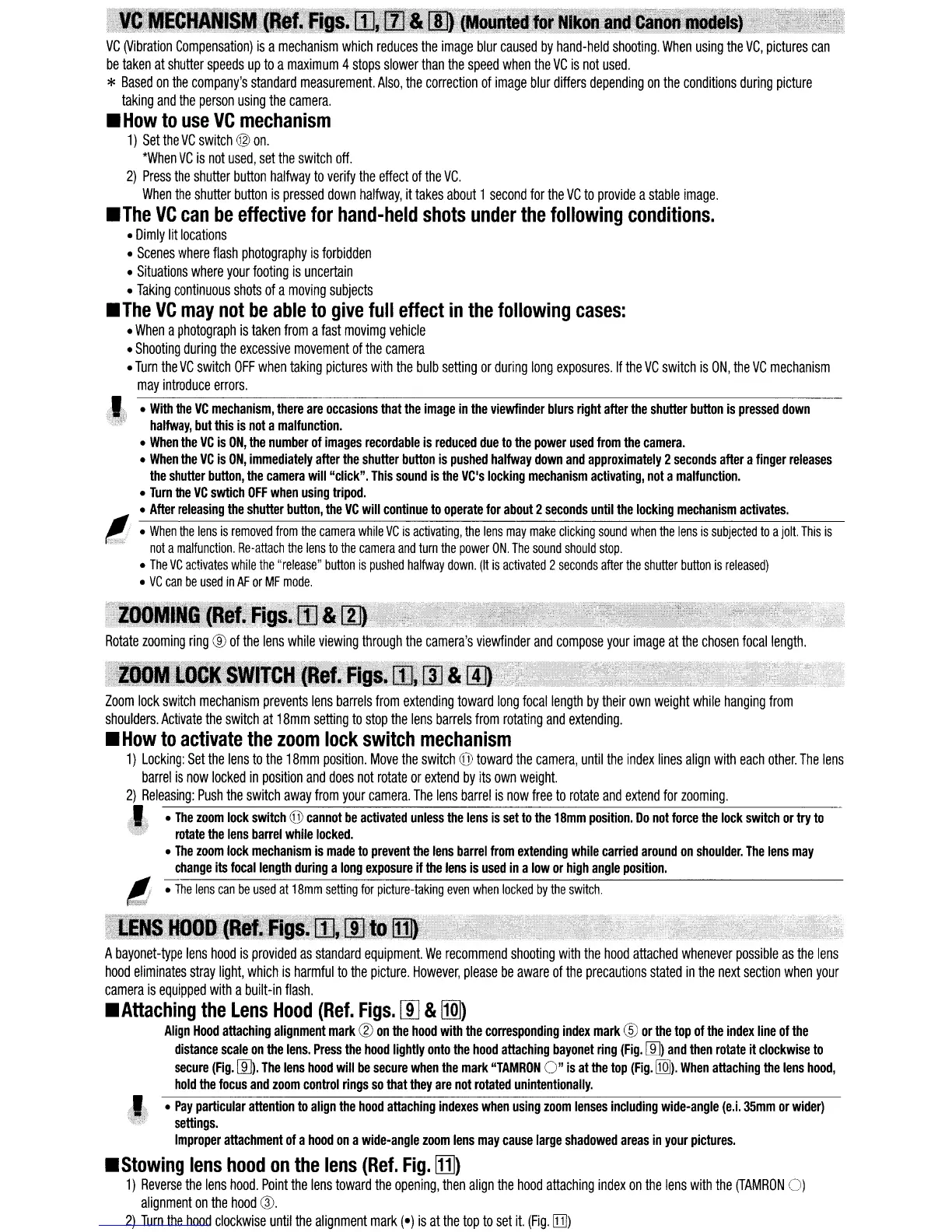
(Vibration
Compensation)
is
a
mechanism
which
reduces
the
image
blur
caused
by
hand-held
shooting.
When
using
the
ve,
pictures
can
be
taken
at
shutter
speeds
up
to
a
maximum
4
stops
slower
than
the
speed
when
the
ve
is
not
used.
*
Based
on
the
company's
standard
measurement.
Also,
the
correction
of
image
blur
differs
depending
on
the
conditions
during
picture
taking
and
the
person
using
the
camera
.
How
to
use
VC
mechanism
1)
Set
the
ve
switch
@
on.
*When
ve
is
not
used,
set
the
switch
off.
2)
Press
the
shutter
button
halfway
to
verify
the
effect
of
the
ve.
When
the
shutter
button
is
pressed
down
halfway,
it
takes
about
1
second
for
the
VC
to
provide
a
stable
image
.
The
VC
can
be
effective
for
hand-held
shots
under
the
following
conditions.
e
Dimly
lit
locations
e
Scenes
where
flash
photography
is
forbidden
e
Situations
where
your
footing
is
uncertain
e
Taking
continuous
shots
of
a
moving
subjects
.The
VC
may
not
be
able
to
give
full
effect
in
the
following
cases:
e
When
a
photograph
is
taken
from
a
fast
movimg
vehicle
e
Shooting
during
the
excessive
movement
of
the
camera
e
Turn
the
ve
switch
OFF
when
taking
pictures
with
the
bulb
setting
or
during
long
exposures.
If
the
ve
switch
is
ON,
the
ve
mechanism
may
introduce
errors.
iii'li[
e
With
the
VC
mechanism,
there
are
occasions
that
the
image
in
the
viewfinder
blurs
right
after
the
shutter
button
is
pressed
down
halfway,
but
this
is
not
a
malfunction.
e
When
the
VC
is
ON,
the
number
of
images
recordable
is
reduced
due
to
the
power
used
from
the
camera.
e
When
the
VC
is
ON,
immediately
after
the
shutter
button
is
pushed
halfway
down
and
approximately
2
seconds
after
a
finger
releases
the
shutter
button,
the
camera
will
"click".
This
sound
is
the
VC's
locking
mechanism
activating,
not
a
malfunction.
e
Turn
the
VC
swtich
OFF
when
using
tripod.
e
After
releasing
the
shutter
button,
the
VC
will
continue
to
operate
for
about
2
seconds
until
the
locking
mechanism
activates.
~/
e
When
the
lens
is
removed
from
the
camera
while
VC
is
activating,
the
lens
may
make
clicking
sound
when
the
lens
is
subjected
to
a
jolt.
This
is
not
a
malfunction.
Re-attach
the
lens
to
the
camera
and
turn
the
power
ON.
The
sound
should
stop.
e
The
VC
activates
while
the
"release"
button
is
pushed
halfway
down.
(It
is
activated
2
seconds
after
the
shutter
button
is
released)
e
VC
can
be
used
in
AF
or
MF
mode.
Rotate
zooming
ring
®
of
the
lens
while
viewing
through
the
camera's
viewfinder
and
compose
your
image
at
the
chosen
focal
length.
Zoom
lock
switch
mechanism
prevents
lens
barrels
from
extending
toward
long
focal
length
by
their
own
weight
while
hanging
from
shoulders.
Activate
the
switch
at
18mm
setting
to
stop
the
lens
barrels
from
rotating
and
extending
.
How
to
activate
the
zoom
lock
switch
mechanism
1)
Locking:
Set
the
lens
to
the
18mm
position.
Move
the
switch
@
toward
the
camera,
until
the
index
lines
align
with
each
other.
The
lens
barrel
is
now
locked
in
position
and
does
not
rotate
or
extend
by
its
own
weight.
2)
Releasing:
Push
the
switch
away
from
your
camera.
The
lens
barrel
is
now
free
to
rotate
and
extend
for
looming.
iillii e
The
zoom
lock
switch
@
cannot
be
activated
unless
the
lens
is
set
to
the
18mm
position.
Do
not
force
the
lock
switch
or
try
to
.
".
rotate
the
lens
barrel
while
locked.
e
The
zoom
lock
mechanism
is
made
to
prevent
the
lens
barrel
from
extending
while
carried
around
on
shoulder.
The
lens
may
change
its
focal
length
during
a
long
exposure
if
the
lens
is
used
in
a
low
or
high
angle
position.
l;
e
The
lens
can
be
used
at
18mm
setting
for
picture-taking
even
when
locked
by
the
switch.
A
bayonet-type
lens
hood
is
provided
as
standard
equipment.
We
recommend
shooting
with
the
hood
attached
whenever
possible
as
the
lens
hood
eliminates
stray
light,
which
is
harmful
to
the
picture.
However,
please
be
aware
of
the
precautions
stated
in
the
next
section
when
your
camera
is
equipped
with
a
built-in
flash
.
Attaching
the
Lens
Hood
(Ref.
Figs.
[ID
&
ffQ])
Align
Hood
attaching
alignment
mark
@
on
the
hood
with
the
corresponding
index
mark
®
or
the
top
of
the
index
line
of
the
distance
scale
on
the
lens.
Press
the
hood
lightly
onto
the
hood
attaching
bayonet
ring
(Fig.
[ill)
and
then
rotate
it
clockwise
to
secure
(Fig.
[ill).
The
lens
hood
will
be
secure
when
the
mark
"TAM
RON
0"
is
at
the
top
(Fig.Iill]).
When
attaching
the
lens
hood,
hold
the
focus
and
zoom
control
rings
so
that
they
are
not
rotated
unintentionally.
::llli
e
Pay
particular
attention
to
align
the
hood
attaching
indexes
when
using
zoom
lenses
inclUding
wide-angle
(e.i.
35mm
or
wider)
settings.
Improper
attachment
of
a
hood
on
a
wide-angle
zoom
lens
may
cause
large
shadowed
areas
in
your
pictures
.
Stowing
lens
hood
on
the
lens
(Ref.
Fig.
[j])
1)
Reverse
the
lens
hood.
Point
the
lens
toward
the
opening,
then
align
the
hood
attaching
index
on
the
lens
with
the
(TAMRON
0)
alignment
on
the
hood
@.
2)
Turn
the
hood
clockwise
until
the
alignment
mark
(e)
is
at
the top
to
set
it.
(Fig.
[TI])

Other manuals for Tamron B008

Related product manuals