Need help?
Do you have a question about the Tascam TA-1VP and is the answer not in the manual?
Instructions for mounting the unit in a standard 19-inch rack.
Explanation of Antares Auto-Tune technology and its function.
How the TA-1VP adjusts pitch to match a selected scale.
Explanation of what audio compression is and why it's used.
Explanation of the limiting function in dynamics processing.
Explanation of de-essing and its purpose.
Description of the process by which Auto-Tune identifies input pitch.
How to use and customize scales for Auto-Tune pitch correction.
Details on compressor parameters: threshold and ratio.
Explanation of downward expanders and noise gates.
Details on compressor attack and release time parameters.
Overview of the TA-1VP's equalization capabilities.
Introduction to the technology for emulating different microphones.
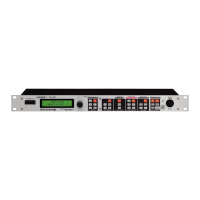
Detailed description of the TA-1VP's front panel controls and displays.
Explanation of the controls for the AUTO-TUNE module.
Detailed description of the TA-1VP's rear panel connectors.
Explanation of the controls for the COMPRESSOR/GATE module.
Explanation of the controls for the DE-ESSER module.
Various methods for connecting the TA-1VP into an audio system.
Operation of the Microphone Modeler module.
Operation of the Auto-Tune module.
Operation of the De-Esser module.
Operation of the Equalizer/Output module.
Critical advice on monitoring during Auto-Tune processing.
Operation of the Compressor/Gate module.
Managing output gain and main bypass.
 General
| Type | Vocal Processor |
|---|---|
| Technology | Antares Auto-Tune |
| Compressor | Yes |
| De-esser | Yes |
| USB | No |
| Effects | Reverb, Delay |
| Input | XLR, 1/4" TRS |
| Output | XLR, 1/4" TRS |
| Frequency Response | 20 Hz to 20 kHz |
| Phantom Power | +48V |
| EQ | Yes |

 To Next Page