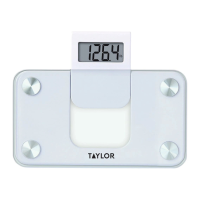
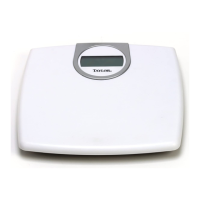
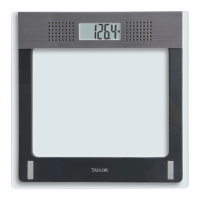
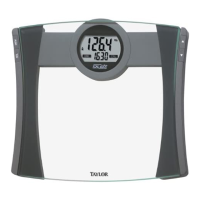
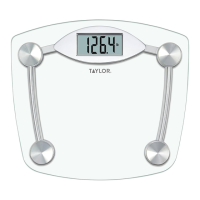
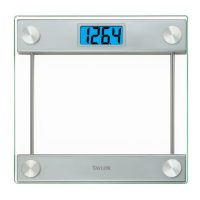
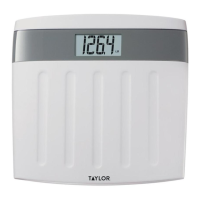
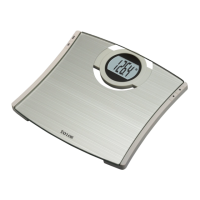
1. There is a plastic strip under the battery cover to prevent battery
drainage during shipping. Please remove the strip before continuing
with these instructions (you may need to remove the battery
compartment cover to avoid breaking the strip). Also, some models
have a static cling label on the lens to prevent scratching. Please
remove before use.
2. Your scale has been set at the factory to read weight in pounds. You
may select kilograms or stone (1 stone = 14 pounds) units of
measurement by pressing the “UNIT” button on the bottom of the scale.
3. Place scale on flat, hard surface. Carpeted or uneven floors may affect
accuracy.
4. Step on the scale (disregarding the reading) and step off. This process
ensure the scale is set and is now ready for use. Do this whenever the
scale is moved. At all other times step straight onto the scale.
5. Step onto the scale platform and remain still. The display will count up to
your weight. The display will flash 3 times when the weight is locked.
Your weight is now displayed.
6. The scale will turn off automatically.
CP7042EF 7.16 WC
Electronic Scale
General Operation
Five (5) Year Limited Warranty
Garantie Limitée de Cinq (5) Ans
There are no express warranties except as listed above.
©2016 Taylor Precision Products, Inc. Taylor® is a registered trademark of
Taylor Precision Products, Inc. All rights reserved.
Made to our exact specifications in China.
Not legal for trade.
Il n'y a aucune garantie expresse sauf celle indiquée précédemment.
©2016 Taylor Precision Products, Inc. Taylor® est une marque de commerce déposée
de Taylor Precision Products, Inc. Tous droits réservés.
Fabriqué en Chine selon nos spécifications exactes.
Non légal pour le commerce
This scale is warranted against defects in materials of workmanship
(excluding batteries) for five (5) years for the original purchaser from date of
retail purchase. It does not cover damages or wear resulting from accident,
misuse, abuse, commercial use, or unauthorized adjustment and/or repair.
Do not return to retailer. Should this scale require service (or replacement at
our option) while under warranty, please pack the item in the original
packaging and return it prepaid, along with store receipt showing date of
purchase and a note explaining reason for return to:
Cette balance est garantit (à l'exclusion des piles) pour une période de cinq (5) ans
pour l'acheteur original contre les défauts de matériaux à partir de la date d'achat
au détail. Elle ne couvre pas les dommages ou l'usure suite à un accident, une
mauvaise utilisation, tout abus, utilisation commerciale ou réglage interdit et/ou
réparation interdite. Ne pas renvoyer cet appareil au fournisseur. Si cette balance
exige un service (ou un remplacement à notre discrétion) sous garantie, veuillez
l'emballer avec soin et la retourner à frais prépayés avec la facture du magasin
indiquant la date d'achat et une note expliquant la raison du retour à l'adresse
suivante.
7042EF
7042EF
1. Il y a une bande de plastique sous le couvercle de la pile afin d'éviter
l'épuisement de la pile durant l'expédition. Veuillez retirer la bande
avant de continuer les instructions (vous devrez peut-être retirer le
couvercle du compartiment de pile pour éviter de briser la bande). De
même, certains modèles ont une étiquette à collement électrostatique
sur la lentille pour éviter tout égratignement. Veuillez la retirer avant
d'utiliser.
2. Votre balance a été réglé à l'usine pour présenter des relevés de poids
en livres. Vous pouvez choisir les unités de mesure en kilogrammes ou les
stones (1 stone = 14 livres) en appuyant le bouton «UNIT» (UNITÉ) au bas
de la balance.
3. Places la balance sur une surface dure et plane. Les planchers à tapis
ou inégaux peuvent affecter l'exactitude.
4. Montez sur la balance (ignorant le relevé) et descendez. Ce processus
assure le réglage de la balance et il est prêt à être utilisé. Faites ceci à
chaque fois que vous déplacez la balance. En tout autre temps, montez
tout simplement sur le balance.
5. Montez sur la plate-forme de la balance et ne bougez pas. La balance
comptera jusqu'à votre poids L'affichage clignotera 3 fois lorsque le
poids est verrouillé. Votre poids est maintenant affiché.
6. La balance s'éteindra automatiquement.
Balance Électronique
Fonctionnement Général
Manuel d'Instructions
Springfield Instruments Inc./ Les Instruments Springfield
104 Barr Street
Ville St.-Laurent, Quebec
H4T 1Y4
1-844-687-4040
or contact us via email at info@springfieldinstruments.com
Springfield Instruments Inc./ Les Instruments Springfield
104 Barr Street
Ville St.-Laurent, Quebec
H4T 1Y4
1-844-687-4040
ou contactez-nous par courriel à info@springfieldinstruments.com
Instruction Manual
Thank you for purchasing a Taylor® Digital scale. All of our precision
instruments for weight measurement are engineered and designed to
meet the highest quality standards to assure you years of uncompromising
accuracy and consistently dependable, convenient performance.
Please read this instruction manual carefully before use. Keep these
instructions handy for future reference.
Merci de votre achat d'une balance numérique au Taylor®. Tous nos
instruments de précision pour mesurer le poids sont fabriqués et conçus
pour répondre aux normes de qualité les plus élevées pour vous assurer
des années d'exactitude sans compromis et une performance pratique,
fiable et constante. Veuillez lire attentivement votre manuel d'instructions
avant d'utiliser l'appareil. Conservez les instructions à portée de la main à
titre de référence.

 Need help?

 To Next Page
 General