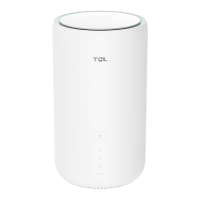
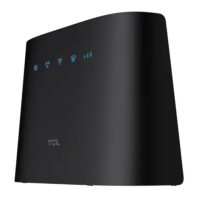
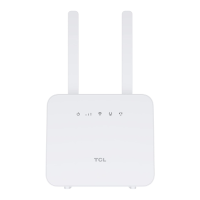
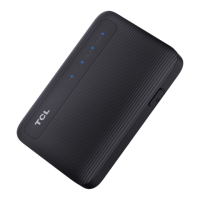
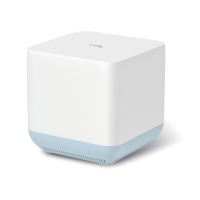
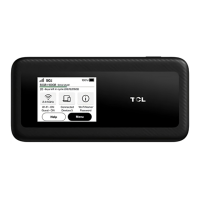
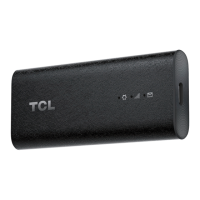
This document serves as the user manual for the TCL LINKHUB HH42CV2, a Cat4 LTE CPE (Customer Premises Equipment) designed to provide wired and wireless internet access for multiple computers and mobile devices. It functions as a central hub for home or business networks, offering various features and functions to manage connectivity and network settings.
Function Description
The TCL LINKHUB HH42CV2 is a versatile device that facilitates internet connectivity through both cellular (LTE) and wired (Ethernet) networks. It supports 2.4 GHz Wi-Fi (802.11 b/g/n) for wireless devices and offers multiple LAN ports for wired connections. The device's core function is to receive a cellular signal via a micro SIM card and convert it into a local Wi-Fi network and wired Ethernet connections. It also supports WAN connectivity, allowing it to act as a router for an existing internet source.
Key indicators on the device provide visual feedback on its operational status:
- Power indicator: Shows if the device is on or off.
- Signal indicator: Displays the strength of the cellular signal with multiple bars, with more blue bars indicating a stronger signal. No signal is indicated by the light being off.
- Wi-Fi/WPS indicator: Blinks blue when WPS connection is available, is solid blue when Wi-Fi is enabled, and is off when Wi-Fi is disabled.
- LAN indicator: Illuminates when a LAN port is connected and is off when not connected.
- Network indicator: Blinks blue when registered to the network, is solid blue when connected, and is solid red if the micro SIM card is unavailable or the device is not registered.
The device features several physical buttons and ports:
- WPS button: Used to enable the WPS function for quick wireless connections.
- Power button: Powers the device on or off.
- Reset button: Resets the device to factory settings.
- Micro SIM card slot: For inserting the micro SIM card to establish cellular connectivity.
- LAN port(s): For connecting wired devices like computers or switches.
- LAN/WAN port: Can be used to connect to an internet source (WAN) or wired devices (LAN).
- External antenna ports: Allows for the installation of external antennas to improve signal reception in areas with weak signals.
- Power connector: For connecting the power adapter.
Usage Features
The TCL LINKHUB HH42CV2 offers a comprehensive web user interface (UI) for configuration and management. Users can access the web UI via a web browser by navigating to http://192.168.1.1 and logging in with the credentials found on the device's bottom label.
The web UI is organized into several sections:
- Status: Provides an overview of device information, including Wi-Fi name, upload/download speed, software version, profile name, and monthly data plan. It also allows quick connection/disconnection to the internet and SSID changes.
- Home: Contains tabs for Status, Statistics (approximate mobile data usage and reset internet statistics), Device access (managing internet access for connected devices, blocking/unblocking devices), and Setup wizard (configuring basic connection settings, data roaming, 2.4 GHz Wi-Fi, SSID, and Wi-Fi password).
- Services: Primarily for managing SMS messages. It includes folders for Inbox, Outbox, Draft, and New message, along with SMS settings. Users can read, send, forward, reply to, and delete SMS messages, as well as enable/disable SMS delivery reports.
- Settings: This is the most extensive section for customizing the CPE. It allows users to:
- Prioritize network connection: Define the order of preference for available connections (Mobile Data or WAN).
- Mobile data settings: Configure connection mode, data roaming, and IP mode.
- Profile management: Set up, edit, or delete APN profiles for network operators.
- Network settings: Choose between Auto or Manual network search modes and select network modes (Auto, 3G only, or 4G only).
- WAN configuration: Set WAN connection mode to DHCP, PPPoE, or Static IP, and modify related parameters.
- MAC Clone: Enable this function for multiple client devices to connect to the CPE and access the internet, with options to reset or clone the MAC address.
- LAN settings: View default gateway and subnet mask, manage DHCP Server function (assigning IP addresses automatically or manually).
- Wi-Fi Basic settings: Configure SSID (name of the Wi-Fi network), SSID Broadcast (visibility of the Wi-Fi network), Security mode (Disable, WEP, WPA, WPA2, WPA/WPA2), Encryption (TKIP, AES, Auto), and view the Wi-Fi password.
- Wi-Fi Advanced settings: Select Country/Region, Channel, 802.11 Mode (default 802.11b/g/n), AP isolation (creating separate virtual networks for wireless clients), and Bandwidth.
- WPS (Wi-Fi Protected Setup): Facilitates faster and easier connections for WPS-supported devices through WPS PIN or PBC (Push Button Connect) modes.
- Security: Manage SIM PIN (enable, disable, change), WAN ping (for network security), LAN IP filter (whitelist/blacklist devices based on IP address), MAC filter (whitelist/blacklist devices based on MAC address), and URL filter (set internet access schedules and define allowed/blocked websites).
- DDNS (Dynamic Domain Name Server): Maps a dynamic WAN IP address to a static domain name for external access.
- DMZ (Demilitarized Zone): Enables external users to access specific network services within the LAN by setting a host IP address.
- UPnP (Universal Plug and Play): Allows connected devices to discover each other and establish network services (disabled by default).
- Port Forwarding: Enables external users to access FTP and other services within the LAN.
- QoS (Quality of Service): Prioritizes internet traffic for applications, online gaming, Ethernet LAN ports, or specified MAC addresses, with settings for upload and download speed limits.
- System: Provides device information (IMEI, software version, MAC address), allows rebooting or resetting the device, modifying the login password, setting system language and time zone, configuring NTP server for clock synchronization, backing up/restoring device configuration, and TR069 (protocol for communication with an Auto Configuration Server).
Maintenance Features
The manual emphasizes several aspects of device maintenance and troubleshooting:
- Software updates: The device supports online updates. Users can check for new software versions and download/update them via the web UI. It is crucial not to power off the device during an upgrade process to prevent damage.
- Resetting the device: If the CPE malfunctions or the login password is forgotten, the device can be reset to factory settings either through the web UI or by pressing the physical reset button for 3 seconds.
- SIM card management: Proper insertion of the micro SIM card is highlighted, with a warning against removing it while the CPE is in use to avoid malfunction or data loss. The manual also provides instructions for managing the SIM PIN, including unlocking the SIM card with a PUK code if the PIN is entered incorrectly multiple times.
- Troubleshooting guide: A dedicated section addresses common problems such as forgotten Wi-Fi passwords, issues with changing Wi-Fi name/password, network indicator status (solid red), inability to find the Wi-Fi network, setting a new SIM PIN, locating device information, accessing the web UI, internet access problems, and "PIN lock" or "PUK lock" messages. Solutions are provided for each scenario, often involving checking connections, reinserting SIM cards, adjusting settings in the web UI, or contacting the internet service provider.
- Safety information: The manual includes important safety instructions, such as observing restrictions on wireless device use, handling the device with care to prevent physical damage, not disassembling or attempting repairs, and keeping it away from small children due to choking hazards.
- Medical device interference: Users are advised to maintain a safe distance from medical devices like pacemakers due to potential interference.
- Power adapter usage: Only the supplied power adapter or compliant alternatives should be used, and the adapter should be kept in a well-ventilated area. Damaged power adapters should not be used.
- Operating temperature: The device is designed to operate within specific ambient temperature ranges (0°C to 45°C) and storage temperatures (-10°C to 70°C). Operating or storing outside these ranges may cause malfunction.
- Regulatory compliance and recycling: Information on electromagnetic fields (EMF) compliance, declaration of conformity, and proper disposal and recycling procedures is provided, encouraging users to observe local regulations and visit www.tcl.com for recycling information.



 To Next Page
 General