EasyManua.ls Logo

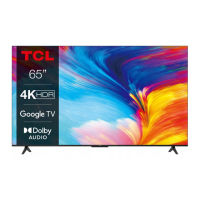
TCL P63 Series - User Manual

TCL P63 Series
16 pages
Print Icon
To Next Page IconTo Next Page
Loading...
EN
1
English
Important information
Safety
Ensure that your domestic mains supply voltage
matches the voltage indicated on the identication
sticker located at the back of your set. Where the
mains plug, AC inlet or an appliance coupler is used
as disconnect device, it shall remain readily operable.
On certain models, the light indicator is located at the
side of the TV set. The absence of a light indication
at the front does not mean that the TV set is fully
disconnected from the mains. To disconnect the TV
set completely, the mains plug must be pulled out.
The TV set’s components are sensitive to heat. The
maximum ambient temperature
should not exceed
35º
Celsius. Do not cover the vents at the back or
sides of the TV set. Leave su󰀩cient space around it to
allow adequate ventilation. Install the appliance away
from any source of heat (replace, etc.) or appliances
creating strong magnetic or electric elds.
Moisture
in rooms where the set is installed should
not exceed
75%
humidity. Moving the set from a cold
place to a warm one can cause condensation on the
screen (and on some components inside the TV set).
Let the condensation evaporate before switching the
TV set on again.
The or
POWER/
button on the TV set or the
button on the remote control can be used to switch it
on and put it into standby mode. If you are
not going
to be watching the TV for a lengthy period of time
,
switch it o󰀨 completely by removing the plug from the
mains power socket.
During
thunderstorms
, we recommend that you
disconnect the TV set from the mains and aerial so
that it is not a󰀨ected by electrical or electromagnetic
surges that could damage it. For this reason, keep the
mains and aerial sockets
accessible so they can be
disconnected
, if necessary.
Unplug
the TV set immediately if you notice it giving
o󰀨 a
smell of burning
or
smoke
. You must never,
under any circumstances, open the TV set yourself,
as you run the risk of an
electric shock
in doing so.
WARNINGS
This appliance is intended for domestic household
use only and should not be used for any other
application, such as for non-domestic use or in a
commercial environment.
If the external exible cable or cord of this product is
damaged, it shall be replaced by the manufacturer or
his service agent or a similar qualied person in order
to avoid a hazard.
Leave more than 10cm clearance around the
television to allow adequate ventilation. The
ventilation should not be impeded by covering the
ventilation openings with items, such as newspapers,
table-cloths, curtains, etc.
The apparatus shall not be exposed to dripping or
splashing and no objects lled with liquids, such as
vases shall be placed on the apparatus.
Batteries (battery pack or batteries installed) shall not
be exposed to excessive heat such as sunshine, re
or the like.
To reduce the risk of re or electric shock, do not
expose this apparatus to rain or moisture.
A television set may fall, causing serious personal
injury or death. Many injuries, particularly to children,
can be avoided by taking simple precautions such as:
ALWAYS use cabinets or stands or mounting
methods recommended by the manufacturer of the
television set.
ALWAYS use furniture that can safely support the
television set.
ALWAYS ensure the television set is not
overhanging the edge of the supporting furniture.
ALWAYS educate children about the dangers of
climbing on furniture to reach the television set or its
controls.
ALWAYS route cords and cables connected to your
television so they cannot be tripped over, pulled or
grabbed.
NEVER place a television set in an unstable
location.
NEVER place the television set on tall furniture
(for example, cupboards or bookcases) without
anchoring both the furniture and the television set to
a suitable support.
NEVER place the television set on cloth or other
materials that may be located between the television
set and supporting furniture.
NEVER place items that might tempt children to
climb, such as toys and remote controls, on the top
of the television or furniture on which the television
is placed.
If the existing television set is going to be retained
and relocated, the same considerations as above
should be applied.
Equipment with this symbol is a Class II or
double insulated electrical appliance. It has
been designed in such a way that it does
not require a safety connection to electrical
earth.
Equipment without this symbol is a Class I
electrical appliance. It shall be connected
to a mains socket outlet with a protective
earthing connection.
To prevent the spread of re, keep candles
or other open ames away from this product
at all times.

Questions and Answers

Summary

Important Information and Safety Precautions

General Safety Guidelines

Ensures correct mains voltage, plug use, and basic safety for TV operation.

Environmental and Installation Safety

Covers heat, moisture, ventilation, and placement to prevent damage.

Thunderstorm and Electrical Surge Protection

Recommends disconnecting TV and aerial during thunderstorms.

Operational Warnings and Cable Safety

Highlights domestic use, cable damage replacement, and ventilation clearance.

Safety Symbols, Installation, and Care

Electrical Safety Symbols and Installation

Explains safety symbols for high voltage and installation requirements.

Wall Mounting Safety

Instructions for safe wall mounting, requiring two people and correct hardware.

Chapter 1: Connecting Your TV

Connecting Power and Antenna

Step-by-step guide to connect the power cord and antenna to the TV.

Connecting to the Internet and Network

Wired and Wireless Internet Connection

Instructions for connecting the TV to wired or wireless networks.

Chapter 2: Getting Started with Your TV

TV Power, Setup, and Battery Safety

Switching the TV On, Off, and Standby

Guide to turning the TV on, entering standby, and disconnecting power.

Initial TV Setup Process

Walkthrough of the welcome screen and initial setup steps like language and network.

Chapter 3: Basic TV Operations

Chapter 4: Using More of Your TV

System Reset and Factory Defaults

Resetting to Factory Default Settings

Steps to restore the TV to its original factory default settings.

Chapter 5: Other Information and Troubleshooting

Troubleshooting Common TV Issues

Solutions for common problems like no picture/sound, unclear picture, and remote control malfunctions.

Overview

This document provides comprehensive information about your new television, covering safety guidelines, operational features, and maintenance tips to ensure optimal performance and longevity of the device.

Safety Information

The television is designed for domestic household use. It is crucial to ensure that the mains supply voltage matches the specifications on the identification sticker at the back of the set. If a mains plug, AC inlet, or appliance coupler is used as a disconnect device, it must remain readily operable. Note that the absence of a light indication at the front does not mean the TV is fully disconnected from the mains; to achieve complete disconnection, the mains plug must be pulled out.

The TV's components are sensitive to heat, so the maximum ambient temperature should not exceed 35° Celsius. To allow adequate ventilation, do not cover the vents at the back or sides of the TV set and leave sufficient space around it. The appliance should be installed away from heat sources like fireplaces and strong magnetic or electric fields. Humidity in the room should not exceed 75%. If the set is moved from a cold to a warm place, condensation may form on the screen and internal components; allow it to evaporate before switching the TV on.

The power button on the TV or remote control can switch the TV on and put it into standby mode. For lengthy periods of non-use, switch off the TV completely by removing the plug from the mains power socket. During thunderstorms, it is recommended to disconnect the TV from the mains and aerial to protect it from electrical or electromagnetic surges. Ensure mains and aerial sockets are accessible for disconnection.

Immediately unplug the TV if you notice a burning smell or smoke. Never open the TV yourself, as this poses a risk of electric shock. The appliance is not intended for non-domestic or commercial use. If the external flexible cable or cord is damaged, it must be replaced by the manufacturer, service agent, or a similarly qualified person to avoid hazards. Maintain more than 10cm clearance around the television for ventilation, and do not impede ventilation openings with items like newspapers, tablecloths, or curtains. The apparatus should not be exposed to dripping or splashing, and no liquid-filled objects, such as vases, should be placed on it. Batteries should not be exposed to excessive heat from sunshine, fire, or similar sources.

To reduce the risk of fire or electric shock, do not expose the apparatus to rain or moisture. A falling television can cause serious personal injury or death, especially to children. Always use manufacturer-recommended cabinets, stands, or mounting methods. Ensure the furniture can safely support the TV and that the TV does not overhang the edge of the supporting furniture. Educate children about the dangers of climbing on furniture to reach the TV or its controls. Route cords and cables to prevent tripping, pulling, or grabbing. Never place the TV in an unstable location or on tall furniture without anchoring both the furniture and the TV to a suitable support. Avoid placing materials between the TV and supporting furniture. Do not place items that might tempt children to climb on top of the TV or furniture. These considerations also apply if an existing TV is being retained and relocated.

The device may be Class II (double insulated) or Class I (requiring protective earthing). To prevent fire, keep candles or other open flames away from the product. High voltage is present inside the product; avoid contact with internal parts. The fuse may be in the neutral, requiring mains disconnection to de-energize phase conductors. Securely attach the apparatus to the floor/wall as per installation instructions. Maintain a use distance of at least 100cm to reduce RF exposure. If an outside antenna or cable system is connected, ensure it is grounded by a skilled person to protect against voltage surges and static charges.

Function Description

The television offers a wide range of functions accessible via the on-screen menus and the remote control. It supports various connections, including power, antenna, Blu-ray Disc players, HD game consoles, HD camcorders, and CI modules. Internet connectivity is available via wired (LAN) or wireless (Wi-Fi) connections, enabling access to Smart TV features and applications.

The remote control provides navigation, volume control, channel selection, input source selection, and quick access to specific apps like Netflix, Prime Video, YouTube, and TCL Channel. The TV also features an Electronic Programme Guide (EPG) for viewing scheduled digital TV programmes, Bluetooth functionality for connecting audio devices, mice, or keyboards, and a Quick Start function for faster power-on from standby.

HbbTV (Hybrid broadcast broadband TV) is supported on certain digital TV channels, offering interactive television services over broadband Internet, including digital teletext, electronic programme guides, games, voting, and catch-up TV. Consumer Electronic Control (CEC) allows for one-touch play and standby with compatible HDMI devices. The TV also includes options for managing subtitles, Teletext, and various system settings.

Usage Features

Getting Started: Upon initial power-on, a Welcome screen guides you through the setup process, including language selection, network connection, and channel scanning. Any skipped steps can be completed later via the settings menu.

Remote Control: The exclusive remote control allows navigation through on-screen menus using direction buttons and the OK button. It includes dedicated buttons for standby, mute, volume, channel change, input source, Smart TV homepage, EPG, and quick settings. App buttons provide direct access to streaming services. Batteries are installed by pushing open the back cover, inserting two AAA batteries according to polarity, and replacing the cover.

Switching On/Off: After connecting the power cord, the TV will either turn on directly or enter standby mode. Press the power button on the set or remote to turn it on from standby. To enter standby, press the power button on the remote. To fully switch off, unplug the mains plug. Some models may have a relay switch, producing a sound when turning on or off.

Connections:

  • Power and Antenna: Connect the power cord and antenna cable. The position of the power socket varies by model. Disconnect the power cord before connecting other devices.
  • External Devices: Connect Blu-ray Disc players, HD game consoles, HD camcorders, headphones, and CI modules to the appropriate ports (HDMI, USB, AV, etc.).
  • Internet: For wired connection, connect an Ethernet cable from your router/modem to the LAN port. For wireless, select "Network and Internet" in the settings menu and follow on-screen guidance to connect to your Wi-Fi network. Note that not all connectors may be visible on all models, and USB ports are for data input and relevant USB devices. Use high-quality, shielded HDMI cables to avoid interference.

Basic TV Operations:

  • Accessing Channels: Use the navigation buttons or P+/P- buttons on the remote to scroll through channels. Press OK to display the channel list.
  • Watching Connected Devices: Press the source button to display the input source list, then select the desired device.
  • Adjusting Volume: Use the +/- buttons to increase or decrease volume. Press the mute button to temporarily mute sound.
  • Smart TV Homepage: Press the home button to access Internet applications (Apps) and adapted Internet websites. Configure network settings before using Smart TV apps.
  • Settings Menu: Press the dashboard button, select "Settings," and press OK to adjust TV settings like picture and sound.

Using More of Your TV:

  • Installing Channels: In TV mode, go to "Settings > Channels and inputs > Channel > Channel scan." Select your country/region, then choose "Automatic search" and "Tuner mode" (Cable, Antenna, or Satellite). After configuration, select "Search" to scan channels.
  • Common Interface: Encrypted digital TV channels can be decoded using a common interface module and card from a service operator. Switch off the TV before inserting the module, following its directions. Once inserted and activated, access services via "Settings > Channels and inputs > Channel > Common interface."
  • Subtitles: Enable subtitles via "Settings > Channels and inputs > Channel > Subtitle." You can select preferred subtitle languages for digital broadcasts.
  • Teletext: Access Teletext via "Settings > Channels and inputs > Channel > Teletext." Select decoding page language and digital Teletext language.
  • Consumer Electronic Control (CEC): Enable HDMI control via "Settings > Channels and inputs > Inputs > Consumer Electronic Control (CEC)" to allow one-touch play and standby with CEC devices.
  • HbbTV: Ensure the TV is connected to the Internet and HbbTV is turned on via "Settings > System > HbbTV settings." When tuning to a digital TV channel offering HbbTV, an on-screen indication (usually a red button) will prompt you to open interactive pages. HbbTV can be deactivated if needed.
  • EPG (Electronic Programme Guide): Access via "Settings > Channels and inputs > Channel > EPG" or the EPG button on the remote. Navigate programmes, view details, set schedules, and filter programmes.
  • Bluetooth Function: Connect Bluetooth audio devices, mice, or keyboards via "Settings > Remotes and accessories > Add accessory." The TV will search for nearby devices. Note that 2.4GHz Wi-Fi devices might interfere with Bluetooth audio streaming; move closer to the TV or increase space between devices if interruptions occur.
  • Quick Start Function: Enable via "Settings > System > Power and energy > Quick start" for faster power-on from standby, though it increases standby power consumption.
  • Networked Waking Up: Enable via "Settings > Network and Internet > Network standby" in Google TV mode. Ensure your TV and controller (e.g., smartphone with a compatible app like YouTube) are on the same wireless network.
  • Reset to Factory Default Settings: Go to "Settings > System > About > Reset > Factory reset > Delete everything." Enter the password (default 1234) to confirm.

Maintenance Features

Care and Cleaning: Use a glass-cleaning product and a soft cloth to clean the screen. For the rest of the set, use a mild detergent and a soft cloth. Avoid strong, alcohol-based, or abrasive products, as they can damage the screen and TV set. Regularly dust the vents at the back and sides. If any object or liquid enters the appliance, unplug it immediately and have it checked by an authorized engineer. Never open the appliance yourself.

Battery Maintenance: Batteries should not be exposed to excessive heat. Remove batteries from the remote control if it will not be used for a long time to prevent damage from deterioration and corrosive leakage. Dispose of used batteries according to local recycling facilities. Replace batteries only with the same or equivalent type recommended by the manufacturer to avoid explosion risk.

Troubleshooting: Before requesting service, check the following:

  • No Picture or Sound: Ensure power cord is inserted, source type is correct, antenna is connected, volume is not muted or at minimum, and headphones are disconnected. The TV might be receiving a non-broadcast signal.
  • Unclear Picture: Check antenna cable connection and signal reception. Poor quality can result from other peripherals (VHS camera, camcorder); switch them off. "Ghost" or double images may be due to antenna obstruction; a highly directional antenna might help. Horizontal dotted lines can be caused by electrical interference (e.g., hair dryer, neon lights); turn off or remove these.
  • Picture Too Dark/Light/Tinted: Adjust colour, brightness, and sharpness settings.
  • Remote Control Not Working: Check batteries. Ensure the remote sensor window on the TV front is not under strong fluorescent lighting and is clean.

For technical issues not resolved by these suggestions, refer to the warranty card for service information.

TCL P63 Series Specifications

General IconGeneral
Display TypeLED
Refresh Rate60 Hz
Smart TVYes
USB Ports2
Resolution4K UHD (3840 x 2160)
HDR SupportHDR10
Wi-FiYes
BluetoothYes
HDMI Ports3
Voice ControlGoogle Assistant

Related product manuals