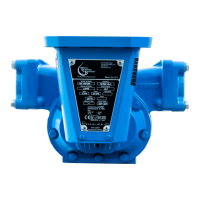
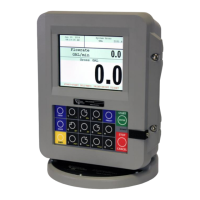
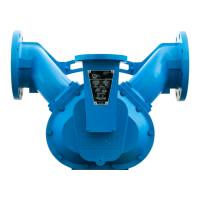
INSTALLATION AND START UP
Best Plumbing Configuration
Meters and piping should be installed to prevent drainage of product from the meter when the
system is not running. One way to do this is to have the inlet and outlet of the meter lower than
the associated system plumbing (sump position). Also, undue strain on the meter's 150# flanges
from the connected piping must be avoided.
Slow Flooding Of System
When a pump is turned on and a valve opened in a new, dry system, tremendous pressure can be
built up in the piping and forced through the meter. The high pressure and volume of air causes
the meter to operate more quickly than normal. When product reaches the meter, there is an
abrupt slowing of the meter plungers, which could cause damage to the register, plunger, gears or
other components.
The recommended method of starting any system is to flood the piping gradually. This allows
product to slowly force the air from the entire system.
Protection From Debris
On new installations, care must be taken to protect the meter from damage during start-up.
Damage may result from the passage through the meter of welding slag or spatter, thread
cuttings, rust, etc. There are several methods of protecting meters from this material including:
the insertion of a spool (a flanged length of pipe equal in length to the meter and any accessories
attached to the meter) in place of the meter until the system is flushed, temporarily bypassing the
plumbing around the meter, or by installing a strainer ahead of the meter in the line.
Calibration
The meter's calibration must be checked (and adjusted, if necessary) using the product being
metered by the user. Generally, calibrating it to a specific product and installation maximizes
any meter's accuracy. The 682 meter exceeds the accuracy requirements specified in NIST
Handbook 44, which is +/- 0.2% at the factory. In the field, NIST Handbook 44 maintenance
test accuracy requirements are +/- 0.5% on a special test, and +/- 0.2% on a normal test. In a five
gallon test, 0.2% = 2.31 cubic inches, 0.3% = 3.47 cubic inches, and 0.5% = 5.78 cubic inches.


 To Next Page