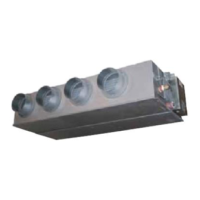
3-22. Increasing the Fan Speed
If external static pressure is too great (due to long
extension of ducts, for example), the air flow volume
may drop too low at each air outlet. This problem may
be solved by increasing the fan speed using the fol-
lowing procedure:
(1) Remove 4 screws on the electrical component box
and remove the cover plate.
(2) Disconnect the fan motor sockets in the box.
(3) Take out the booster cable (sockets at both ends)
clamped in the box.
(4) Securely connect the booster cable sockets
between the disconnected fan motor sockets in
step 2 as shown in Fig. 3-70.
(5) Place the cable neatly in the box and reinstall the
cover plate.
Fig. 3-70
Fig. 3-71
■ How to read the diagram
The vertical axis is the external static pressure (Pa) while the horizontal axis represents the air flow (m
3
/minute).
The characteristic curves for “HT,” “H,” “M” and “L” fan speed control are shown. The nameplate values are shown
based on the “H” air flow. For the 25 type, the air flow is 18 m
3
/minute, while the external static pressure is 49 Pa at
“H” position. If external static pressure is too great (due to long extension of ducts, for example), the air flow vol-
ume may drop too low at each air outlet. This problem may be solved by increasing the fan speed as explained
above.


 To Next Page
 Loading...