EasyManua.ls Logo

TechnipFMC Smith Meter 210 - User Manual

TechnipFMC Smith Meter 210
26 pages
Print Icon
To Next Page IconTo Next Page
Loading...
Valve and Line Accessories
MANUAL
MN03010 Issue/Rev. 0.4 (6/17)
Installation / Operation / Service Manual
Smith Meter
®
Model 210
Digital Electro-Hydraulic Set Stop
Question and Answer IconNeed help?

Do you have a question about the TechnipFMC Smith Meter 210 and is the answer not in the manual?

Summary

General

Receipt of Equipment

Check outside packing case for shipping damage. Inspect unit for damaged or missing parts upon receipt.

Installation

Ensure the valve is installed with the correct flow direction, indicated on the valve body.

Electrical

Wiring details are covered in the appropriate controller manual for AccuLoad and microLoad devices.

Operation

Principle

Explains the Smith Meter® Model 210 Valve's fundamental components and how solenoids control its operation.

Start-up and Field Adjustments

Sequential steps recommended for initial system start-up to ensure stable and proper operation.

Troubleshooting Guide

Service and Maintenance

Service; Maintenance Intervals

Provides a maintenance schedule for solenoids based on actuation counts and elastomer inspection guidelines.

Recommended Spare Components

Directs users to reference the valve parts list for recommended spare parts.

Tools Required

Lists the necessary tools for performing service and maintenance on the valve.

Document Sequence

Explains that the document follows a sequential flow of actions with accompanying pictures.

210 Valve Service

Advises servicing the valve in a horizontal plane to prevent component misalignment.

Related Publications

Summary

General

Receipt of Equipment

Check outside packing case for shipping damage. Inspect unit for damaged or missing parts upon receipt.

Installation

Ensure the valve is installed with the correct flow direction, indicated on the valve body.

Electrical

Wiring details are covered in the appropriate controller manual for AccuLoad and microLoad devices.

Operation

Principle

Explains the Smith Meter® Model 210 Valve's fundamental components and how solenoids control its operation.

Start-up and Field Adjustments

Sequential steps recommended for initial system start-up to ensure stable and proper operation.

Troubleshooting Guide

Service and Maintenance

Service; Maintenance Intervals

Provides a maintenance schedule for solenoids based on actuation counts and elastomer inspection guidelines.

Recommended Spare Components

Directs users to reference the valve parts list for recommended spare parts.

Tools Required

Lists the necessary tools for performing service and maintenance on the valve.

Document Sequence

Explains that the document follows a sequential flow of actions with accompanying pictures.

210 Valve Service

Advises servicing the valve in a horizontal plane to prevent component misalignment.

Related Publications

Overview

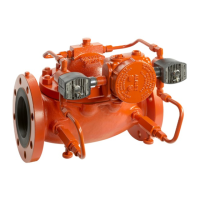
The Smith Meter® Model 210 Digital Electro-Hydraulic Set Stop is a hydraulically-operated, diaphragm-controlled valve designed for precise flow control, typically used in conjunction with an AccuLoad or microLoad controller in petroleum applications. Its primary function is to regulate flow rates and prevent line shock during loading operations.

Function Description:

The Model 210 valve fundamentally consists of a Smith Meter® 200 Series Valve with two solenoid controls: a normally open (N.O.) solenoid and a normally closed (N.C.) solenoid. A valve response control device, usually a needle valve, is positioned between each solenoid and its respective upstream or downstream port. This device allows for fine-tuning of the valve's opening and closing rates and provides control loop isolation for easier service. Adjustments to these devices control the flow rate to and from the cover chamber, enabling the valve to adapt to different product viscosities and pressures.

The operation is controlled by the solenoids. When both solenoids are energized, high upstream pressure is blocked from reaching the main valve cover, and the pressure in the cover vents downstream (lower pressure), causing the valve to open. Conversely, when both solenoids are de-energized, the downstream control loop is blocked, and high upstream pressure closes the valve.

During normal flow, the N.O. solenoid is energized while the N.C. solenoid is de-energized, trapping pressure in the cover and hydraulically locking the valve poppet in a fixed open position, thus maintaining a constant flow rate. If operating conditions change and alter the flow rate for a given valve opening, the flow controller (e.g., microLoad or AccuLoad) momentarily signals the appropriate solenoid to open or close, readjusting the valve's position and the flow rate to its set value.

When the set flow rate changes (e.g., from a low flow start to a high flow limit, or during a multi-step valve shutdown), the solenoids are signaled to adjust the flow rate to the new set value. When the delivered product reaches a predetermined (field-adjustable first stage trip) value in the controller, valve closure is initiated. The flow controller ramps down the flow in a multi-step manner to prevent line shock. A typical load cycle involves a low flow start, followed by a first high flow rate, then a second high flow rate, and finally a multi-stage shutdown initiated by first and final stage trip points.

Important Technical Specifications:

  • Solenoids: Standard explosion-proof solenoids are UL listed and CSA certified for use in Class I, Groups C and D, Division 1, and Class II, Groups E, F, and G, Division 1 hazardous locations.
  • Valve Sizes: Available in 2-inch (8 bolt), 3-inch (8 bolt), 4-inch (10 bolt), and 6-inch (12 bolt) configurations.
  • Stem Nut Torque Values:
    • 2 Inch: 14-17 ft-lbs (uses a counter nut instead of a lock washer)
    • 3 Inch: 25-30 ft-lbs
    • 4 Inch: 60-65 ft-lbs
    • 6 Inch: 130-140 ft-lbs
  • Materials: Designed for petroleum applications, with adequate material allowance for minimal corrosion/erosion.
  • Springs: 2-inch and 3-inch valves have one spring; 4-inch and 6-inch valves have two springs.

Usage Features:

  • Hydraulically-operated, diaphragm-controlled: Provides robust and reliable flow control.
  • Digital Control: Works with AccuLoad or microLoad controllers for precise, automated operation.
  • Multi-step Flow Control: Enables smooth transitions between different flow rates and prevents line shock during shutdown.
  • Field Adjustable: Opening/closing rates and trip points are adjustable to optimize performance for specific applications and product characteristics.
  • Emergency Stop (E-Stop) Capability: Allows for rapid shutdown in emergencies, with considerations for line shock and volume throughput.
  • Modulating Pressure Pilot (Optional): If supplied, the pilot can control the valve by adjusting manual valves in the system, maintaining a desired pressure.

Maintenance Features:

  • Maintenance Intervals for Solenoids:
    • 250,000 actuations: Inspect and replace components as needed.
    • 500,000 actuations: Rebuild the solenoids.
    • 750,000 actuations: Inspect and replace components as needed.
    • 1,000,000 actuations: Replace the solenoids.
  • Elastomer Inspection: Diaphragm, stem O-rings, and poppet seal should be visually inspected for cracks, breakout, and deterioration every 3 to 5 years under normal load rack conditions. This is a guideline, and a unique maintenance plan based on experience is recommended for each customer.
  • Tools Required: Open-ended wrenches, standard sockets, crescent wrench, manual torque wrench, pry bar, and two flat-headed screwdrivers.
  • Safety Precautions: Before any service, ensure the line is completely drained and power is removed from the solenoids. Use proper protective equipment (safety glasses, gloves, etc.).
  • Valve Service Orientation: Highly recommended to service the valve in the horizontal plane to prevent misalignment of components. If removed from piping, place on a flat surface with wedges to prevent rolling.
  • Diaphragm and O-ring Replacement: Detailed steps for disassembling the valve cover, removing the stem assembly, replacing diaphragm O-rings and diaphragm, and reassembling the valve. Caution is advised to avoid galling threads or fraying the diaphragm during installation.
  • Back-up Plate Maintenance: Dress surfaces and inner diameter of the back-up plate to remove burrs using a fine file and brass bristle brush.
  • Stem Nut Fastening: Apply LOCTITE® Nickel Anti-Seize 77164 on stem threads before placing the stem nut. Tighten to specified torque values using a torque wrench.
  • Tubing and Solenoid Reinstallation: Reinstall tubing and solenoids, ensuring proper connections and avoiding over-tightening of tubing fittings to prevent crushing and leaks.
  • Post-Maintenance Tuning: After assembly, refer to the Start-up and Field Adjustments section for proper valve tuning procedures.

TechnipFMC Smith Meter 210 Specifications

General IconGeneral
BrandTechnipFMC
ModelSmith Meter 210
CategoryControl Unit
LanguageEnglish

Related product manuals