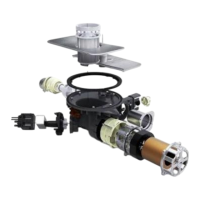
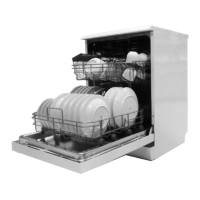
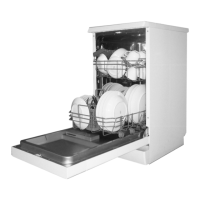
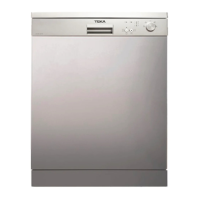
This document serves as a service manual for various Teka dishwasher models, including LP2 140, LP8 400, LP8 410, LP8 700, LP8 810, LP8 818, LP8 820, LP8 825, LP8 840 (VR01/VR02), LP8 440 (VR01/VR02), LP8 850 (VR02/VR03), LP9 850, LP9 840, LP9 440, LPM 819, LPZ 417, LPZ 817 BL/INOX, LVS 831 BL/INOX, DW 605 S (VR01/VR02), DW 455 S (VR01), DW1 605 FI (VR01/VR02), DW1 455 FI (VR01/VR02), DW8 40 FI, DW8 41 FI, DW8 55 FI, DW8 57 FI, DW8 58 FI, DW8 70 FI, DW9 70 FI, DWM 859 FI, and DWZ 57 FI. The manual, updated on April 28, 2020, provides technical information, wiring diagrams, main component features, error message explanations, and instructions for performing service tests.
Function Description:
The Teka dishwashers covered by this manual are designed to wash and clean dishes. They incorporate various components to manage water intake, heating, circulation, and drainage, as well as sensors to monitor operational parameters. Models may feature different control panels with buttons for ON/OFF, Half Load, Delay, Program selection, Start/Pause, Dual Wash, Extra Dry, and Function, along with indicators for Salt, Rinse Aid, Half Load, Delay, Program Phase, Child Lock, Water Faucet, and Display.
Important Technical Specifications (Main Components):
-
Inlet Valve / Aquastop:
- Power Supply: 220 - 240 V
- Coil Resistance: 4.4 - 4.8 KΩ
- Function: Controls water intake into the dishwasher. Some models integrate the inlet valve into an aquastop hose for added safety.
-
NTC Sensor (Temperature Sensor):
- Function: Measures water temperature. Resistance varies with temperature.
- Resistance values at different temperatures:
- 15°C: 17.48 KΩ
- 20°C: 12.12 KΩ
- 25°C: 10 KΩ
- 30°C: 8.299 KΩ
- 40°C: 5.807 KΩ
- 50°C: 4.144 KΩ
- 60°C: 3.011 KΩ
- 70°C: 2.224 KΩ
- 80°C: 1.667 KΩ
- 85°C: 1.451 KΩ
-
Flowmeter:
- Function: Measures the volume of water entering the dishwasher.
- Maintenance Feature: Can be checked with a multimeter in diode function between its two pins; it should beep intermittently when water is flowing.
-
Washing Pump:
- Power Supply: 220 - 240 V
- Main Coil Resistance: 116.4 Ω (±7%)
- Secondary Coil Resistance: 101.5 Ω (±7%)
- Capacitor: 3μF
- Function: Circulates water for washing. Operates at high and low speeds during the service test.
-
Draining Pump:
- Power Supply: 220 - 240 V
- Coil Resistance: 235 Ω ± 15 Ω
- Function: Drains water from the dishwasher.
-
Heating Element:
- Power Supply: 230 V
- Rated Power: 1800 W
- Resistance: 29.3 Ω ± 1.47 Ω
- Function: Heats water during the wash cycle.
-
Alternate Valve (Optional - Opc.(1)):
- Power Supply: 230 V
- Resistance: 5.75 KΩ
- Function: Diverts water flow to different spray arms (e.g., upper or lower).
-
Turbidity Sensor (Optional - Opc.(2)):
- Function: Detects the level of dirtiness in the water to adjust wash cycles.
- Maintenance Feature: Can be checked during service test, step 1. A display value of 99 indicates a faulty sensor.
Usage Features:
- Control Panel Variations: Different models feature varying button layouts and indicators. Common buttons include ON/OFF, Half Load, Delay, Program, and Start/Pause. Indicators typically show program status, salt/rinse aid levels, and error codes.
- Child Lock: Some models (e.g., LP8 810, LP8 818, LP8 410, LPM 819, LPZ 417, LVS 831, LPZ 817, LP8 820, LP8 825, LP9 850, LP9 840, LP9 440) include a child lock feature.
- Dual Wash: Available on models like LP8 850 (VR02/VR03) and DW8 70 FI.
- Extra Dry: Available on models like DW8 57 FI, DW8 58 FI, DW8 41 FI, and DW8 70 FI.
- Extra Functions Button: Available on models like DW9 70 FI.
- Program Indicators: LEDs or a display show the selected program and its current phase.
- Error Indication: Errors are displayed as codes (e.g., E1, E3, E4) on models with a display, or through a sequence of blinking LEDs (LED1, LED2, LED3) on models without a display.
Maintenance Features:
-
Service Test: A diagnostic mode that runs through a predefined sequence of operations to check component functionality.
- Initiation: The method to start the service test varies by model but generally involves pressing and holding a specific button (e.g., Start/Pause or Program) with the door open, then pressing the ON/OFF button. All LEDs will blink, and the test begins once the door is closed.
- Phases: The service test includes steps such as water filling, washing pump operation (high and low speed), heating, dispenser activation, regeneration valve activation, and draining pump activation.
- Progression: Users can advance to the next step of the test by pressing the Start/Pause or Program button, except during water loading.
- Display Feedback: During the service test, the display shows consumption values, temperature, or specific codes for each phase. Models without a display will show sequential blinking of program LEDs.
- Completion: The test ends with a beep, and the dishwasher enters standby mode.
-
Error Messages and Remedies: The manual provides a comprehensive list of error codes (E1, E3, E4, E6, E7, E8, E9) with their possible causes and corresponding remedies.
- E1 (Water filling exceeding preset time): Possible causes include closed water tap, low water pressure, broken pressure switch, broken inlet valve, or PCB failure. Remedies involve checking water supply, replacing components, or reconnecting wiring.
- E3 (Heating phase exceeding preset time): Possible causes include loose or broken temperature sensor, loose wiring to the heater, or a broken heating element. Remedies involve checking/replacing the sensor or heater, or reconnecting wiring.
- E4 (Overflow): Possible causes include tank leakage, hose leakage, or a faulty floater switch/PCB. Remedies involve patching leaks, replacing hoses, or replacing the floater switch/PCB.
- E6 (Open circuit failure of temperature sensor): Possible cause is loose wiring to the temperature sensor. Remedy is to reconnect the wire terminal or replace the sensor.
- E7 (Short circuit failure of temperature sensor): Possible cause is short-circuited or open-circuited wiring to the temperature sensor. Remedy is to reconnect the wire terminal or replace the sensor.
- E8 (Alternate valve failure): Possible cause is wiring damage or alternate valve failure. Remedy is to check connections or replace the valve.
- E9 (Sensor/button pressed for more than 30s): Possible cause is water on the control panel. Remedy is to check the control panel for water.
-
Component Testing: The manual details how to test specific components like the flowmeter (using a multimeter) and the turbidity sensor (during the service test).
This manual is an essential resource for technicians and users to diagnose and resolve issues, ensuring the proper functioning and longevity of Teka dishwashers.

 Need help?
 General

 To Next Page