The purpose of making adjustments is to make the car go faster around the track, or to make it more controllable, or both if possible. A car
that's easier to drive should produce lower, more consistent lap times. It will also inspire more confidence in the driver, which is always
good when nerves start getting the best of you.
Before you start thinking about changing your car's setup, consider these two things: First, is the car in perfect working order? Be sure
that all of the suspension components operate freely without excessive play, and that the car isn't tweaked. Binding and worn out parts
will result in poor performance and inconsistent handling. Second, always consider tires before making other adjustments. Time spent
trying to get the vehicle to work with the wrong tires mounted will be wasted time. Without the right tires, even a great setup won’t be a
winning setup.
Bumpsteer
MO
R
E
bum
p
ou
t
b
u
m
p
o
u
t
L
ESS
L
E
S
S
bum
p
ou
t
b
u
m
p
o
u
t
M
O
R
E
Ackermann
MORE
(front)
LESS
DRO
OP
ME
A
S
U
R
E
M
E
N
T
A
DJU
S
T
HERE
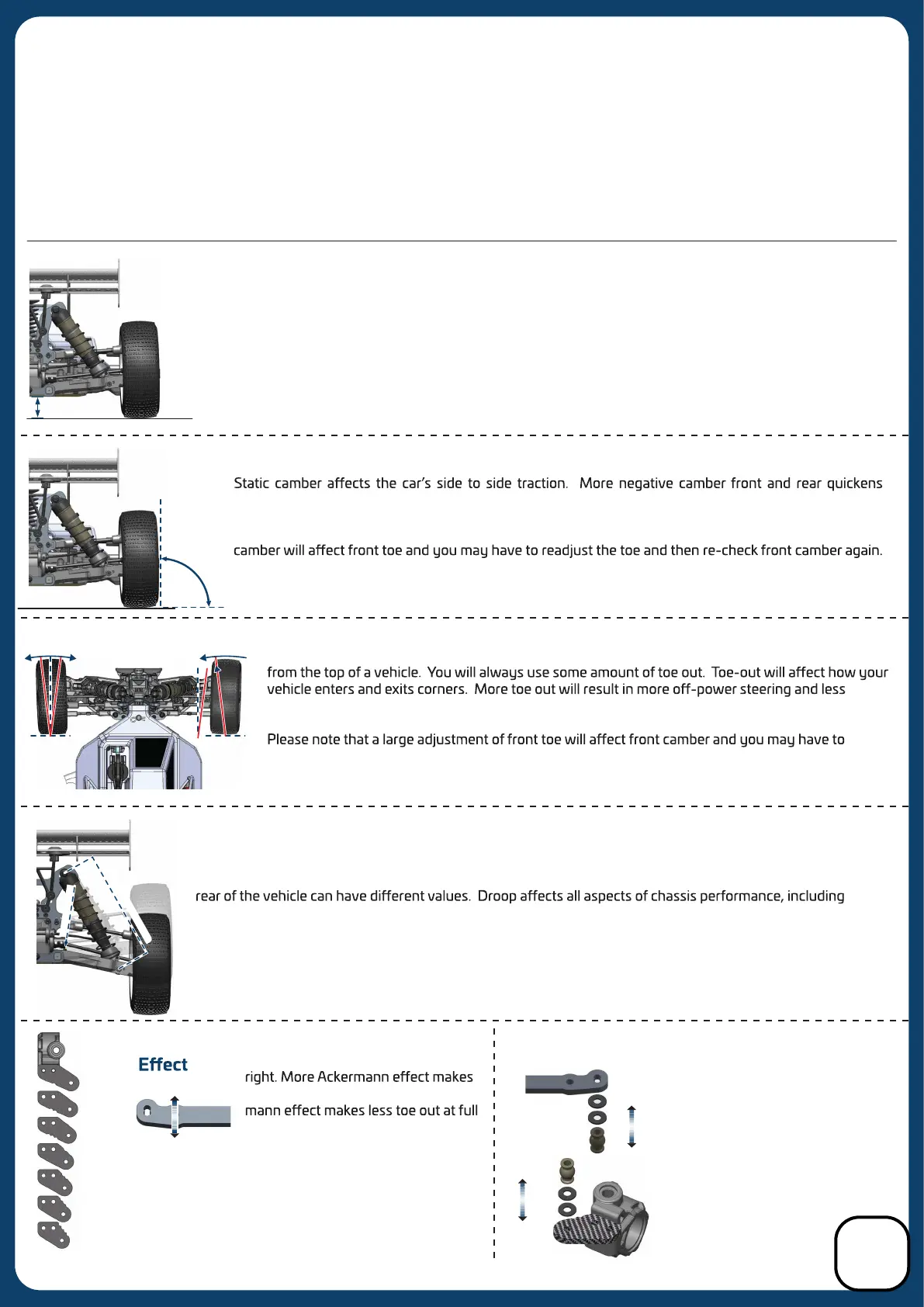
Ride height is the distance from the bottom of the chassis to the running surface. Ride height
should only be checked and adjusted when your vehicle is ready to run (i.e. with fuel tank
full/body on). Ride height is the first adjustment to be made and should be set with a ride height measurement
tool. Measurements should be taken from the flat parts of the chassis, front and rear. Be sure to measure the
front ride height at a point before the kick up in the chassis starts. To measure ride height, first make sure the
suspension is completely free, then simultaneously compress the front and rear all the way down and let the
vehicle settle. Take your measurement from that position. Use the shock spring adjustment collars to raise or
lower the ride height to your desired setting. 23mm front and 25mm rear is a good starting point.
Think of bump steer as active toe
when the suspension compresses or
rebounds. To adjust bump steer you
have to change the angle of the
steering link. This is accomplished by
adding or removing washers under
the ball stud on the steering spindles.
Anytime you change camber link
locations, front arm pills, front arm
spacers, or Ackermann you will need
to check and possibly
adjust your bumpsteer. It's
best to start with zero
bumpsteer or slight bump
out.
Think of Ackermann as active toe
when the steering moves from left to
more toe out at full turn. Less Acker-
turn. More Ackermann will be smooth-
er and have less overall steering. Less
Ackermann will feel more direct and have more overall
steering. A good starting point is forward on the
bellcrank plate, and the “F” plate on the spindle.
More ackermann is better on high speed flowing tracks
and less ackermann is better on slower, tighter tracks.
MEASUREMENT
C
A
M
B
E
R
rotation in corners. Less negative camber will make the vehicle easier to drive but you may give up some
responsiveness (i.e. steering). To set your static camber have your vehicle at ride height (see above) and
adjust the camber links until desired angle is achieved. Please note that a large adjustment of front
A good starting measurement for camber is 1-2 degrees in the front and 1.5-2.5 degrees in the rear.
Droop is the measured amount of down travel in the suspension. It is measured from the shock mount-
ing points while the vehicle is up on a stand allowing the arms to hang freely and is adjusted by turning
the droop screw located in the suspension arms front/rear. This screw limits the suspension travel by provid-
ing a stopping point against the chassis. Left and right sides should always be equal, however the front and
braking, acceleration, jumping, traction, and bump handling. A good starting droop measurement is 115.5mm
front, and 125mm rear.
If using a ‘block’ style droop gauge, the rear axle center is typically level with or below the bottom of the
chassis and the front axle center is typically level with or above the bottom of the chassis. We suggest +4mm
front droop and -4mm rear droop as a good all-around starting point.
Front toe is used to describe the angle in which the front wheels point when looking down at them
on-power steering and less toe out will have the opposite results. To set your front toe, have your
vehicle at ride height (see above) and adjust the steering links until desired angle is achieved.
readjust the camber and then re-check front toe again. A good starting point is approximately 0.5-1
degree of toe out per side.
Front Toe
O
U
T
_
_
_
_
I
N
I
N
_
_
_
_
O
U
T
(rear)
(TKR9047A)
MOST
LEAST
(TKR9047B)
(TKR9047H)
(TKR9047C)
(TKR9047E)
(TKR9047F)
(TKR9047G)
Droop
Camber
Ride Height
27
Setup Information


 To Next Page
 Loading...