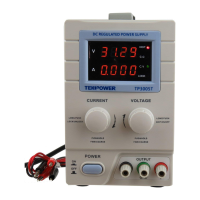
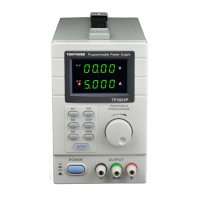
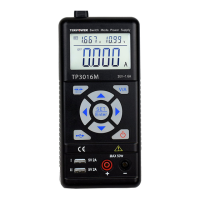
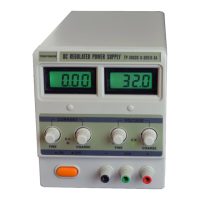
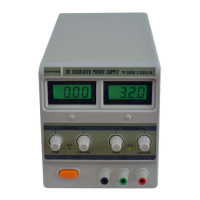
The TEKPOWER TP3005D-3 is an adjustable DC regulated power supply designed for various applications, including scientific investigation, college laboratories, factories, and electronic appliance maintenance. This unit offers three output channels: two adjustable channels and one fixed 5V output.
Function Description
The two adjustable output channels are capable of operating in either constant voltage (CV) or constant current (CC) mode, providing high stability and performance. In CV mode, the output voltage can be arbitrarily adjusted from 0V up to the nominal range. Similarly, in CC mode, the output current can be adjusted from 0A up to the nominal range. Each adjustable output is equipped with high-accuracy volt and amp meters (either 3-digit LED or LCD displays) to indicate the respective output values.
A key feature of this power supply is its ability to connect the two adjustable outputs in parallel or in series. When connected in series, the maximum output voltage can be doubled compared to an independent output. When connected in parallel, the maximum output current can be doubled. In these configurations, one channel acts as the master for voltage or current adjustment, simplifying control.
The third output channel provides a fixed 5V voltage. This fixed output benefits from a single-chip integrated regulator, ensuring good stability and a low ripple factor. It also incorporates reliable overload protection to prevent damage to the unit in case of overload or short circuit conditions.
The unit is designed with a compact size, good performance, and a modern appearance, making it a versatile tool for various professional and educational settings.
Usage Features
To ensure safe and optimal operation, several precautions and procedures should be followed:
- Initial Setup: Before connecting the equipment to the mains, verify that the available mains voltage matches the voltage setting of the unit. The mains plug should only be connected to an earthed outlet.
- Environmental Considerations: Avoid placing the equipment on damp or wet surfaces, and protect it from direct sunlight, extreme temperatures, high humidity, and strong vibrations or shocks. Do not operate the unit near strong magnetic fields.
- Safety Practices: Always replace a defective fuse with one of the original rating; never short-circuit the fuse or its housing. Do not exceed the maximum permissible input rating. When performing measurements, wear dry clothing and rubber shoes or use isolating mats. Observe all warning labels and avoid inserting metal objects into the ventilation slots. Keep water-filled containers away from the unit to prevent accidental spills.
- Stabilization: Allow the equipment to stabilize at room temperature before taking measurements to ensure accuracy.
- Independent Output Operation:
- For CV output, ensure the CC adjustment knobs (2) and (17) are rotated clockwise to their maximum positions. Turn on the power switch (13), then adjust the CV adjustment knobs (4) and (14) until the desired output voltage is reached. In this state, the CC indicators (1) and (11) will be off, and the CV indicators (3) and (12) will be lit.
- For CC output, after turning on the power switch (13), first rotate the CV adjustment knobs (4) and (14) clockwise to maximum, then rotate the CC adjustment knobs (2) and (17) counterclockwise to minimum. Connect the load, and then adjust the CC adjustment knobs (2) and (17) clockwise until the desired output current is reached. In this state, the CV indicators (3) and (12) will be off, and the CC indicators (1) and (11) will be lit.
- The current-limiting protection point can be set arbitrarily. To do this, turn on the power, rotate the CC adjustment knobs (2) and (17) counterclockwise to minimum, short-circuit the positive and negative output terminals, and then rotate the CC adjustment knobs (2) and (17) clockwise until the output current matches the desired current-limiting protection point.
- Series Operation:
- Set switch (9) to spring out and press in switch (7). The master voltage adjustment (14) will control both outputs, with the slave output tracking the master. The total output voltage can be up to double the independent maximum voltage (between terminals (18) and (23)).
- Before connecting in series, ensure that the negative terminals of both master and slave outputs are not connected to the case ground, as this could cause a short-circuit.
- While in series, the master output controls the voltage, but current adjustment remains independent. Ensure that the slave CC adjustment knob (2) is rotated clockwise to its maximum position to prevent the slave output voltage from failing to track the master.
- For series connection, use appropriate leads to short-connect the negative terminal of the master output with the positive terminal of the slave output.
- Parallel Operation:
- Press in both switches (7) and (9). The two outputs will be in parallel, and adjusting the master voltage adjustment (14) will keep both voltages the same. The slave output CC indicator (1) will light up.
- In parallel mode, the slave output CC adjustment (2) is inactive. To use as a CC supply, adjust only the master output CC adjustment (17). The total output current will be controlled by this adjustment and can be up to double the independent maximum current.
- When operating in parallel, use suitable leads to reliably short-connect both positive terminals and both negative terminals of the master and slave outputs separately. This ensures the load is reliably connected to both parallel outputs. Connecting the load to only one output terminal can cause current imbalance and potentially damage the series/parallel switches.
Maintenance Features
- Cleaning: Before cleaning the cabinet, always unplug the unit from the power outlet. Use a damp, soft cloth and a mild household cleaner. Prevent water from entering the equipment to avoid shorts and damage.
- Storage: After use, store the unit in a dry, well-ventilated, and clean place. If the unit will not be used for an extended period, unplug the power supply cord.
- Protection: The unit features excellent protection functions. The 5V output has reliable current-limit and short-circuit protection. The two adjustable outputs also have current-limit protection. While the controlling circuit for regulating transistor power loss prevents significant damage during short-circuits, it is advisable to identify and resolve faults as quickly as possible and turn off the power to reduce aging and energy consumption.
- Servicing: Any opening of the equipment or service and repair work must be performed by qualified service personnel. If repair work is needed, it should be done in the presence of a second person trained in first aid.
- Calibration: For more accurate measurements than the three-digit LED/LCD display (analog meter is 2.5 class) provides, external calibration with a precision measuring instrument is recommended.
- Input Voltage: For maintenance procedures, the input voltage must be disconnected.

 Need help?
 General

 To Next Page