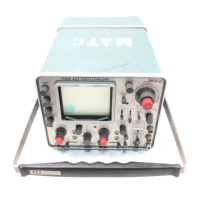
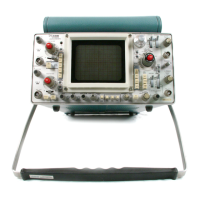
Operating Instructions—Type 422 AC-DC
Battery Precautions. The nickel-cadmium battery cells
used in the AC-DC Power Supply have been selected as a
result of extensive evaluation. Each battery cell in the bat
tery pack has received an ampere-hour test, has met or
exceeded the minimum ampere-hour storage requirement
and has been rigidly inspected. The battery cells used in the
battery pack should provide a useful operating life extend
ing over several hundred charge-discharge cycles.
To extend the useful operating life of the nickel-
cadmium battery cells used in this instrument, observe the
following precautions.
1. Do not exceed the recommended charge rate as pro
vided by the AC-DC Power Supply.
2. Do not charge the battery pack at the full rate for
extended periods beyond the recommended charge time.
3. Excessive discharge of the battery pack after the
POWER light begins to blink may cause one or more of the
cells to reverse polarity. Although the cells are protected
against immediate damage, repeated polarity reversal will
shorten the useful life of the batteries.
4. Observe the temperature limits given in this manual
for battery charging, operation and storage.
Battery Operation. This instrument can be operated on
the internal batteries over an ambient temperature range of
—15° C to +40° C. However, the maximum operating time
and useful battery life is provided at about +25° C. Table
2-2 lists typical battery charge capacity with variations in
charge and discharge temperatures. For operation from the
internal batteries, set the Power Mode switch on the rear of
the AC-DC Power Supply to the OPERATE I NT BATT
position (be sure battery pack is charged). The POWER
switch on the front panel of the Type 422 controls the
power to the circuits in the instrument in the same manner
as for AC or DC operation.
TABLE 2-2
Typical Battery Charge Capacity
(referenced to charge-discharge at +20°C to +30°C)
Charge temperature
Operating temperature
—15 C
+20 C to +30 C +55 C
0°C
40%
60%
50%
+20 °C to +30 °C
65%
100% 85%
+40 °C
40% 65% 55%
When this instrument is connected to an AC line-voltage
source, the internal batteries can be recharged when the
Power Mode switch is set to the applicable CHARGE BATT
position (see Battery Charging). The battery charger circuit
is disconnected in the OPERATE I NT BATT position so
the instrument cannot be operated from the batteries while
the batteries are being charged. To simultaneously charge
the batteries and operate the instrument, use the OPER
ATE 230V AC or OPERATE 115V AC position (30 milli-
ampere trickle charge applied to batteries).
WARNING
When this instrument is operated from the internal
batteries, the chassis is floating with respect to earth
(ground). Connect the instrument to earth with a
jumper lead from the front-panel ground post. Opera
tion without this ground lead is not recommended
due to the potential shock hazard produced if the
chassis becomes elevated with respect to earth.
When operating from the internal batteries, the POWER
light on the front panel of the indicator provides an indica
tion of the charge level on the internal batteries. When the
batteries have been discharged to near the minimum level
necessary for correct power supply regulation, the POWER
light begins to blink. Further discharge of the batteries be
yond this level not only provides inaccurate measurements,
but may also damage the batteries.
The following suggestions will aid in obtaining the maxi
mum operating time from the batteries:
1. Set the INTENSITY control only as far clockwise as
is necessary to obtain a visible display. Due to the type of
CRT blanking used in this instrument, the CRT emits elec
trons even though the sweep is not operating (also see dis
cussion on Intensity Control in this section).
2. Whenever the instrument is not to be used for periods
longer than about 1/2 hour, turn the POWER switch off
(pushed in). Since this instrument is completely solid-state
except for the CRT, it requires only about 30 seconds
warmup before it is operable and about five minutes warm
up to reach the specified accuracy.
3. Set the SCALE ILLUM control fully counterclock
wise unless the graticule is not visible when making a meas
urement. When scale illumination must be used, return the
SCALE ILLUM control to the fully counterclockwise posi
tion after the measurement.
Battery Charging. The battery pack of the AC-DC
Power Supply can be charged from either a 115-volt or
230-volt (nominal) AC line-voltage source. In the CHARGE
BATT 230V AC or CHARGE BATT 115V AC positions of
the Power Mode switch, the battery pack is charged at a
400 milliampere rate. In the OPERATE 230V AC or OPER
ATE 115V AC positions, the battery pack is trickle-charged
at about a 30 milliampere rate. A 16-hour charge period in
either of the CHARGE BATT positions should be sufficient
to charge the battery pack to its full potential. Although
the batteries may not be damaged immediately by longer
charge periods, repeated over-charging will shorten the use
ful life of the batteries. A full charge level can be main
tained on the battery pack by the 30 milliampere trickle
charge available in the OPERATE 230V AC or OPERATE
115V AC positions (POWER switch must be pulled out).
2-5


 To Next Page
 Loading...