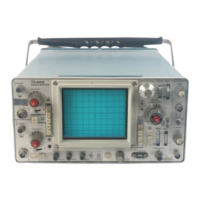
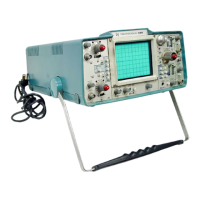
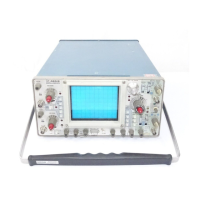
Operating Instructions—Type 422 AC-DC
leads and the BNC to binding post adapter (supplied acces
sory). This coupling method works best for signals below
about one kilohertz and deflection factors above one volt/
division. When this coupling method is used, establish a
common ground between the Type 422 and the equipment
under test. Attempt to position the leads away from any
source of interference to avoid errors in the display. If int
erference is excessive with unshielded leads, use a coaxial
cable or a probe.
Loading Effect of Type 422
As nearly as possible, simulate actual operating condi
tions in the equipment under test. Otherwise, the equip
ment under test may not produce a normal signal. The 10X
attenuator and field effect transistor probes mentioned pre
viously offer the least circuit loading. See the probe instruc
tion manual for loading characteristics of the probes.
When the signal is coupled directly to the input of the
Type 422, the input impedance is about one megohm paral
leled by about 30 pF. When the signal is coupled to the
input through a coaxial cable, the effective input capaci
tance is increased. The actual input capacitance depends
upon the type and length of cable used and the frequency
of the signal.
Ground Considerations
Reliable signal measurements cannot be made unless
both the oscilloscope and the unit under test are connected
together by a common reference (ground) lead in addition
to the signal lead or probe. Although the three-wire AC
power cord provides a common connection when used with
equipment with similar power cords, the ground loop pro
duced may make accurate measurements impossible. The
ground straps supplied with the probes provide an adequate
ground. The shield of a coaxial cable provides a common
ground when connected between two coaxial connectors
(or with suitable adapters to provide a common ground).
When using unshielded signal leads, a common ground lead
should be connected from the Type 422 chassis to the chas
sis of the equipment under test. Additional ground consid
erations must be made for safety reasons to provide an
earth (ground) connection to this instrument at all times
when operating from external DC or internal batteries (see
Operating Voltage in this section for details).
Input Coupling
The Channel 1 and 2 Input Coupling switches allow a
choice of input coupling methods. The type of display de
sired and the applied signal will determine the coupling to
use.
The DC Coupling position can be used for most applica
tions. This position allows measurement of the DC compo
nent of a signal. It must also be used to display signals
below about 20 hertz (two hertz with a 10X probe) as they
will be attenuated in the AC position.
In the AC Coupling position, the DC component of the
signal is blocked by a capacitor in the input circuit. The
low-frequency response in the AC position is about two
hertz (—3 dB point). Therefore, some low-frequency atten
uation can be expected near this frequency limit. Attenua
tion in the form of waveform tilt will also appear in square
waves which have low-frequency components. The AC
coupling position provides the best display of signals with a
DC component which is much larger than the AC compo
nents.
The GND position provides a ground reference at the
input of the Type 422 without the need to externally
ground the INPUT connectors. The signal applied to the
input connector is internally disconnected, but not ground
ed, and the input circuit is held at ground potential.
Deflection Factor
The amount of vertical deflection produced by a signal is
determined by the signal amplitude, the attenuation factor
of the probe (if used), the setting of the VOLTS/DIV
switch and the setting of the VARIABLE VOLTS/DIV con
trol. The calibrated deflection factors indicated by the
VOLTS/DIV switches apply only when the VARIABLE
VOLTS/DIV control is set to the CAL position.
The VARIABLE VOLTS/DIV controls provide contin
uously variable (uncalibrated) vertical deflection factors be
tween the calibrated settings of the VOLTS/DIV switches.
The VARIABLE control extends the maximum vertical de
flection factor of the Type 422 to at least 50 volts/division
(20 volts position).
When the X I0 GAIN AC switch in Channel 2 is pulled
out, the deflection factor indicated by the VOLTS/DIV
switch must be divided by 10 to obtain the actual deflec
tion factor.
Channel 2 X I0 Gain
The X I0 GAIN AC switch provides 10 times gain for the
Channel 2 amplifier to extend the minimum deflection fac
tor to 0.001 volt/division in the .01 position of the Channel
2 VOLTS/DIV switch. The DC component of the applied
signal is not amplified. For best results when using the X I0
GAIN AC switch, the Channel 2 Input Coupling switch
should be set to the AC position.
Dual-Trace Operation
Alternate Mode. The ALT position of the vertical Mode
switch produces a display which alternates between Chan
nel 1 and 2 with each sweep of the CRT. Although the ALT
mode can be used at all sweep rates, the CFIOPPED mode
provides a more satisfactory display at sweep rates below
about 0.5 millisecond/division. A t these slow sweep rates,
alternate mode switching becomes visually perceptible.
Proper internal triggering in the ALT mode can be ob
tained in either the CH 1 & 2 or the CH 1 position of the
TRIGGERING Source switch. When in the CH 1 & 2 posi
tion, the sweep is triggered from the signal on each channel.
This provides a stable display of two unrelated signals, but
2-16


 To Next Page
 Loading...