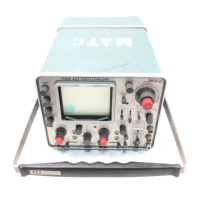
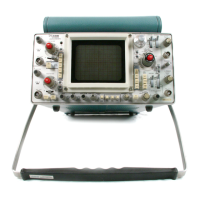
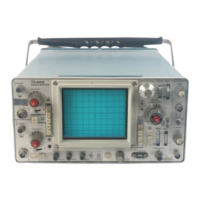
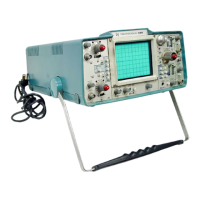
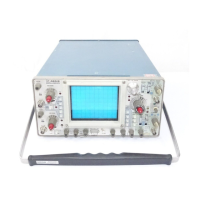
Operating Instructions—Type 422 AC-DC
Fig. 2-10. Removing the light filter or faceplate protector.
The tinted light filter minimizes light reflections from
the face of the CRT to improve contrast when viewing the
display under high ambient light conditions. A clear plastic
faceplate protector is also provided for use when neither
the mesh nor the tinted filter is used. The clear faceplate
protector provides the best display for waveform photo
graphs. It is also preferable for viewing high writing rate
displays.
A filter or faceplate protector should be used at all times
to protect the CRT faceplate from scratches. The faceplate
protector and the tinted light filter mount in the same hol
der. To remove the light filter or faceplate protector from
the holder, press it out to the rear. Both can be replaced by
snapping them back into the holder.
Vertical Channel Selection
Either of the input channels can be used for single-trace
displays. Apply the signal to the desired INPUT connector
and set the vertical Mode switch to display the channel
used. Since channel 1 only triggering is provided only in
Channel 1, and the invert and X10 AC gain features are
provided only for Channel 2, the correct channel must be
selected to take advantage of these features. For dual-trace
displays, connect the signals to both INPUT connectors and
set the vertical Mode switch to one of the dual-trace
positions.
Vertical Gain Adjustment
To check the gain of either channel, set the VOLTS/DIV
switch to the CALIBRATE 4 DIVISIONS position and the
VARIABLE control to CAL. The vertical deflection should
be exactly four divisions. If not, adjust the front-panel
GAIN adjustment for exactly four divisions of deflection.
NOTE
If the gain of the two channels must be closely
matched (such as for ALG ADD operation), use the
adjustment procedure given in the Calibration Proce
dure
The best measurement accuracy when using probes is
provided if the GAIN adjustment is made with the probes
installed. This compensates for any inaccuracies of the
probes. Set the VOLTS/DIV switch to .05 and apply an
accurate square wave to the probe tips. Also, to provide the
best measurement accuracy, calibrate the vertical gain of
the Type 422 at the temperature at which the measurement
is to be made.
Step Attenuator Balance Adjustment
To check the step attenuator balance of either channel,
set the Input Coupling switch to GND and the TRIGGER
ING modeswitch to AUTO. Change the VOLTS/DI V switch
from .05 to .01. If the trace moves vertically, adjust the
front-panel STEP ATT BAL adjustment as follows:
1. With the Input Coupling switch set to GND and the
VOLTS/DI V switch set to .05, move the trace to the center
horizontal line of the graticule with the vertical POSITION
control.
2. Set the VOLTS/DIV switch to .01 and adjust the
STEP ATT BAL adjustment to return the trace to the
center horizontal line.
3. Repeat steps 1 and 2 for minimum trace shift as the
VOLTS/DIV switch is changed from .05 to .01.
Signal Connections
In general, probes offer the most convenient means of
connecting a signal to the input of the Type 422. Tektronix
probes are shielded to prevent pickup of electrostatic inter
ference. A 10X attenuator probe offers a high input imped
ance and allows the cirucit under test to perform very close
to normal operating conditions. However, a 10X probe also
attenuates the input signal 10 times. A Tektronix field ef
fect transistor probe offers the same high-input impedance
as the 10X probes. However, it is particularly useful since it
provides wide-band operation while presenting no attenua
tion (IX gain) and a low input capacitance. A standard IX
probe can be used for signal connection, although it does
not provide as high an input impedance and may result in a
lower overall bandwidth. Specialized probes are also avail
able from Tektronix, Inc. for high-voltage measurement,
current measurement, etc. See the Tektronix, Inc. catalog
for characteristics and compatability of probes for use with
this system.
In high-frequency applications requiring maximum over
all bandwidth, use coaxial cables terminated in their charac
teristic impedances at the Type 422 INPUT connectors.
High-level, low-frequency signals can be connected directly
to the Type 422 INPUT connectors using short unshielded
E
2-15


 To Next Page
 Loading...