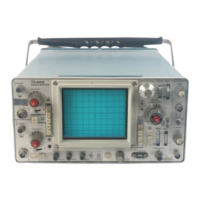
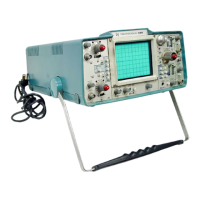
Operating I nstructions—Type 422 AC-DC
Calibrator
The internal calibrator of the Type 422 provides a con
venient signal for checking vertical gain. This signal is inter
nally connected to the Input Amplifiers when the VOLTS/
DIV switches are set to the CALIBRATE 4 DIVISIONS
position. The calibrator output signal available at the front-
panel CALIBRATOR jack is also very useful for checking
and adjusting probe compensation as described in the probe
instruction manual. In addition, the calibrator can be used
as a convenient signal source for application to external
equipment.
APPLICATIONS
General
The following information describes the procedures and
techniques for making basic measurements with a Type 422
Oscilloscope. These applications are not described in detail
since each application must be adapted to the requirements
of the individual measurements. This instrument can also be
used for many applications which are not described in this
manual. Contact your local Tektronix Field Office or repre
sentative for assistance in making specific measurements
with this instrument. Also, the following books describe
oscilloscope measurement techniques which can be adapted
for use with this instrument.
Harley Carter, “ An Introduction to the Cathode Ray
Oscilloscope", Phillips Technical Library, Cleaver-Hume
Press Ltd., London, 1960.
J. Czech, "Oscilloscope Measuring Technique", Phillips
Technical Library, Springer-Verlag, New York, 1965.
Robert G. Middleton and L. Donald Payne, "Using the
Oscilloscope in Industrial Electronics", Howard W. Sams &
Co. Inc., The Bobbs-Merrill Company Inc., Indianapolis,
1961.
John F. Rider and Seymour D. Uslan, "Encyclopedia of
Cathode-Ray Oscilloscopes and Their Uses", John F. Rider
Publisher Inc., New York, 1959.
John F. Rider, "Obtaining and Interpreting Test Scope
Traces", John F. Rider Publisher Inc., New York, 1959.
Rufus P. Turner, "Practical Oscilloscope Handbook",
Volumes 1 and 2, John F. Rider Publisher Inc., New York,
1964.
Peak-to-Peak Voltage Measurements-AC
To make peak-to-peak voltage measurements, use the
following procedure:
NOTE
For low-frequency signals below about 20 hertz use
the DC position to prevent attenuation.
5. Set the TRIGGERING controls to obtain a stable
display. Set the TIME/DIV switch to a position that dis
plays several cycles of the waveform.
6. Turn the vertical POSITION control so the lower por
tion of the waveform coincides with one of the graticule
lines below the center horizontal line, and the top of the
waveform is on the viewing area. With the horizontal POSI
TION control, move the display so one of the upper peaks
lies near the center vertical line (see Fig. 2-14).
Position to center
vertical line
Fig. 2-14. Measuring peak-to-peak voltage of a waveform.
7. Measure the divisions of vertical deflection peak to
peak. Make sure the VARIABLE VOLTS/DIV control is in
the CAL position.
NOTE
This technique can also be used to make measure
ments between two points on the waveform, rather
than peak to peak.
8. Muliply the distance measured in step 7 by the
VOLTS/DIV switch setting. Also include the attenuation
factor of the probe if used.
EXAMPLE. Assume that the peak-to-peak vertical
deflection is 4.6 divisions (see Fig. 2-14) using a 10X
attenuator probe and a VOLTS/DIV switch setting of .5.
Volts
Peak to Peak
1. Apply the signal to either INPUT connector.
2. Set the vertical Mode switch to display the channel
used.
3. Set the VOLTS/DIV switch to display about six divi
sions of the waveform.
vertical
deflection
(divisions)
VOLTS/DIV
setting
probe
attenuation
factor
Substituting the given values:
Volts Peak to Peak = 4.6 X 0.5 V X 10
4. Set the Input Coupling switch to AC.
The peak-to-peak voltage is 23 volts.


 To Next Page
 Loading...