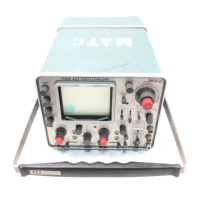
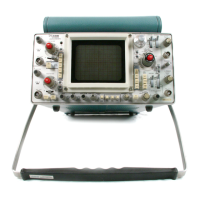
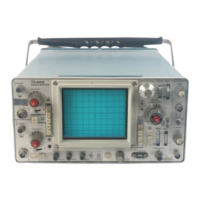
OperatingInstructions—Type 422 AC-DC
Instantaneous Voltage Measurements-DC
To measure the DC level at a given point on a waveform,
use the following procedure:
1. Connect the signal to either INPUT connector.
2. Set the vertical Mode switch to display the channel
used.
3. Set the VOLTS/DIV switch to display about six divis
ions of the waveform.
4. Set the input Coupling switch to GND.
5. Set the TRIGGERING Mode switch to AUTO.
10. Establish the polarity of the signal. If the waveform
is above the reference line the voltage is positive; below the
line, negative (with the INVERT switch pushed in for Chan
nel 2).
11. Multiply the distance measured in step 9 by the
VOLTS/DIV switch setting. Include the attenuation factor
of the probe, if used.
EXAMPLE: Assume that the vertical distance measured
is 4.6 divisions (see Fig. 2-15) and the waveform is above
the reference line using a 10X attenuator probe and a
VOLTS/DI V switch setting of 2.
Using the formula:
6. Position the trace to the bottom line of the graticule
or other reference line. If the voltage is negative with re
spect to ground, position the trace to the top line of the
graticule. Do not move the vertical POSITION control after
this reference line has been established.
NOTE
To measure a voltage level with respect to a voltage
other than ground, make the following changes in
step 6. Set the Input Coupling switch to DC and ap
ply the reference voltage to the INPUT connector.
Then position the trace to the reference line.
Instantaneous
Voltage
vertical
distance X polarity X
(divisions)
VOLTS/DIV
setting
probe
X attenuation
factor
Substituting the given values:
Instantaneous
Voltage
4.6 X +1 X 2 V X 10
7. Set the Input Coupling switch to DC. The ground
reference line can be checked at any time by switching to
the GND position.
8. Set the TRIGGERING control to obtain a stable dis
play. Set the TIME/DIV switch to a setting that displays
several cycles of the signal.
9: Measure the distance in divisions between the refer
ence line and the point on the waveform at which the DC
level is to be measured. For example, in Fig. 2-15 the meas
urement is made between the reference line and point A.
Fig. 2-15. Measuring instantaneous DC voltage with respect to a
reference voltage.
The instantaneous voltage is +92 volts.
Comparison Measurements
In some applications it may be desirable to establish
arbitrary units of measurement other than those indicated
by the VOLTS/DIV switch or TIME/DIV switch. This is
particularly useful when comparing unknown signals to a
reference amplitude or repetition rate. One use for the
comparison-measurement technique is to facilitate calibra
tion of equipment (e.g., on an assembly-line test) where the
desired amplitude or repetition rate does not produce an
exact number of divisions of deflection. The adjustment
will be easier and more accurate if arbitrary units of meas
urement are established so that correct adjustment is indica
ted by an exact number of divisions of deflection. Arbitrary
sweep rates can be useful for comparing harmonic signals to
a fundamental frequency, or for comparing the repetition
rate of the input and output pulses in a digital count-down
circuit. The following procedure describes how to establish
arbitrary units of measure for comparison measurements.
Although the procedure for establishing vertical and hori
zontal arbitrary units of measurement is much the same,
both processes are described in detail.
Vertical Deflection Factor. To establish an arbitrary
vertical deflection factor based upon a specific reference
amplitude, proceed as follows:
1. Connect the reference signal to the INPUT connector.
Set the TIME/DIV switch to display several cycles of the
signal.
2-22


 To Next Page
 Loading...