EasyManua.ls Logo

Tektronix 585 - Page 35

Tektronix 585
151 pages
Print Icon
To Next Page IconTo Next Page
To Previous Page IconTo Previous Page
Loading...
Circuit
Description
Type
585
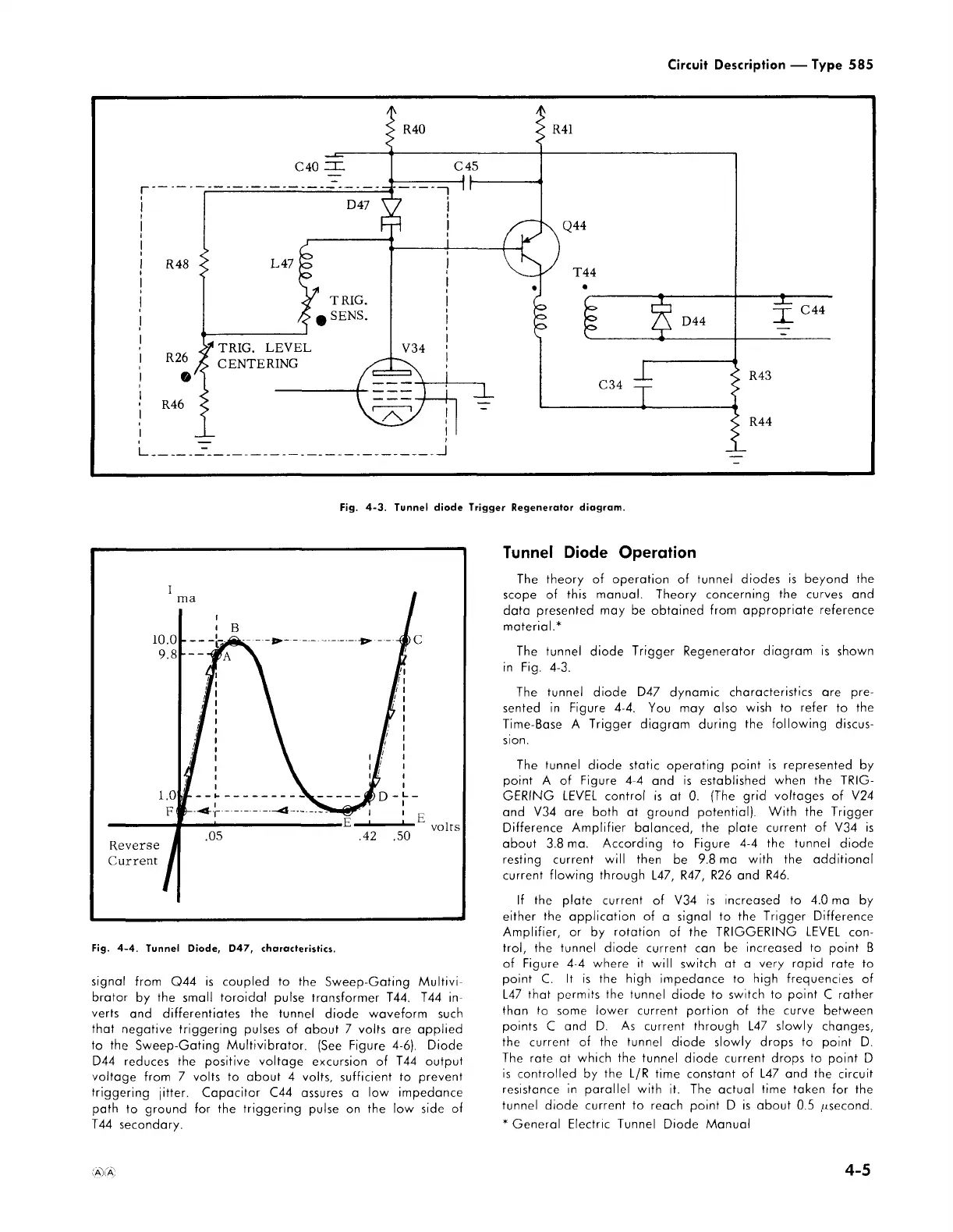
Fig.
4-4.
Tunnel
Diode,
D47,
characteristics.
signal
from
Q44
is
coupled
to
the
Sweep-Gating
Multivi
brator
by
the
small
toroidal
pulse
transformer
T44.
T44
in
verts
and
differentiates
the
tunnel
diode
waveform
such
that
negative
triggering
pulses
of
about
7
volts
are
applied
to
the
Sweep-Gating
Multivibrator.
(See
Figure
4-6).
Diode
D44
reduces
the
positive
voltage
excursion
of
T44
output
voltage
from
7
volts
to
about
4
volts,
sufficient
to
prevent
triggering
jitter.
Capacitor
C44
assures
a
low
impedance
path
to
ground
for
the
triggering
pulse
on
the
low
side
of
T44
secondary.
Tunnel
Diode
Operation
The
theory
of
operation
of
tunnel
diodes
is
beyond
the
scope
of
this
manual.
Theory
concerning
the
curves
and
data
presented
may
be
obtained
from
appropriate
reference
material.*
The
tunnel
diode
Trigger
Regenerator
diagram
is
shown
in
Fig.
4-3.
The
tunnel
diode
D47
dynamic
characteristics
are
pre
sented
in
Figure
4-4.
You
may
also
wish
to
refer
to
the
Time-Base
A
Trigger
diagram
during
the
following
discus
sion.
The
tunnel
diode
static
operating
point
is
represented
by
point
A
of
Figure
4-4
and
is
established
when
the
TRIG
GERING
LEVEL
control
is
at
0.
(The
grid
voltages
of
V24
and
V34
are
both
at
ground
potential).
With
the
Trigger
Difference
Amplifier
balanced,
the
plate
current
of
V34
is
about
3.8
ma.
According
to
Figure
4-4
the
tunnel
diode
resting
current
will
then
be
9.8
ma
with
the
additional
current
flowing
through
L47,
R47,
R26
and
R46.
If
the
plate
current
of
V34
is
increased
to
4.0
ma
by
either
the
application
of
a
signal
to
the
Trigger
Difference
Amplifier,
or
by
rotation
of
the
TRIGGERING
LEVEL
con
trol,
the
tunnel
diode
current
can
be
increased
to
point
B
of
Figure
4-4
where
it
will
switch
at
a
very
rapid
rate
to
point
C.
It
is
the
high
impedance
to
high
frequencies
of
L47
that
permits
the
tunnel
diode
to
switch
to
point
C
rather
than
to
some
lower
current
portion
of
the
curve
between
points
C
and
D.
As
current
through
L47
slowly
changes,
the
current
of
the
tunnel
diode
slowly
drops
to
point
D.
The
rate
at
which
the
tunnel
diode
current
drops
to
point
D
is
controlled
by
the
L/R
time
constant
of
L47
and
the
circuit
resistance
in
parallel
with
it.
The
actual
time
taken
for
the
tunnel
diode
current
to
reach
point
D
is
about
0.5
second.
*
General
Electric
Tunnel
Diode
Manual
4-5

Related product manuals