EasyManua.ls Logo

Tektronix 585 - Page 36

Tektronix 585
151 pages
Print Icon
To Next Page IconTo Next Page
To Previous Page IconTo Previous Page
Loading...
Circuit
Description
Type
585
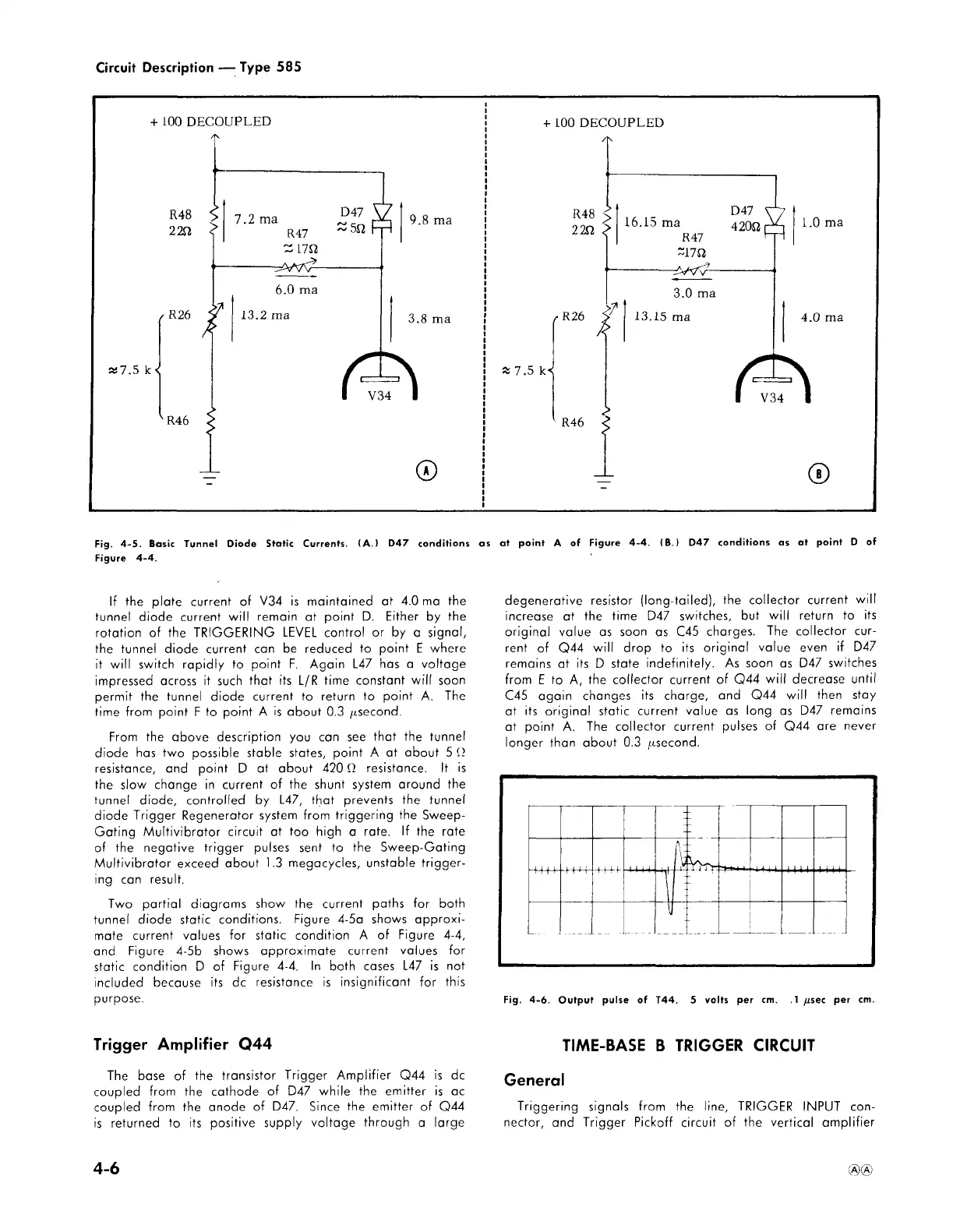
Fig.
4-5.
Basic
Tunnel
Diode
Static
Currents.
(A.)
D47
conditions
as
at
point
A
of
Figure
4-4.
(B.)
D47
conditions
as
at
point
D
of
Figure
4-4.
If
the
plate
current
of
V34
is
maintained
at
4.0
ma
the
tunnel
diode
current
will
remain
at
point
D.
Either
by
the
rotation
of
the
TRIGGERING
LEVEL
control
or
by
a
signal,
the
tunnel
diode
current
can
be
reduced
to
point
E
where
it
will
switch
rapidly
to
point
F.
Again
L47
has
a
voltage
impressed
across
it
such
that
its
L/R
time
constant
will
soon
permit
the
tunnel
diode
current
to
return
to
point
A.
The
time
from
point
F
to
point
A
is
about
0.3
second.
From
the
above
description
you
can
see
that
the
tunnel
diode
has
two
possible
stable
states,
point
A
at
about
5
(
resistance,
and
point
D
at
about
420
resistance.
It
is
the
slow
change
in
current
of
the
shunt
system
around
the
tunnel
diode,
controlled
by
L47,
that
prevents
the
tunnel
diode
Trigger
Regenerator
system
from
triggering
the
Sweep-
Gating
Multivibrator
circuit
at
too
high
a
rate.
If
the
rate
of
the
negative
trigger
pulses
sent
to
the
Sweep-Gating
Multivibrator
exceed
about
1.3
megacycles,
unstable
trigger
ing
can
result.
Two
partial
diagrams
show
the
current
paths
for
both
tunnel
diode
static
conditions.
Figure
4-5a
shows
approxi
mate
current
values
for
static
condition
A
of
Figure
4-4,
and
Figure
4-5b
shows
approximate
current
values
for
static
condition
D
of
Figure
4-4.
In
both
cases
L47
is
not
included
because
its
d
c
resistance
is
insignificant
for
this
purpose.
degenerative
resistor
(long-tailed),
the
collector
current
will
increase
at
the
time
D47
switches,
but
will
return
to
its
original
value
as
soon
as
C45
charges.
The
collector
cur
rent
of
Q44
will
drop
to
its
original
value
even
if
D47
remains
at
its
D
state
indefinitely.
As
soon
as
D47
switches
from
E
to
A,
the
collector
current
of
Q44
will
decrease
until
C45
again
changes
its
charge,
and
Q44
will
then
stay
at
its
original
static
current
value
as
long
as
D47
remains
at
point
A.
The
collector
current
pulses
of
Q44
are
never
longer
than
about
0.3
^second.
Fig.
4-6.
Output
pulse
of
T44.
5
volts
per
cm.
.1
fisec
per
cm.
Trigger
Amplifier
Q44
The
base
of
the
transistor
Trigger
Amplifier
Q44
is
d
c
coupled
from
the
cathode
of
D47
while
the
emitter
is
ac
coupled
from
the
anode
of
D47.
Since
the
emitter
of
Q44
is
returned
to
its
positive
supply
voltage
through
a
large
TIME-BASE
B
TRIGGER
CIRCUIT
General
Triggering
signals
from
the
line,
TRIGGER
INPUT
con
nector,
and
Trigger
Pickoff
circuit
of
the
vertical
amplifier
4-6

Related product manuals