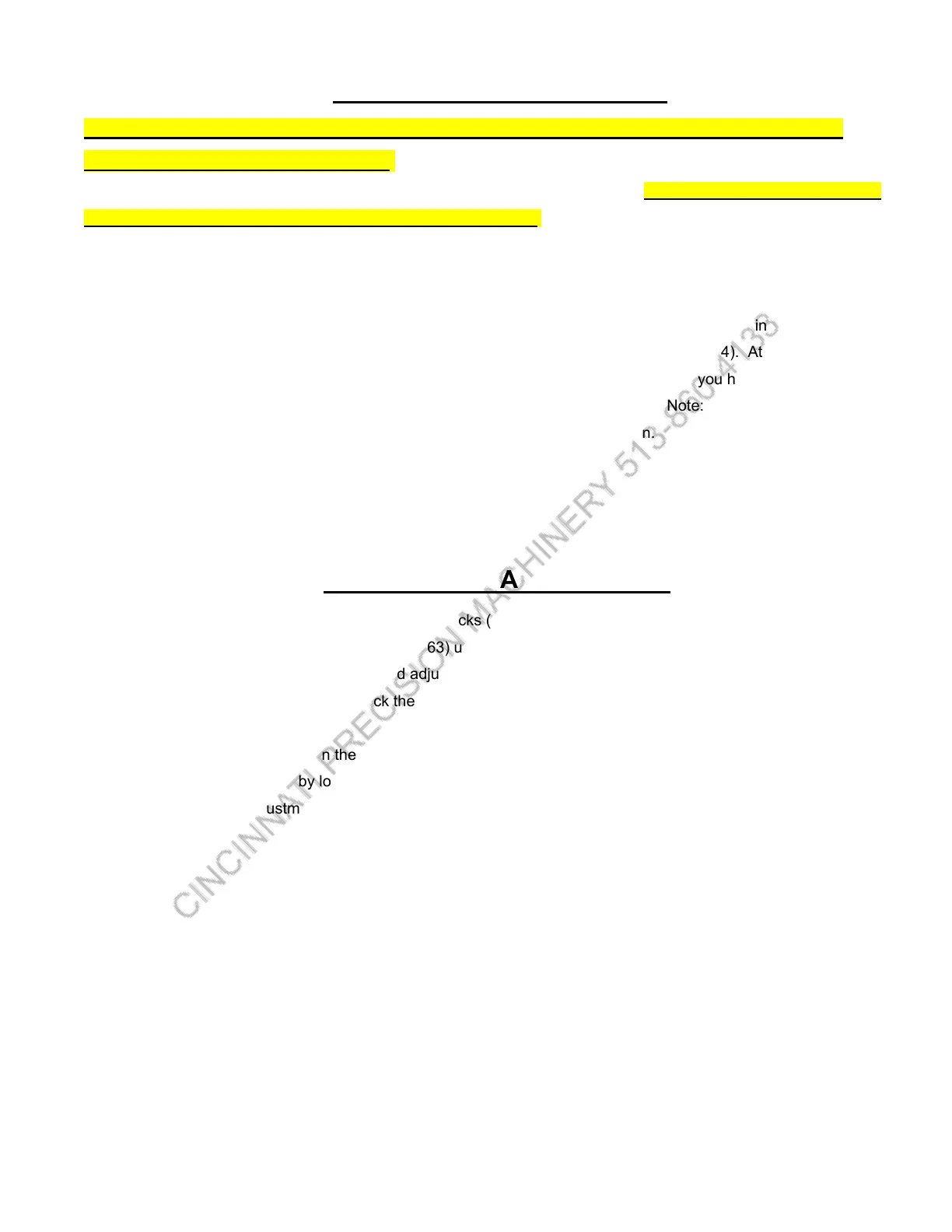
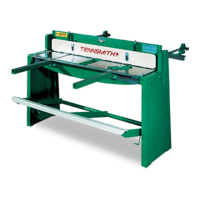
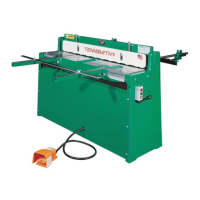
HOLD-DOWN ADJUSTMENT
CAUTION: THIS SHEAR SHOULD NOT BE OPERATED WITHOUT THE HOLDDOWN IN
PLACE AND PROPERLY ALIGNED. The hold-down (3) is designed to engage the material before the blades
yet allow only minimal clearance between the guard’s feet and the table surface. The gap between the hold-down
feet and table surface should never be above 3/16” of an inch. The gap between the hold-down and the table is
controlled by turning the nut on the hold-down studs (11). Clockwise rotation will increase clearance; counter clockwise
turns will decrease the gap.
The guard should be held snug against the milled pads on the cutter bar and not feel loose. You must be careful,
however, that the hold-down bolts (13) are not so tight as to bind the guard when the cutter bar is in the down position.
Properly aligned, the bolts will snug but still allow rotation of the hold-down screw washers (14). At the rear of the cutter
bar you will find two tapped holes wherein hold-down jam screws (45) are located. Once you have applied proper
tension to the hold-down screws, tighten the jam screws to lock alignment in place. (Note: The milled pads on the front
and rear of the hold-down should be greased periodically to maintain proper action.
BACK GAUGE ADJUSTMENT
Slide back gauge rods (62) through the adjustment blocks (66) and brackets (71). Mount the rods in the holes found at
the rear of the cutter bar. Move the gauge angle (63) up the rods until it contacts with the lower blade. Observe the
pointers attached to the adjustment blocks and adjust the rods in or out until the embossed scales read zero on the
pointers. Tighten the set screws (44) to lock the rods in place.
To attain a particular setting, loosen the four lock screws (70) and slide the gauge to an approximate position. Fine tune
adjustments are accomplished by locking the screws of the two adjustment brackets (71) while keeping those of the
blocks (66) loose. The adjustment dial (68) can then be used to position the gauge in or out.
8


 To Next Page