3-1
3. Placement and installation
3.1 Before using the fan
When you receive the delivery of the fan, check the following points first.
If there are any problems, contact the sales agent you purchased the product from.
Handle the motor according to the instruction manual of the motor.
Incorrect handling may result in an accident or failure.
(1) Check the nameplate to verify that the product is the one you ordered.
(2) Check that the discharge direction, rotation direction, and power transmission methods are as
ordered.
(3) No parts of the product are damaged during transportation.
(4) All fastening parts including bolts and nuts are securely tightened.
(5) All the accessories that you ordered have been delivered.
3.2 Precautions during transportation and storage
3.2.1. Precautions for transportation
Warning
• Do not step under the suspended fan. The fan may fall onto you.
• For transportation of the unit, ask a specialist company who should
move and place it in consideration of the center of gravity and
weight.
• Before hoisting the unit, refer to the catalogue or external
dimensions drawing etc. to confirm that the weight of the fan does
not exceed the rated load limit of the hoisting equipment.
• Do not lift the whole unit using the main shaft of the fan, lifting eyes
of the motor, or other parts.
Caution
• Care should be taken to nails especially when opening a wooden
box that contains the unit, or you may get injured.
(1) To lift the fan, use the specified lifting eyes on the casing.
(A fan of #61/2 or larger has labels on it to indicate the lifting point.)
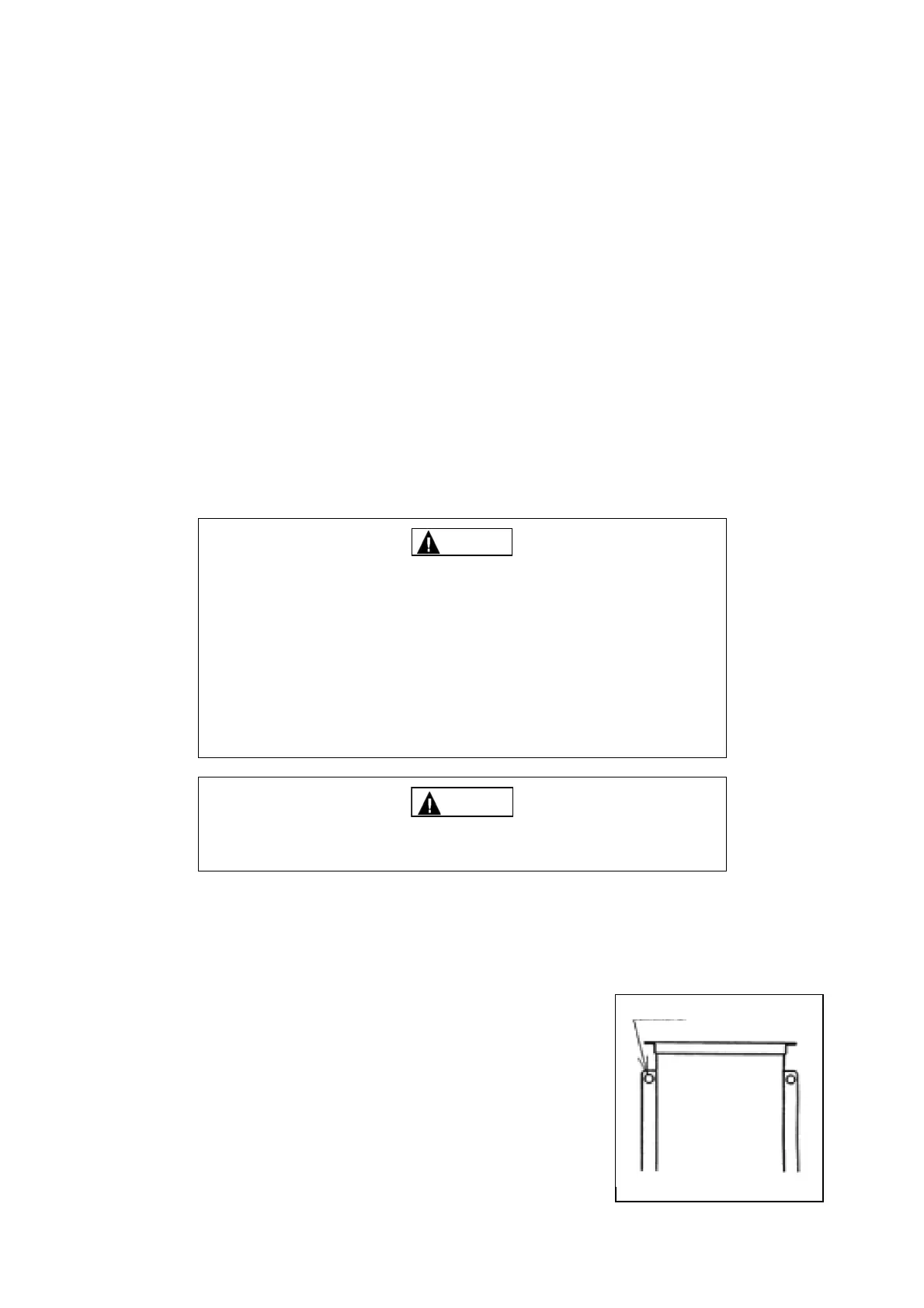
(2) If the fan is small-sized and has no lifting eyes, lift the fan by running a rope or wire under the
common base.
(3) When lifting a split casing or impeller, ensure that the points which a rope or wire would contact
are covered with blankets, etc. so that any distortion is
prevented.
(4) Use as long ropes and wires as possible so that the fan can be
lifted at an angle of 90° or less, which prevents the fan from
being deformed/damaged by the lifting load.
(5) When the casing surface is covered with lagging (for heat
insulation), even a very small load will cause deformation, so
ensure that the rope should not contact the lagging surface.
Lifting eye



 To Next Page