TPMS malfunctions can occur for a variety of
reasons, including installing replacement or
alternate tires or wheels that prevent the
TPMS from functioning properly. Always
check the TPMS malfunction indicator light
after replacing one or more tires or wheels on
your vehicle to ensure that the replacement
tires or wheels allow the TPMS to continue to
function properly.
NOTE: If a tire has been replaced or repaired
using a dierent tire sealant than the one
available from Tesla, and a low tire pressure is
detected, it is possible that the tire sensor has
been damaged. Contact Tesla to have the
fault repaired as soon as possible.
Seasonal Tire Types
Understand Your Tire Type
The type of tires that your vehicle is originally
equipped with depends on vehicle model and
market region. It is important to understand
the capabilities of your vehicle's tires and
whether they are suited for summer, all-
season, or winter driving. Check the
information on the sidewall of a tire for
information about a tire's performance
characteristics (see
Understanding Tire
Markings on page 240)
Summer and All-Season Tires
Summer tires and all season tires are
designed for maximum dry and wet road
performance but are not designed to perform
well in winter conditions. All-season tires are
designed to provide adequate traction in
most conditions year-round, but may not
provide the same level of traction as winter
tires in snowy or icy conditions. All-season
tires can be
identified by “ALL SEASON"
and/or "M+S” (mud and snow) on the tire
sidewall.
If driving in cold temperatures or on roads
where snow or ice may be present, Tesla
recommends using winter tires. If not
equipped with winter tires, contact Tesla for
winter tire recommendations.
WARNING:
In cold temperatures or on
snow or ice, summer and all-season
tires do not provide adequate traction.
Selecting and installing the
appropriate tires for winter conditions
is important to ensure the safety and
optimum performance of your
Model X.
Winter Tires
Use winter tires to increase traction in snowy
or icy conditions. When installing winter tires,
always install a complete set of four tires at
the same time. Winter tires must be the same
diameter, brand, construction and tread
pattern on all four wheels. Contact Tesla for
winter tire recommendations.
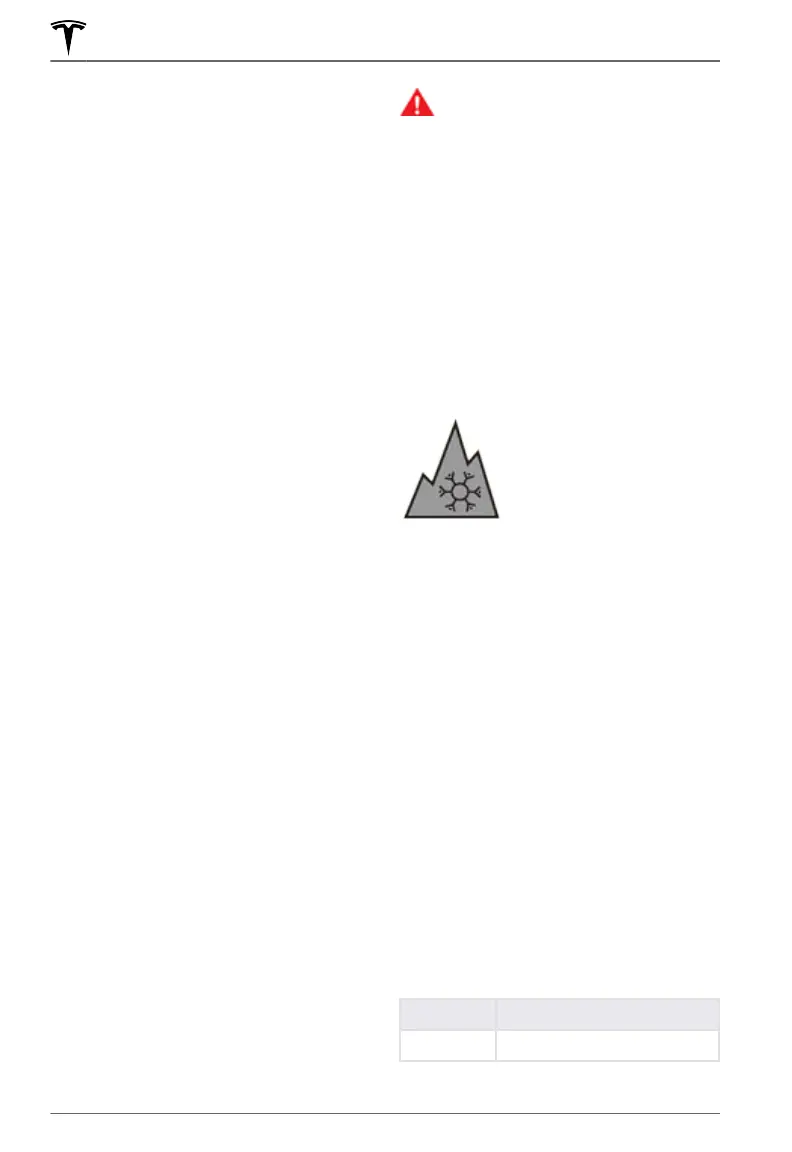
Winter tires can be
identified by a mountain/
snowflake symbol on the
tire's sidewall.
When driving with winter tires, you may
experience more road noise, shorter tread life,
and less traction on dry roads.
Driving in Low Temperatures
Tire performance is reduced in low ambient
temperatures, resulting in reduced grip and
an increased susceptibility to damage from
impacts. Performance tires (summer
applications) have reduced traction in
ambient temperatures below
40° F (5° C),
and are not recommended in snow/ice
conditions. Performance tires can temporarily
harden when cold, causing you to hear
rotational noise for the
first few miles
(kilometers) until the tires warm up.
Using Tire Chains
Tesla has tested and approved the following
tire chains to increase traction in snowy
conditions. Tire chains should only be
installed on the rear tires. The approved tire
chains can be purchased from Tesla.
Tire Size Recommended Chain
20" KONIG K-SUMMIT K67
Do not use tire chains on 22" tires.
Tire Care and Maintenance
218 MODEL X Owner's Manual









 To Next Page