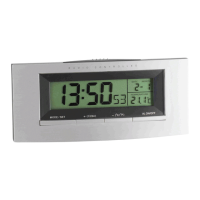
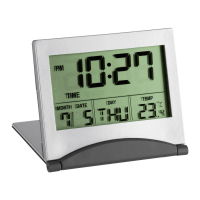
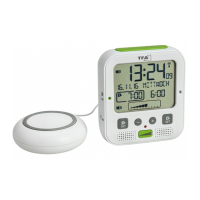
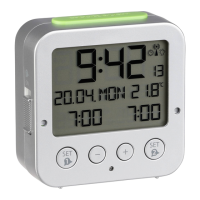
Radio controlled alarm clock with thermometer
Radio controlled alarm clock with thermometer
1918
•
Inside ferro-concrete rooms (basements, superstructures), the
received signal is naturally weakened. In extreme cases,
please place the unit close to a window to improve the
reception.
•
During night-time, atmospheric interference is usually less
severe and reception is possible in most cases. A single daily
reception is adequate to keep the accuracy deviation below 1
second.
Important information on product safety!
•
Do not place the unit near extreme temperatures, vibration
or shock.
•
Protect from moisture.
Note for radio-controlled time DCF:
The time base for the radio-controlled time is a caesium atomic
clock operated by the Physikalisch Technische Bundesanstalt
Braunschweig. It has a time deviation of less than one second in
one million years. The time is coded and transmitted from
Mainflingen near Frankfurt via frequency signal DCF-77 (77.5
kHz) and has a transmitting range of approximately 1,500 km.
Your radio-controlled clock receives this signal and converts it
to show the precise time. Changeover from summer time or
winter time is automatic. The quality of the reception depends
mainly on the geographic location. Normally there should be
no reception problems within a 1,500 km radius around Frank-
furt.
Please take note of the following:
•
Recommended distance to any interference sources like com-
puter monitors or TV sets is at least 1.5 - 2 metres.
4. Elements (Fig. 1+2)
LCD
A: Clock
B: Date with weekday
C: Indoor temperature,
alarm 1, alarm 2, dual time
D: DCF signal
E: Alarm symbol
Buttons
F: “ALARM” button
G: “°C/°F WAVE” button
H: “MODE” button
I: “▼“ button
J: “▲“ button
K: “LIGHT/SNOOZE” button
L: Battery compartment


 To Next Page