6
66
6. DRIVING
. DRIVING. DRIVING
. DRIVING
Before driving make sure that the Battery is fully charged, check that the tyres do not appear to be soft, see
Maintenance section for details of monthly checks and tyre pressures. Check that the Key is switched OFF before
entry. When comfortably sat, ensure that the seat lever has locked the seat secure. Ensure that the armrests are in the
down position.
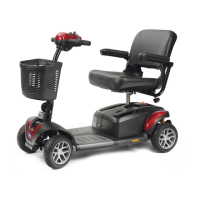
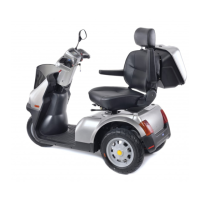
1. Set the Breeze speed to slow. Hold the Tiller with both hands and gently squeeze the right control lever to move the
Breeze forward. The more you squeeze the lever, the faster you will go. Always come to a stop before changing H or L
speeds, or forward and reverse.
2. Releasing the control lever automatically operates the brakes to slow down and stop. Once stopped, the parking
brake will automatically come on.
3. Use the Tiller to steer.
4. To go backwards, select reverse and squeeze the right control lever again. The speed in reverse is reduced
automatically for safety.
5. To negotiate from pavement to road, or road to pavement, you should try to find a suitable slope. The Breeze will
mount, or go down kerbs 12cm high, but you should approach a kerb at right angles (90°). You should stop just short
of the edge and:
* If you are going up; select the high speed setting then drive until both front and back wheels are on the
pavement, then immediately lower the speed.
* If going down, proceed slowly on low setting until on the road, then switch to a suitable higher speed to cross
the road safely.
6. The Breeze is suitable for road use BUT great care must be taken and at the maximum speed of 8 mph, you may
present a hazard to other faster moving road users. (See safe driving tips at the rear of this manual.)
7. Watch your Battery Indicator. The distance you can travel depends on many factors, the more slopes, the less
distance you can travel. We recommend that you gradually explore going further each day.
8. Should the battery “run out” before you get home there are two things you can do to avoid being stranded.
Stopping and switching off the KEY for 5 – 10 minutes will allow the battery to “recover” a little power so that you can
proceed further. You can attempt this a number of times. If you are unfortunate and cannot return to home under the
battery power there is a “Free Wheel” device that will allow someone to push the Breeze home (see Parking Brake
Release).
9. Range is influenced by many environmental conditions, hills will substantially decrease the range. Establish what you
can obtain around your locality by gradually increasing the distance and checking the battery indicators at the end of
each journey.
10. Reducing the speed will also reduce the power. For climbing obstacles or hills you will need to increase the speed
setting to give the power and then control the speed with the levers.
Parking
ParkingParking
Parking
1. Before leaving the scooter, switch the ignition off, the battery indicator will then go off. Remove the ON/OFF Key for
security.
2. If the Breeze has been used in the Free Wheel mode (see Parking Brake Release), it is VERY IMPORTANT to re-
engage the drive to ensure that the scooter brake is on before you get off.
3. Flip up the armrest to make it easier to get up from the Breeze, or swivel the seat through 90°.


 To Next Page