CHECK IT OUT
43
SolarBots
ENERGY FROM THE SUN
The terms “solar energy” and “solar power” refer to the energy of the solar radiation
that we are able to harness and use. The sun is a star that is 150 million kilometers from
Earth. Despite this immense distance, solar energy has an enormous impact on our
lives: Life is not possible without the sun!
You can feel how strong solar energy is on any sunny day. Just lay out for a bit in the sun
in the middle of summer. But be careful — you need to protect yourself adequately
against sunburn. The sun emits so much energy because it is a gigantic nuclear reactor.
It is so hot on the inside that the atoms, the building blocks of all matter, fuse together.
Even on the sun’s surface, it is still around 5,500 degrees Celsius. The nuclear fusion
produces nearly inexhaustible amounts of energy. This is radiated out into space. And
some of it strikes Earth’s surface as electromagnetic radiation, as light.
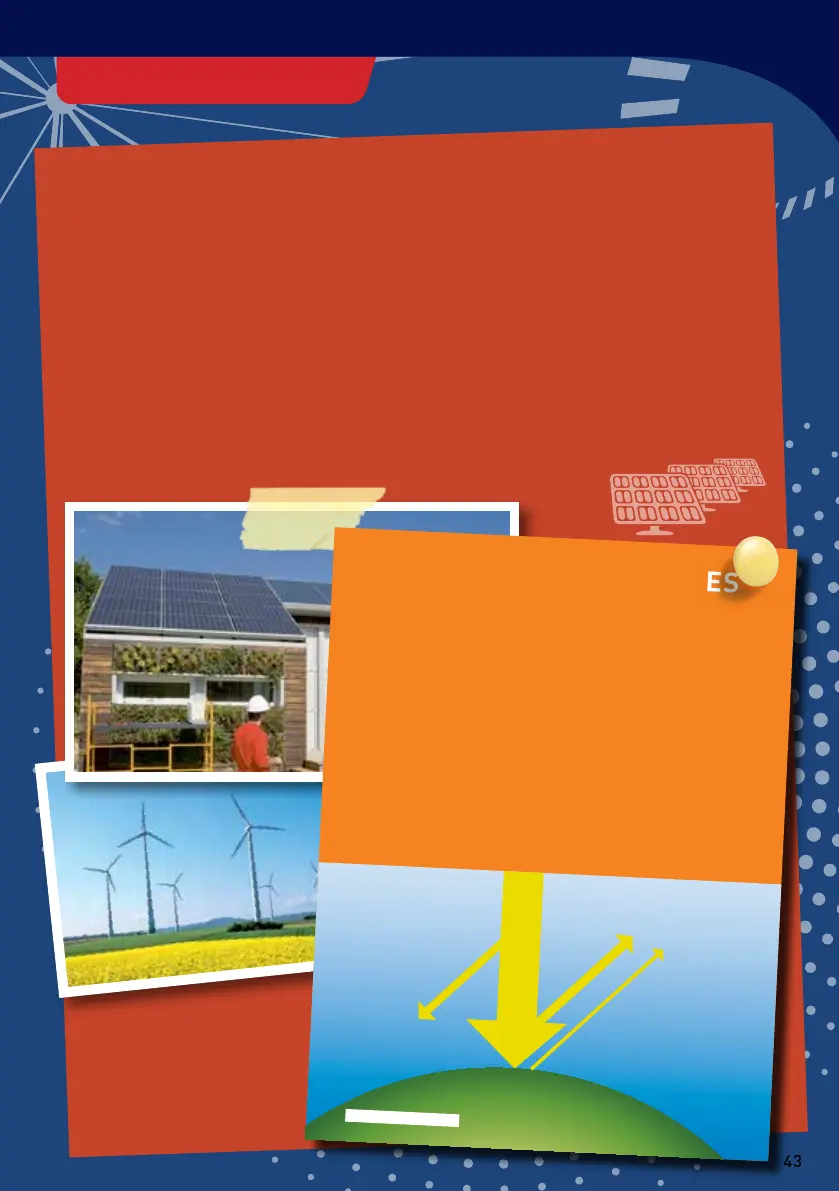
Solar radiation
342 W/m²
Absorbed by the
atmosphere
67 W/m²
Reflected from the
atmosphere
77 W/m²
Reflected off the
ground
30 W/m²
Absorbed by Earth’s
surface
168 W/m²
W/m² = Was per square meter
AMAZING ENERGY RESERVES
The solar energy striking Earth’s atmosphere each year
is an unimaginable 1,500,000,000,000,000,000 kilowatt
hours. This corresponds to about 10,000 times the
energy consumption of all of humanity (as of 2010).
By comparison: A three-person household in a single-
family home consumes 4,000 kilowatt hours of power
each year on average, which is but a tiny fraction of the
incident solar energy.
However, a large portion of the solar energy is lost in
the atmosphere, since it is “swallowed up” there or
reflected back. The rest of it is enough, though, to give
us sunlight that we can use to generate electricity.
Incident Solar Energy: the radiant
solar energy that hits Earth's
surface and is referred to as
“global radiation” on a surface.
Kilowatt Hours: a measure of
electrical energy equivalent to a
power consumption of 1,000 watts
for 1 hour.


 To Next Page