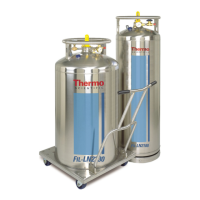
The Model 8120 is a 180-liter LN2 Supply Tank, a cryogenic liquid cylinder designed for the transportation and storage of liquefied gases such as liquid argon, liquid nitrogen, and liquid oxygen. These cylinders are double-walled, vacuum, and multi-layer insulated, providing a reliable, convenient, and economical method for gas supply.
Function Description:
The Cryo-Cyl Series liquid cylinders are designed to store cryogenic products in liquid form and dispense them as gas or liquid for various applications. They are equipped with all operating controls at the top for ease of gas withdrawal and liquid dispensing. The internal pressure building system automatically maintains the preset operating pressure during gas withdrawal, and an internal vaporizer converts cold liquid to gas. A back control regulator (economizer) allows gas withdrawal directly from the vapor space until the cylinder head pressure is reduced to the normal operating range, minimizing product loss during periods of non-use. For precise regulation of outlet gas, a final line gas regulator can be added at the gas use connection.
Important Technical Specifications:
- Capacity: 180 liters (Cryo-Cyl 180)
- Physical Characteristics:
- Diameter: 20 inches (50.8 cm)
- Height: 63.5 inches (161.3 cm)
- Empty Weight: 210 lbs (95.2 kg)
- Fill Weight: See Section 4 for details.
- Design Specification: DOT/CTC 4L
- DOT Service Pressure: 100 psig (6.9 BAR)
- Relief Valve Setting: 22 psig (1.5 BAR)
- Normal Operating Pressure: 10-100 psig (0.7-6.9 BAR)
- Normal Evaporation Rate:
- Nitrogen: 1.5%
- Oxygen or Argon: 1.0%
- Gross Capacity (liters): 196
- Storage Capacity, Liquid (liters): 185
- Liquid Level Gauge: Float type
- Construction Material: Stainless Steel
- Pressure Building Regulator: 0-25 psig (0-1.7 BAR)
- Finish: Stainless Steel
- Base Construction: Stainless Steel Footring
Usage Features:
- Ease of Handling: Designed to be easily handled by one person. The stainless steel ring protects plumbing components and has slots for use with a hand truck or overhead hoist.
- Purity: Gas stored in liquid form in these cylinders is purer than gas stored in conventional cylinders.
- Pressure Maintenance: The highly efficient insulation system minimizes pressure rise during non-use, reducing venting. The pressure control regulator automatically maintains working pressure with minimum product loss.
- Continuous Gas Supply: Internal pressure building and vaporization systems permit continuous gas flow without an external vaporizer. Cylinders can be used individually or manifolded for larger gas storage capacities.
- Filling Procedures: Recommendations for optimal filling include keeping transfer lines short and uninsulated, using safety relief devices in lines where liquid can be entrapped, conducting filling quickly, avoiding overfilling, using minimum bends/valves/reducers, and using large transfer lines (at least 1/2" ID). The "Lo-Loss" system is recommended for filling.
- Liquid Withdrawal: For liquid withdrawal, the cylinder is typically refitted with a 22 psig relief valve to minimize loss. The process involves connecting a transfer line to the user's receiving vessel, opening the liquid valve, and closing it when the vessel is filled. The vent valve is opened to release excess pressure.
- Safety: The cylinders are protected from over-pressurization by a safety pressure relief valve and a secondary bursting disc, meeting CGA Pamphlet S-1.1 standards. A reverse buckling rupture disc protects the vacuum casing.
Maintenance Features:
- Cleaning: Cylinders should be kept clean and free from grease and oil. Only parts compatible with the specific liquid should be used for repairs.
- Recommended Inner Vessel Purging: Before any operation involving pressure or cryogenic fluid, all safety precautions must be taken. The procedure involves opening the vent, warming the inner vessel with warm nitrogen gas through the liquid valve, closing valves, evacuating the inner vessel with a vacuum pump, breaking the vacuum with high purity gas, and repeating the vacuum/purge steps.
- Fittings and Decals: Proper fittings for the specific gas product must be installed, as regulated by the Compressed Gas Association to prevent cross-contamination. Fitting adapters should not be used. Decals, including the sight gauge decal, must be correctly placed and legible.
- Changing Service Pressure: The relief valve can be changed to limit maximum pressure. This involves releasing all pressure, removing the old relief valve and identification tag, installing a new tag and relief valve with oxygen-compatible thread sealant, and leak testing.
- Level Gauge Maintenance: If the level gauge malfunctions, it can be removed and repaired. This involves releasing pressure, removing the protector and sight gauge, replacing damaged parts, and adjusting the float assembly to ensure the indicator hangs freely in the empty zone.
- Rebuilding Operational Valves: The Cryo-Cyl valves have a spring-loaded rotary stem that compensates for thermal shrinkage and wear. If a valve is defective, it can be disassembled, inspected, and rebuilt by replacing worn parts, ensuring proper torque and using oxygen-compatible thread sealant.
- Troubleshooting: The manual provides a troubleshooting guide for common issues like excessive pressure, frost, vacuum loss, and delivery problems, along with corrective actions. For further information, Chart's Technical Service Department can be contacted.
Safety Bulletins:
- Oxygen Enriched Atmospheres: Excess oxygen (above 23%) creates an oxygen-enriched atmosphere where flammable items burn vigorously. Keep all organic and flammable materials away from oxygen.
- Oxygen Deficient Atmospheres: Nitrogen and argon vapors can dilute oxygen, leading to unconsciousness or death. Use a "buddy system" and portable air supply in potentially oxygen-deficient environments.
- Damaged Containers: Damaged or suspect containers should be emptied immediately, not refilled until repaired and recertified. Continued use of a container with vacuum problems can lead to embrittlement and cracking.
- Cryogenic Burns: External valves and fittings can become extremely cold. Personnel must wear protective gloves and eye protection when handling parts or loosening fittings to prevent burns.
The warranty period starts two weeks from the shipment date. Component parts are covered for one year, and LN2 Vacuum Integrity is covered for two years. Installation, calibration, and expendable items are excluded. Repairs require prior approval from Thermo's Technical Services Department.

 Need help?
 General


 To Next Page