
 Need help?
Do you have a question about the Thermo Scientific RVT5105 and is the answer not in the manual?
Describes RVT series traps as reliable, compact benchtop units for solvent vapor collection.
Procedures for inspecting the unit upon arrival, unpacking, and handling potential shipping damage.
Guidelines for unit placement, power requirements, and adequate air circulation.
Details on connecting power, adding CryoCool, and other components.
Instructions for installing the GCF400 Glass Condensation Flask.
Instructions for installing the GF4000 Flask with SC250EXP.
Steps for powering on the unit and reaching operating temperature.
Procedure for emptying the glass vessel to maintain efficiency and prevent damage.
Procedure for replenishing and refreshing CryoCool fluid.
Addressing vibration issues and cleaning the condenser grill.
List of optional accessories for the RVT5105 unit.
Contact information for technical support and application support.
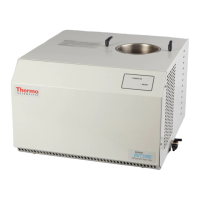
The Thermo Scientific RVT5105 Refrigerated Vapor Trap is a compact, benchtop device designed for efficient solvent vapor condensation and collection, offering a reliable and easy-to-use alternative to traditional dry ice/methanol traps. Its primary function is to protect high-vacuum, rotary vane oil pumps in a vacuum system from potentially damaging solvent vapors. This is achieved by condensing solvents removed from samples during vacuum evaporation, typically with a SpeedVac Concentrator or during rotary evaporation, within a Glass Condensation Flask. The condensed solvents collect on the flask's walls, preventing them from reaching the vacuum pump.
The RVT5105 operates at a low temperature of -105°C, making it highly effective for trapping a wide range of solvents. It employs a cascade (dual compressor) refrigeration system to reach these low operating temperatures. When used in conjunction with the ThermoSci VaporNet controller, RVT-series traps are capable of achieving solvent recovery levels comparable to more elaborate liquid nitrogen traps.
Operating the RVT5105 is straightforward, controlled by an on/off (I/O) switch located on the left side of the unit. An amber LED on the right front panel indicates when the unit is powered on, while a green LED illuminates when the operating temperature has been reached, signaling that the unit is ready for use. After switching on, it may take up to 90 minutes for the trap fluid to reach its ultimate operating temperature of -105°C, though a ready-to-use temperature of -75°C is typically reached in about 60 minutes. During operation, the trap temperature may fluctuate slightly due to the heat transfer caused by condensing and freezing solvent vapors. The RVT5105 is designed for continuous operation and can be left on for extended periods, but regular checks of the glass trap or flask are essential for optimal performance.
For installation, the trap should be placed on a sturdy benchtop, at least 26 inches (66 cm) deep, near a power outlet of the required voltage (13 A for 115V or 7 A for 230V). Adequate ventilation is crucial, requiring at least 3 inches (7.62 cm) of clearance for ambient air suction, particularly at the rear of the unit where air is drawn. The ambient temperature should not exceed +90 °F (+32 °C) during operation. It is important not to place other high-powered equipment on the same circuit as the trap, as it draws high current when first switched on. The unit is equipped with a three-prong grounded plug for safety and is intended for indoor use only, avoiding areas of excessive humidity or temperature extremes.
Before operation, CryoCool Heat Transfer Fluid (500 ml) must be poured into the stainless steel trap chamber. CryoCool is a permanent, safe, efficient, and economical alternative to methanol or ethanol, being odorless, non-toxic, and having very low water absorption. The chamber should be filled to the correct level before each use.
The device utilizes Glass Condensation Flasks (GCF400 or GF4000, depending on the SpeedVac system used) for solvent collection. The GCF400 is an open-mouth flask designed for 4-liter traps, facilitating easy cleaning and removal. It is sealed with a rubber Flask Cover (FC400) and an insulating cover to maintain cold temperatures and prevent atmospheric condensation. The GF4000 is a wide-mouth threaded flask specifically for the SC250EXP SpeedVac system, also featuring an insulating cover and a polypropylene vacuum connection.
To install a flask, a clean, dry Glass Condensation Flask is placed into the stainless steel chamber, followed by the black insulating cover. The flask mouth is then sealed with the appropriate Flask Cover. The flask and insulating cover should be pressed down until the CryoCool rises around the flask, ensuring they are seated in the operating position. Two black retaining clips are then lifted and rotated to hold down both the insulation ring and the glass flask, sealing the chamber. After installation, it's important to verify that the CryoCool level is within about a half-inch (12–15 mm) from the top of the flask. Any spilled CryoCool should be wiped clean immediately.
Tubing connections are made using a 1/2-inch O.D. fitting to the rubber flask cover. If the tubing from the SpeedVac concentrator is wider, a reducer fitting may be required. The suction line from the pump end of the system is connected similarly. The ideal setup involves the shortest, straightest line of tubing with minimal bends to ensure easy removal of the rubber cover and flask for maintenance.
Maintenance of the RVT5105 is crucial for its longevity and efficiency. The glass vessel must be regularly emptied before it is half full to maintain peak system efficiency and prevent solvent vapors from contaminating or damaging the vacuum pump. It is good practice to change the vessel at the end of each workday or workweek. When removing glass vessels, protective gloves and clothing should be worn due to the low operating temperatures.
To remove a flask for cleaning, the system must first be bled back to atmospheric pressure. The rubber flask cover or poly nut on the vacuum connector is then removed. The flask is partially withdrawn to allow CryoCool to drain briefly, then fully removed along with the insulating black foam ring. To prevent thermal shock, the flask should be placed on absorbent paper toweling and allowed to reach room temperature before cleaning. A clean, dry spare flask should be inserted into the chamber, covered with the insulating foam ring, and sealed. This process can be done without shutting off the Refrigerated Vapor Trap. Defrosted contents of the used flask should be disposed of responsibly, and the flask cleaned and dried for future use. If the trap will not be used for several weeks, it can be shut off, but the glass vessel should always be replaced with a clean, dry one before restarting.
CryoCool also requires periodic refreshing. Water vapor from the air can condense and form ice crystals, especially in humid environments, which can reduce efficiency. Loose crystals can be removed with a strainer. If an ice build-up is observed on the chamber walls, the glass vessel rises above its usual position, or the trap's efficiency decreases, the CryoCool needs attention. The RVT5105 features a drain valve for removing defrosted CryoCool and water contaminants directly from the condenser. To use the drain valve, the unit must be turned off and allowed to defrost, or hot water can be poured in to melt the ice. The drain valve can be connected to a hose with a 3/8-inch barbed fitting to drain into a waste can. If CryoCool has a layer of water, it can be transferred to a container, allowed to settle into a bilayer, and placed in a freezer until the water layer freezes. The liquid CryoCool can then be decanted and reused, while the ice is disposed of.
Vibration issues should be addressed by checking the line voltage with a voltmeter; it must be above 108V for 120V units and above 209V for 240V units, as low line voltage can cause thermal overload. The condenser grill requires cleaning at least every three months to ensure proper air flow and ventilation. The trap should be turned off before cleaning to prevent dust and dirt from being drawn in. A vacuum cleaner with a brush attachment or compressed air can be used for cleaning. The refrigeration system itself is hermetically sealed and does not require maintenance.
 General
| Model | RVT5105 |
|---|---|
| Type | Refrigerated Vapor Trap |
| Temperature | -105°C |
| Capacity | 5 L |
| Manufacturer | Thermo Scientific |
| Power Supply | 230V, 50Hz |



 To Next Page