ELECTRICAL SYSTEM
CUSTOMER CARE | 877.855.2867
72
10
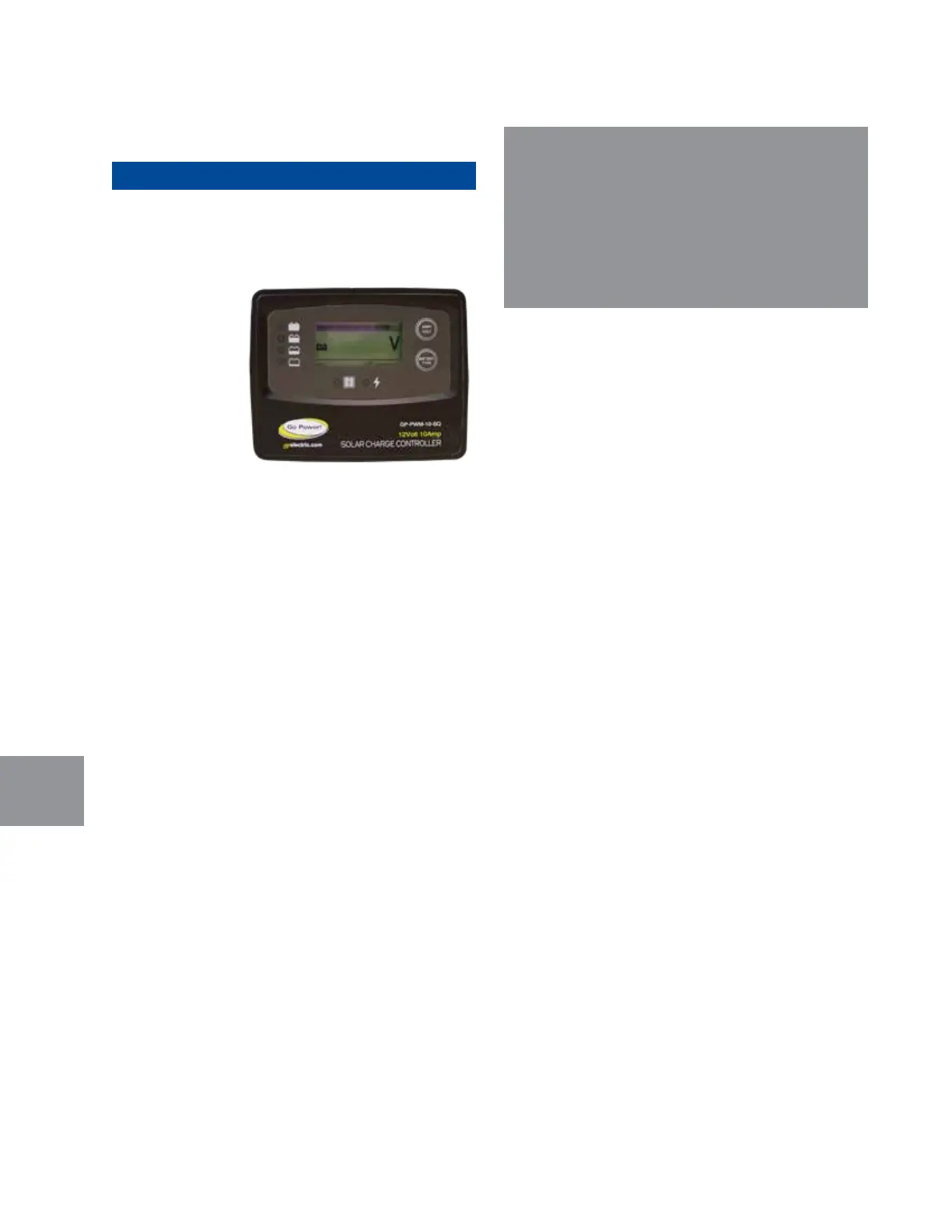
Typical10 Amp Solar Charge Controller
Solar Charge Controller
Your or Motor
Coach motor-
home may be
factory-equipped
with a solar
charge controller.
Along with a
roof-mounted
solar panel
(typically not
factory-supplied),
this system is
designed to pro-
vide an alternate
battery charging
method for
your auxiliary
battery(ies).
e solar charge controller regulates the charge energy
applied to the auxiliary battery from the solar panel. When
the battery reaches 100% state of charge, the controller
reduces charge energy to a trickle charge level, thus pro-
tecting the battery from damage caused by overcharging.
Inversely, when the controller senses that the auxiliary
battery(ies) requires a charge, the controller allows energy
generated from the solar panel to charge the battery. e
12 volt electrical devices installed in your motorhome are
not directly powered from the solar panel; they are pow-
ered from the auxiliary battery(ies).
e maximum input current rating of the solar controller
is 10 amps (input from the solar panel). e typical facto-
ry-installed solar panel is rated for 190 watts (peak). e
output charge voltage is up to 14 volts DC. Some solar
charge controllers are rated for 30 amps. e panel(s)
installed on your motorhome may vary from these speci-
cations; refer to your Owner’s Packet for details.
Maintenance and operational instructions from the man-
ufacturer is included with your owner’s packet and also
available through the TMC Owners Resource document
service on the TMC website.
When installing a roof-mounted solar panel(s), ensure
they are securely attached to mounting brackets and
all mounting points and wiring ports are well sealed
from moisture intrusion.
NOTICENOTICE
NOTE: The solar charge controller and associated
solar panel is not designed to directly power the ap-
pliances and/or electric components installed in your
motorhome.
All 12 volt systems and components are either pow-
ered directly from the auxiliary batteries or through
the converter, which receives input power from either
the on-board generator or external shore power.
Chassis Alternator
e 12 volts DC chassis alternator supplies power to both
the automotive systems as well as the auxiliary battery, if
equipped, while the motorhome’s engine is running. e
alternator compensates for electrical usage in the vehicle,
the power drawn by lights, fans, and other 12 volt powered
items, as well as charging of the automotive and auxiliary
batteries.
When driving, if the alternator is not keeping pace with
the draw on your motorhome’s electrical system, it means
it is working in a negative mode; more power is being used
than the alternator is capable of supplying. If you draw too
much power from your batteries there may not be enough
power le to start the motorhome or run the 12 volts DC
appliances when you stop for a break or for the night.
e alternator will charge at a higher rate right aer the
motorhome has been started, replacing the power used to
start the vehicle, but the charging should quickly drop back
to ‘normal’ and hold its own even when you turn on lights
or appliances.
If the alternator shows a discharge while the vehicle’s
engine is running, turn OFF appliances and lights to see
if a charge comes on or if the alternator indicates ‘neutral.’
en apply a load (turn ON a 12 volt DC appliance) on the
system to see if a discharge returns. If a discharge persists,
your alternator may not be working correctly; contact your
dealer.
When stopped at a campsite that allows you use of the
shoreline power, the on-board converter will recharge your
auxiliary battery. Under heavy usage and in warm weather,
check the uid level of auxiliary batteries frequently (if they
are not the maintenance free type). Top-o with distilled
water only. Low battery uid level is very harmful to the
battery’s longevity.


 To Next Page