HEATING AND COOLING
THOR MOTOR COACH | MADE TO FIT
91
13
Introduction
Your motorhome’s heating and cooling system consists of
equipment sourced from a variety of manufacturers, yet
the individual components are designed to function as an
integrated system. Components may have manufacturer’s
warranties and registrations. Your dealer can assist you
with completing component registrations.
Due to the wide variety of or Motor Coach models and
oor plans, heating and cooling information that is unique-
ly specic to your particular motorhome is not included in
this manual. Please review and retain all manufacturer’s
instruction manuals and documentation that is included
with your TMC Owner’s Packet. e manufacturers
of the heating and cooling equipment installed in your
motorhome are the best source for information regarding
component features, operation, and maintenance.
Always refer to the manufacturer’s documentation if you
have questions regarding your heating and cooling system
that are not covered in this manual. TMC Customer Care
representatives are also available to answer any question
you may have. Call toll free:
877-855-2867
e heating, ventilation, and air conditioning (HVAC)
functions of your motorhome consist of two separate
systems: the dash (vehicle) and house (living space). Much
like the heating and air conditioning systems in passenger
cars, the dash system is designed to heat and cool the front
driver and passenger compartment, along with providing
windshield defrosting. Although the dash heating and
air conditioning system of your motorhome is generally
more powerful than standard automobile systems, it is
not designed to heat and cool the entire motorhome, even
while the vehicle is in motion.
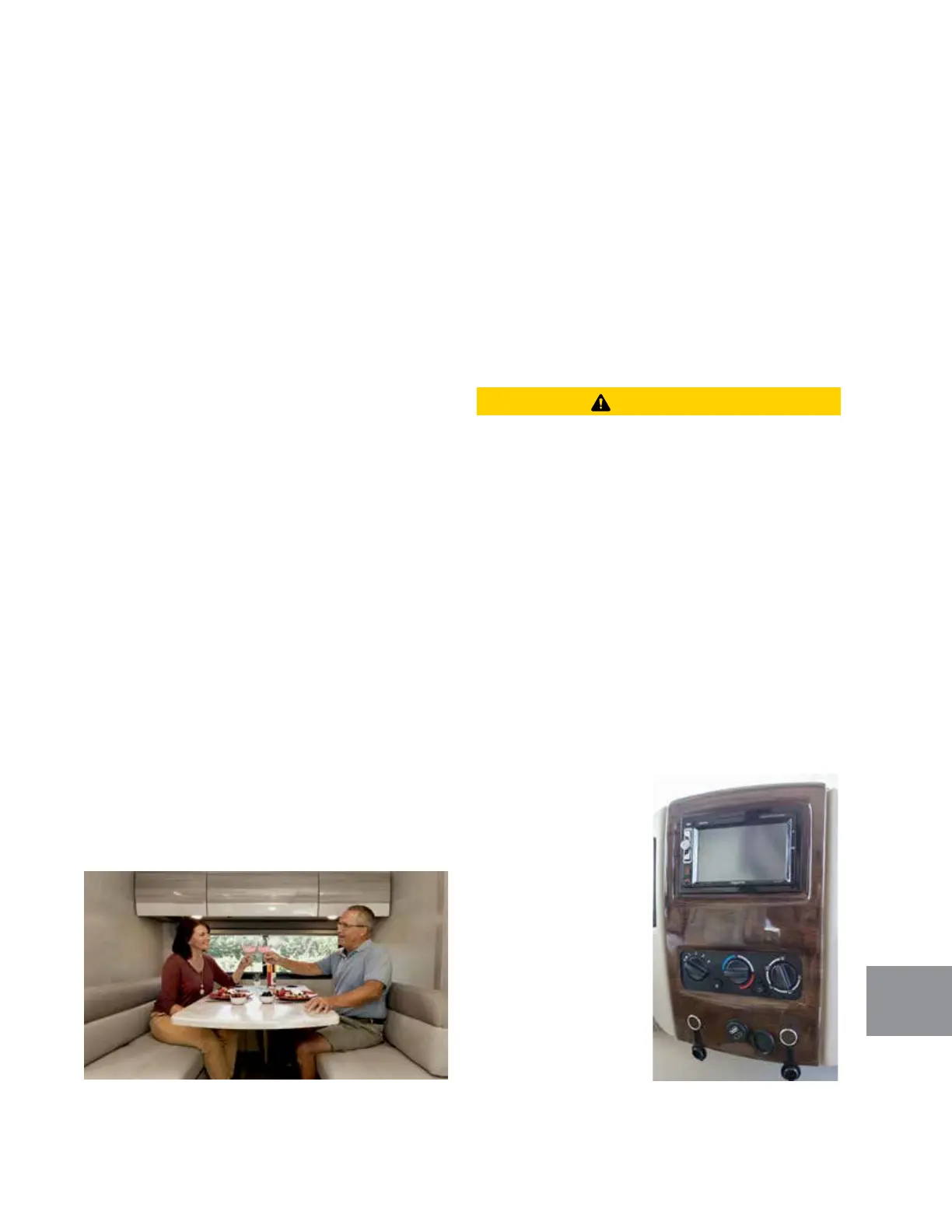
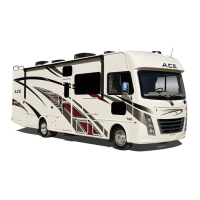
Regardless of the outside temperature, your motorhome's heating and
cooling system will keep you and your traveling companions comfortable.
Typical Class A heating and air
conditioning dash controls
The vehicle air conditioning system contains refrigerant
134a under high pressure and should only be serviced
by qualied technicians. Improper service methods
could cause serious personal injury.
CAUTIONCAUTION
If cooling of the living space is needed while the vehicle
is in motion, it is possible to operate the house air condi-
tioner(s), however, to do so, the on-board generator must
be in operation, supplying 120 volts AC to the air condi-
tioning units. e Master Battery Disconnect Switch must
also be ON, providing power to HVAC control devices.
DO NOT OPERATE THE PROPANE GAS FURNACE,
OR ANY OTHER PROPANE APPLIANCE, WHILE
THE VEHICLE IS IN MOTION.
Dash Heater and Air Conditioner
Control Panel
e heater and air conditioner dash controls for most TMC
Class C motorhomes is similar to what is found in many
passenger and light commercial vehicles and is installed
by the chassis manufacturer. For Class C dash control
operation, refer to the chassis manufacturer’s instructions
provided in your Owner’s Packet.
Class A dash heating and air conditioning units dier in
that they are installed by the motorhome manufacturer.
Both operate similarly in controls and functions, and both
require the vehicle’s engine to be running in order to heat
or cool the cockpit of the motorhome.
e typical control
panel consists of three
rotary dials, which
regulate FAN SPEED,
TEMPERATURE,
and VENTING. e
conguration of these
controls may dier
from model-to-model,
but the functions are
similar. Motorhomes
may be equipped with
touch-panel dash tem-
perature controls.
e heater/air condi-
tioner unit is located
beneath the dash or on
the rewall. In most
Heating and Cooling System


 To Next Page