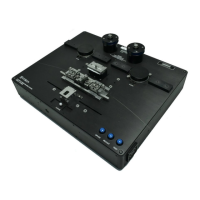
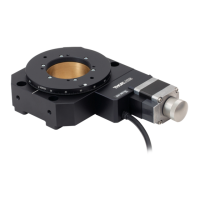
The Thorlabs PCS-5000 Series Motorized Patch-Clamp Micromanipulator is an ultra-stable, high-resolution positioning system designed primarily for patch clamp recording, though it can be used for other high-precision positioning applications. The system integrates over 20 years of experience in piezoelectric actuators, precision mechanics, and electronic control to maximize research productivity.
Function Description
The PCS-5000 Series micromanipulator facilitates precise positioning of a pipette tip within the field of view of a microscope. It consists of a micromanipulator assembly (PCS-520), an axis control unit (PCS-503), and a power supply (PCS-PS60). The PCS-520 micromanipulator assembly is mounted on or next to the microscope, with the headstage and pipette attached to it.
Coarse positioning is achieved using manual linear stages, providing 25 mm of travel with better than 5 µm resolution. Fine positioning is handled by integrated PZT (piezoelectric transducer) actuators, which offer travel ranges of 150 µm or 300 µm depending on the model. These PZT flexure stages amplify the motion of the piezoelectric ceramic element when a voltage is applied.
The PCS-503 Axis Control Unit (ACU) generates the 0 to 60 V drive signals that control the PZT actuators. It features three independent control knobs, each connected to a three-turn potentiometer, allowing precise control of the voltage and, consequently, the flexure stages' extension. The resolution of each potentiometer is 0.04% (one part in 2500), translating to 120 nm resolution for a 300 µm stage and 60 nm for a 150 µm stage.
The PCS-PS60 Power Supply provides a regulated, very low noise constant voltage to one or two PCS-503 ACUs, making it suitable for experiments requiring multiple manipulators on the same microscope.
Special rotational adjustments are incorporated into the PCS-520 to allow for optimal pipette working angles and easy pipette exchange. The base pivots around the vertical axis, enabling the entire micromanipulator to swing away from the microscope. The headstage pivots around the horizontal axis, allowing it to be raised for pipette exchange and then lowered to a precise, repeatable angle. This pivot also helps optimize the approach angle for various microscope types and minimize pipette capacitance in solution.
Important Technical Specifications
Environmental Specifications:
- Operating Conditions:
- Ambient Temperature: 5 to 40 °C
- Altitude: 2000 m maximum
- Atmospheric Pressure: 70 to 106 kPa
- Relative Humidity: 15 to 95% (non-condensing)
- Installation Category: II
- Pollution Degree: 2
- Transport and Storage Conditions:
- Temperature: -40 to 70 °C
- Relative Humidity: 10 to 100%
- Atmospheric Pressure: 50 to 106 kPa
Product Safety (IEC 61010-1:2001, EN 61010-1:2001, CAN/CSA C22.2 No. 61010-1-04, UL61010-1:2nd):
- Safety Requirement for Electrical Equipment for Measurement, Control and Laboratory Use Part I; General Requirements.
- IEC Equipment Class: I
- Installation Category: II
- Pollution Degree: 2
Electromagnetic Compatibility (EN 61326-1:2001/A1/A2):
- Electromagnetic Compatibility Immunity Testing - Measurement, Control and Laboratory Equipment.
- CE Marking:
- Council Directive 73/23/EEC (Low Voltage Directive)
- Council Directive 89/336/EEC (EMC Directive)
- FCC CLASS A Digital or Peripheral-Information to User: Complies with Part 15 of FCC Rules. Operation is subject to two conditions: (1) device may not cause harmful interference, and (2) device must accept any interference received, including undesired operation.
PCS-520 Micromanipulator Assembly:
- Number of Axes: 3 Linear Axes, 2 Rotational Axes
- Range of Motion for Linear Stages: 25 mm (Coarse Motion)
- PZT Motion Options: None, 150 µm, or 300 µm (Fine Motion)
- Fine Motion Actuator: PZT Stack with Flexure Amplifier
- Operating Voltage: 0 to 60 V
- Cable Length: 2.9 meters
- Types of Stages: Linear Crossed-Roller Bearings with Aluminum Construction
- Weight: 3.25 lbs
PCS-PS60 Power Supply:
- General:
- AC Power: 100-120/220-240 V, 0.3 A
- Line Frequency: 50/60 Hz
- Fuse: T0.3A 250 V (dual-line fusing, accepts 1/4" x 1/4" or 5 x 20 mm style fuses)
- Weight: 2.3 lbs
- Dimensions: 5.57" x 7.00" x 2.52" (144 mm x 178 mm x 64 mm)
- High Voltage Outputs:
- Output Voltage: 68 ± 0.5 V (No Load)
- Output Impedance: 2 Ω
- Noise and Ripple: < 0.8 mV RMS (1 Hz to 100 kHz), < 0.2 mV RMS (1 Hz to 1 kHz)
- Long-Term Stability: ± 0.1 V
- Front Panel:
- Axis Control Unit: 2 Female, 6-pin, mini-DIN Style Connectors
- Rear Panel:
- Power Module: On/Off Switch, Fuse(s), Voltage Selection
- Chassis Ground: Chassis Three-Way Grounding Post
PCS-503 Axis Control Unit:
- Number of Axes: 3 Axes
- Control Type: 3-Turn Potentiometer
- Output Voltage: 0 to 60 V
- Voltage Stability: Better than 0.1% (after 20 min initial warm-up period)
- Resolution: 0.04% (1 part in 2500)
- Cable Length: 2.9 m
- Weight: 1.5 lbs
Usage Features
- Configurable Operation: Standardized dimensions, mounting holes, and fasteners allow for easy configuration for right-side, left-side, or orthogonal operation.
- Pipette Exchange: Rotary pivot stages enable the entire micromanipulator assembly to swing away from the microscope, simplifying pipette removal and insertion. The headstage also pivots for easy access.
- Adjustable Approach Axis Angle: The approach axis can be set to any desired angle, with adjustable and repeatable stops on both the headstage pivot stage and base pivot stage.
- Cable Management: Adjustment knobs and cables for linear stages are numbered (1, 2, 3) to facilitate flexible configuration with the ACU's labeled connectors (A, B, C), allowing any knob to control any stage. Careful attention to cable routing is required to prevent interference with stage motion.
- Friction Adjustment: The friction of the PCS-503 Axis Control Unit knobs can be adjusted by loosening a lock screw, pressing the knob to the desired friction level, and re-tightening. The PCS-520 adjustment knobs also have a sleeve that can be rotated with a special spanner wrench to adjust friction and lateral stability.
- Microscope Mounting Options: Thorlabs offers a variety of optional PCS-500 Series microscope mounts designed for direct attachment to popular inverted microscopes (e.g., Leica, Nikon, Olympus, Zeiss). Universal post and platform mounts (PCS-500-PP11 with magnetic base, PCS-500-PP12 without magnetic base) are available for upright microscopes or when direct microscope mounts are not suitable. Gibraltar Platform Adapters are also available for specific Zeiss, Olympus, Nikon, and Leica microscopes, allowing the microscope objective to be moved in X, Y, and Z without disturbing the preparation or patch pipettes.
- Headstage Mounting: The adapter plate includes tapped holes for common headstages like AXON CV-5, CV 203B, and HEKA EPC-9.
- Double-Patching Experiments: The PCS-PS60 power supply can support two PCS-503 ACUs, enabling the operation of multiple manipulators on the same microscope.
Maintenance Features
- Troubleshooting Guide: The manual includes a comprehensive troubleshooting guide for common issues like excess pipette motion, no motion, and drift, helping users identify and resolve problems.
- Fuse Replacement: The PCS-PS60 power supply features a user-replaceable fuse holder with dual-line fusing. Instructions are provided for changing fuses and reconfiguring input voltage.
- Shipping Clips: Shipping clips are provided and must be reinstalled for storage or transportation to prevent damage to the PZT flexure assembly.
- PZT Actuator Poling: If PZT actuators have not been used for several months, they should be "poled" by setting the voltage for each actuator to 60 V for one minute to ensure optimum stability.
- Cleaning Instructions: The exterior of the axis control unit, manipulator, and power supply enclosure can be cleaned with a dry or slightly dampened cloth. Users are warned to unplug the supply cord before cleaning and not to remove the covers of the control unit or power supply due to hazardous voltages.
- Modular Design: The PCS-5000's modular design allows for greater flexibility and ease of service, though user repair of PZT actuators and cross roller bearing stages is not recommended.

 Need help?
 General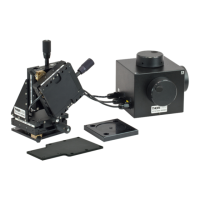

 To Next Page