PAGE 6 of 7
M300 SERIES
01A-02-D4
002 02/96
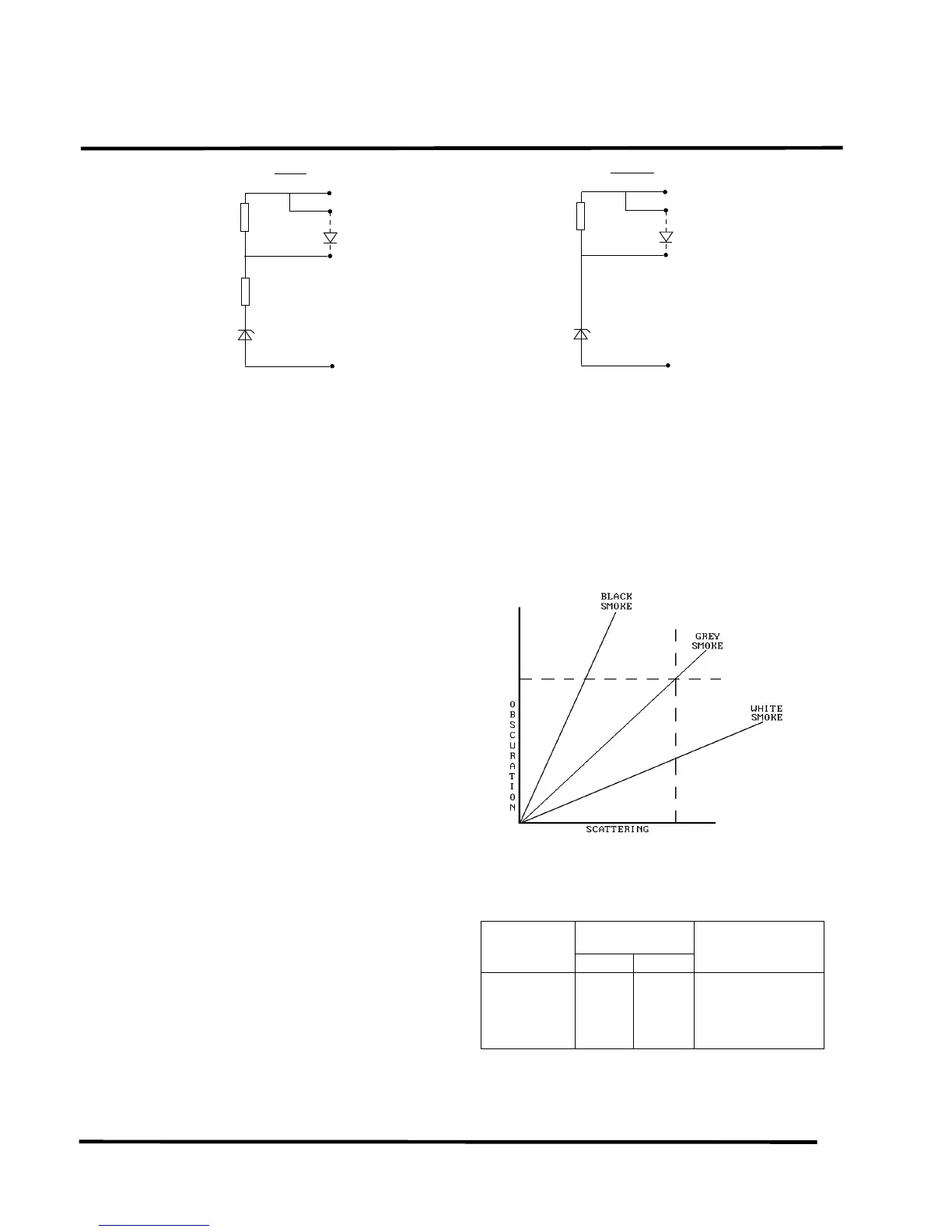
Fig. 6 Alarm Loads
REMOTE
LED
150R
270R
4.9 to 6.6V
MR301
+V
IN
+V
OUT
0V
REMOTE
LED
220R
5.9 to 8.2V
MR301Ex
+V
IN
+V
OUT
0V
The MR301 is suitable for the majority of applications and
the high and low sensitivity types should only be used for
very clean and very dirty [smoky] environments respective-
ly.
Fig. 7 Graph, Obscuration v Scattering
Table. 2 Detector Sensitivity
DETECTOR
TYPE
RESPONSE
THRESHOLD
IDENTIFICATION
COLOUR
dB/m %/m
MR301H 0.12 2.7 RED
MR301 0.15 3.4 WHITE
MR301Ex 0.15 3.4 WHITE
MF301l 0.27 6.0 BLUE
4.4 INTRINSIC SAFETY
The MR301Ex, detector is designed to comply with BS 5501
Pt 7 [EN 50 020] for intrinsically safe apparatus. It is de-
signed to be certified:
E Ex ia IIC T5
and to be used in conjunction with a shunt diode safety bar-
rier in a certified intrinsically-safe system.
Electrical and performance details are generally the same as
for the MR301 detector. The following additional informa-
tion is applicable to the MR301Ex detector:
Maximum Voltage [for safety]: 28V
Maximum Power Input: 0.58W
Equivalent Inductance: 0
Equivalent Capacitance: 1.5nF
4.5 PERFORMANCE CHARACTERISTICS
The fundamental parameter used to define the sensitivity of
an optical smoke detector is the level of smoke which will
just produce an alarm under ‘ideal’ conditions. This param-
eter, known as the response threshold value, is normally
measured in a smoke tunnel and is defined in terms of the ob-
scuration produced by the smoke over a one metre path. The
response threshold value is normally designated “m” and is
given in dB/metre, [or % per metre].
Interpretation of response threshold value is somewhat com-
plicated by the fact that the measurement is given in terms of
obscuration, whereas the detector works by scattering from
the smoke particles. The response threshold [m] value will
therefore depend on the colour of the smoke. Black smoke
give less scattering than light smokes for given values of ob-
scuration as shown in Fig. 7.
Sensitivities are invariably specified for ‘grey’ smokes as
produced by typical smouldering fires. Values for the
MR300 range are given in Table 2.


 To Next Page
 Loading...