Need help?
Do you have a question about the Thuraya SF2500 and is the answer not in the manual?
Declares product conformity with standards and directives.
Warns about health hazards from antenna radiation and separation distance.
Covers service access restrictions and grounding/cable guidelines.
Details power supply requirements and environmental operating conditions.
Explains the process and necessity of obtaining licenses for operation.
Covers copyright ownership and registered trademarks.
Lists various use cases for the SF2500 terminal.
Details the functionalities and specifications of the base terminal.
Lists cable types, loss, operating temperatures, and humidity.
Details general specifications and compliance approvals.
Outlines GPS capabilities and physical dimensions/weight.
Lists the components included in the SF2500 system package.
Shows images and descriptions of RF and power cables.
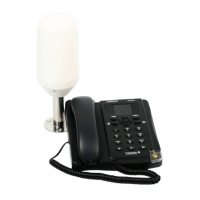
Visual identification of the SF2500 Base Terminal and its ports.
Details the Alert Button, SIM card slot, and Mini USB port functions.
Explains serial port, power switch, DC input, I/O port, and grounding stud.
Describes SAT/GPS ports, grounding, antenna unit, and RF cable specifications.
Step-by-step guide for mounting and connecting the antenna unit.
Details using U-bolts and cable ties for antenna mounting and connection.
Instructions for selecting a location and mounting the base terminal.
Illustrates wall mounting screws and securing the terminal with a locking screw.
Step-by-step guide for inserting the SIM card into the terminal.
Instructions for connecting RF cables and the DC power source.
Steps to turn on the SF2500 terminal.
Guide to making the initial voice call, including handset locking.
Instructions for composing and sending an SMS message.
Provides tips for typing text, inserting symbols, and clearing input.
Identifies and labels the main keys and buttons on the SF2500 terminal.
Explains the functions of navigation, selection, keypad, home, clear, and alert keys.
Details the functions of the Star (*) and Hash (#) keys for numbers and text.
Explains the elements of the home screen, including indicator lines and selection keys.
Defines the meaning of various status icons displayed on the home screen.
Covers making, ending, and receiving voice calls, including handset operation.
Explains how to adjust call volume using navigation keys or the volume switch.
Describes how to access and navigate the main menu options.
Details how to add, save, and format contacts.
Covers editing, searching, deleting, and assigning speed dial for contacts.
Explains how to view missed, received, and dialled calls and manage log entries.
Instructions for clearing specific call log categories or all entries.
Details how to configure speed dial entries, assign contacts, and make calls using speed dial.
Guide to composing and sending SMS messages, including options and text tips.
Explains how to open, reply, delete, forward, save, and add contacts from the inbox.
Covers options for sent and draft SMS messages like open, delete, send, save, and add to contact.
Details message centre, saving sent messages, reloading, memory status, and deleting messages.
Covers setting the local time zone and configuring GPS reporting parameters.
Details GPS unit ID, timing/distance intervals, authorized numbers, and alarm configuration.
Explains Geo-fencing setup (type, trigger, status, radius, coordinates) and external buzzer control.
Summarizes points required for circle and rectangle fencing types.
Shows how to check signal strength (RSSI) and GPS status.
Covers enabling, disabling, and changing the SIM card PIN.
Details enabling/disabling authentication and changing the tracking password.
Explains display settings like wallpaper, backlight, and language configuration.
Covers tone settings, factory reset, terminal restart, and device information.
Advises against user servicing and warns about using unauthorized antennas/cables.
Lists general warnings, care instructions, and common problems like signal or cable issues.
Answers questions about protecting settings and the distress alert functionality.
Addresses multiple distress button presses and how to find the GPS tracking ID.
 General
| Satellite Network | Thuraya |
|---|---|
| Frequency | L-Band |
| GPS | Yes |
| Voice Communication | Yes |
| SMS | Yes |
| Data Communication | Yes |
| Battery Life (Talk Time) | Up to 6 hours |
| Battery Life (Standby) | Up to 80 hours |
| Waterproof Rating | IP54 |
| Weight | 300 g |
| Operating Temperature | -20°C to +55°C |
| Storage Temperature | -40°C to +80°C |

 To Next Page