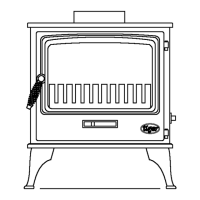
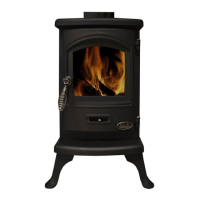
The Cub is a freestanding solid multi-fuel heating stove.
INSTALLING a stove is a 'controlled service', the law expects
that it is either supervised by a qualified installer or that the
building inspector is informed. Check with your local authority.
ASBESTOS: Your stove does not contain asbestos, but take care
to avoid disturbing asbestos in an old installation.
WEIGHT: Your stove is heavy (60kg) take great care when
moving it and ensure that the intended fireplace can support the
weight- consider fitting a load distributing plate.
YOUR CHIMNEY, by becoming warm, makes the gas inside it
rise, pulling fresh air into the stove to make it work. It must:
•Generate a draught in use of at least 12Pa (0.05ins wg)
•Be capable of withstanding the temperatures generated.
•Be absolutely incapable of leaking fumes into the dwelling
This may commonly be achieved by it:
•Being at least 5m high. Terminating at least 1m above any roof
ridge.
•Being free from even the slightest crack or source of leakage.
•Having no bends sharper than 45º.
•Being swept and entirely free of obstructions
•Being connected only to this one appliance.
•Being of thick masonry or otherwise highly insulated.
•Conforming to local building regulations.
•Having an internal cross-section preferably never less than
125mm diameter, or more than 0.14m² (eg 375 x 375mm).
Exceptionally, where 125mm flue is impractical, a 100mm
internal diameter flue may be used, which must be short,
straight, accessible at both ends for cleaning and completely
insulated. An adaptor to connect to 100mm flue is available.
Special rules apply where the flue passes through timber, thatch
or other vulnerable materials- take specialist advice.
Although it is possible to access the chimney through the stove,
fit hatches to provide access if needed.
INSTALLATION
Typical installation (above) in masonry fireplace, shows a short
plain flue length (up to 50cm) completely and absolutely sealed
into oversize chimney with a 125mm diameter connecting flue
pipe.
There should be a hearth of incombustible material underneath
the stove, extending at least 250mm in front and 125mm at each
side. Where these hearth dimensions are difficult to achieve, a
ready-made protective hearth is available.
Where the stove is to be fitted
in a shed or other building, or
inland marine craft, for
occasional use a short 125mm
or 100mm internal diameter
flue may be used, with the
proviso that the flue is:
•Substantially straight
•Insulated - to keep the
gases hot so that they rise
•At least 2m high
•Accessible from both ends
for cleaning
•Protected against rain by a
cap
•Free from risk of 'plume
grounding' where annoying
smoke is blown down into
neighbouring properties
Special care is needed to
protect vulnerable materials,
such as wood or plastic,
buildings, or craft against fire.
There must be the correct fire
protection air-gap around flue
parts (see flue supplier's
instructions) where flue - even
insulated flue - passes through combustible materials such as a
wooden roof.
For marine installations - follow the detailed instructions on
a separate leaflet at www.soliftec.com/installation.htm
SAFE CLEARANCES
This stove can get VERY hot -
hot enough to set fire to
combustibles such as carpet,
textiles, wood, glass-fibre (GRP),
paper, wallpaper, plastics,
furniture, clothing, cardboard,
plasterboard some distance
away. Under normal
circumstance, with good
ventilation the stove should be
fitted at least 500mm away from
combustible materials (700mm in
front), on a non-combustible
hearth (temperature below is
<100°C so a light-duty hearth
can be used)
If the optional heat shield is
fitted, the safe distance to
combustibles can be reduced to
150mm from the shield at the
rear
Clearance around at the back
and sides can be reduced to just
100mm where any combustible
materials are protected by either
(1) 150mm of solid masonry, or
(2) a protection panel of 45mm
calcium silicate foam board
with a 10mm air gap behind
AIR SUPPLY
Your stove needs air to breathe - there should be a permanent
fresh air supply into the space in which it is installed equal to
about 550mm² for each kW of nominal output.
This degree of air can often be provided by leakage around door
2
AND CAN PRODUCE POISONOUS GASES.
Take care to protect children or the infirm. The installer is
international standards.


 To Next Page
 Loading...