The Titus Alpha Dual-Duct VAV Controller, available in models BAC-8007 and BAC-8207, is a direct digital controller designed for Variable Air Volume (VAV) terminal units. These controllers are native BACnet MS/TP compliant devices, making them suitable for integration into complete facilities management systems. They offer precise monitoring and control of connected points and are preconfigured with standard VAV control sequences to provide pressure-independent control of dual-duct VAV units for heating and cooling.
Function Description:
The primary function of the Alpha Dual-Duct VAV Controller is to manage VAV terminal units in dual-duct HVAC systems. It integrates an actuator and comes with pre-programmed sequences for temperature setback, overrides, reheat, and other HVAC operations. The controller supports both stand-alone environments and networked BACnet devices.
Key application programs supplied with the BAC-8x07 include:
- Dual-duct VAV heating and cooling: Manages the airflow and temperature for both heating and cooling in a dual-duct system.
- CO2 monitoring: Controls indoor air quality by monitoring CO2 levels.
- Local lighting control: Integrates with motion sensors for automatic lighting control in the space.
- Fan control: Manages the operation and speed of VAV unit fans.
- Balancing: Includes an airflow balancing program for optimal system performance.
- UL 864 smoke control: The BAC-8207 model specifically supports UL 864 smoke control applications.
The controller features an on-board airflow sensor, which can be used with a single or multi-point differential pressure measuring station or pitot tube. This sensor provides internal measurement of primary duct pressure and is configured as a BACnet analog input object. It utilizes CMOS differential pressure measurement (0-2 inches of water or 0-500 Pa), is internally linearized and temperature compensated, and offers a span accuracy of 4.5% of reading. Barbed connections are provided for 1/4 FR tubing.
Important Technical Specifications:
- Active inputs: 2
- Passive inputs: 4
- Airflow sensor: 1 (internal)
- Actuator position: 1 (internal)
- Key features: All inputs configured as analog, standard units of measure, overvoltage input protection.
- Connector: Spade connectors, 0.25 inch.
- Conversion: 12-bit analog-to-digital.
- Input range: 0-12 volts DC.
- Specific Inputs:
- AI1 (Discharge Air Temperature): Terminal block, 10kΩ pull-up. Connects to 10k Type 3 thermistor probes (e.g., STE-1405).
- AI2 (Space Sensor): RJ-45, 10kΩ pull-up. Configured for STE-6010, STE-6014, STE-6017 sensors.
- AI3 (Space Setpoint): RJ-45, 10kΩ pull-up. Configured for setpoint dials on STE-6014 or STE-6017 sensors.
- AI4 (Primary Duct Pressure): Internal airflow sensor, N/A pull-up.
- AI5 (Secondary Duct Pressure): Terminal block, no pull-up. Connects to P Out terminal of TSP-8000 series actuator.
- AI6 (Secondary Damper Position): Terminal block, 10kΩ pull-up. Connects to position potentiometer of TSP-8000 series actuator.
- AI7 (CO2): Terminal block, no pull-up. Connects to CO2 sensor with active voltage output (e.g., STE-1001).
- AI8 (Primary Damper Position): Internal damper position, N/A pull-up.
Analog Outputs:
- Number: 2
- Key features: Output short protection, configured as BACnet analog objects, standard units of measure.
- Connector: Spade connectors, 0.25 inch.
- Conversion: 12-bit analog-to-digital.
- Output voltage: 0-10 volts DC.
- Output current: 30 mA per output, 30 mA total for all analog outputs.
- Specific Outputs:
- AO3 (Analog Heat): 0-10 VDC. Controls modulating analog reheat.
- AO4 (Fan Speed): 0-10 VDC. Controls variable speed fan.
Binary Outputs:
- Number: 4 triacs for external equipment, 2 for internal actuator.
- Key features: Optically isolated triac output.
- Conversion: 12-bit analog-to-digital.
- Connector: Spade connectors, 0.25 inch.
- Output range: Maximum switching 24 VAC at 3 amperes.
- Specific Outputs:
- BO1 (Damper Clockwise): Internal.
- BO2 (Damper Counter Clockwise): Internal.
- BO5 (Fan Start/Stop): Triac. Switches up to 1 ampere at 24 VAC.
- BO6 (Secondary Damper Clockwise): Triac. Controls TSP-8000 series actuator.
- BO7 (Secondary Damper Counterclockwise): Triac. Controls TSP-8000 series actuator.
- BO8 (Lighting): Triac. Switches up to 1 ampere at 24 VAC.
Actuator Specifications:
- Torque: 40 in-lb (4.5 Nm).
- Angular rotation: 0 to 95°.
- Adjustable end stops: At 45° and 60° rotation.
- Motor timing (BAC-8007): 90 sec./90° at 60 Hz, 108 sec./90° at 50 Hz.
- Motor timing (BAC-8207): 60 sec./90° at 60 Hz, 72 sec./90° at 50 Hz.
- Shaft size: Directly mounts on 3/8 to 5/8 inch (9.5 to 16 mm) round or 3/8 to 7/16 inch (9.5 to 11 mm) square damper shafts.
Communications:
- BACnet MS/TP: EIA-485 operating at rates up to 76.8 kilobaud.
- Terminal block: Removable screw terminal block.
- Wire size: 12-24 AWG.
- Sensor jack: RJ-45, compatible with STE-8000 and STE-6000 models.
Supported Objects:
- Control Basic: 5 program areas in BAC-8007, 6 program areas in BAC-8207.
- PID loop objects: 8.
- Value objects: 60 analog, 32 binary, and 12 multistate.
Memory:
- Programs and parameters stored in nonvolatile memory.
- Auto restart on power failure.
Installation:
- Supply voltage: 24 VAC, -15%, +20%, 5 VA.
- Weight: 13.2 ounces (376 grams).
- Case material: Flame retardant plastic.
Environmental Limits:
- Operating: 32 to 120° F (0 to 49° C).
- Shipping: -40 to 140° F (-40 to 60° C).
- Humidity: 5-95% relative humidity (non-condensing).
Regulatory:
- UL 916 Energy Management Equipment.
- FCC Class B, Part 15, Subpart B.
- BACnet Testing Laboratory listed as an application specific controller (ASC).
- UL 864 smoke controls (BAC-8207 only).
Usage Features:
- Preconfigured for Dual-Duct Operation: The BAC-8007 and BAC-8207 are factory-configured for dual-duct VAV operation, simplifying setup.
- Adjustable Rotation Limits: Users can set the actuator's rotation limits to either 45 or 60 degrees using a supplied stop screw, ensuring compatibility with various VAV damper specifications.
- Direct Damper Mounting: The controller is designed for direct mounting onto damper shafts, accommodating common round and square shaft sizes.
- Sensor Compatibility: Supports a range of Titus sensors (STE-8001, STE-8201, STE-6010, STE-6014, STE-6017) via an RJ-45 jack. The controller automatically detects the connected sensor type, eliminating the need for manual configuration.
- Network Integration: Connects to BACnet MS/TP networks, allowing for centralized control and monitoring. Guidelines for network wiring, including cable specifications, device limits, and termination, are provided to ensure reliable communication.
- Temperature Setpoint Control: Allows for setting occupied and unoccupied cooling/heating setpoints, minimum/maximum setpoints, and standby differentials. These can be adjusted via an attached sensor or manually.
- Airflow Setpoint Control: Configurable minimum and maximum airflow limits for cooling, heating, and ventilation modes, as well as fan speed limits, to optimize VAV unit operation and indoor air quality.
- VAV Terminal Unit Parameters: Offers settings for reheat type (modulating), dual-duct mixing minimum airflow, and damper direction to close (CCW or CW).
- Fan Operation Configuration: Supports different fan types (None, Series, Parallel) within the VAV terminal unit, with specific operational logic for each.
- Local Lighting Control: Can be integrated with an STE-8201 motion sensor to automatically control local lighting, with a configurable "light off delay."
Maintenance Features:
- Nonvolatile Memory: Programs and parameters are stored in nonvolatile memory, preventing data loss during power outages.
- Auto Restart: The controller automatically restarts upon power failure, ensuring continuous operation.
- Status LEDs: Provides visual indicators (COMM, READY, SENSOR, T-STAT/SENSOR) for quick status checks and troubleshooting.
- Removable Terminal Blocks: The use of removable screw terminal blocks for communications and other connections simplifies wiring and maintenance.
- Clear Wiring Diagrams: The manual includes detailed wiring diagrams for inputs, outputs, power, MS/TP network, and dual-duct connections, aiding in correct installation and troubleshooting.
- Airflow Balancing Program: An included program assists in balancing airflow, which is crucial for optimal system performance and energy efficiency.
- Safety Guidelines: The manual emphasizes safety considerations with DANGER, WARNING, and CAUTION labels, guiding users to avoid hazards during installation and operation.

 Need help?
 General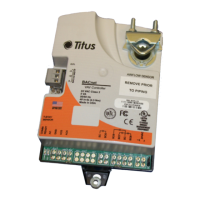

 To Next Page