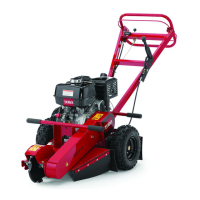
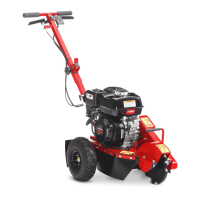
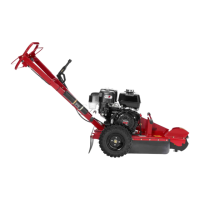
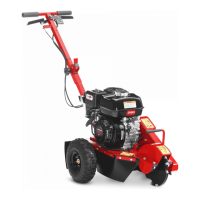
This document describes the SGR-13 Stump Grinder, a machine designed for grinding and removing tree stumps and surface roots. It is not intended for cutting rock or any material other than wood and the surrounding soil. The manual emphasizes safe operation, proper maintenance, and storage procedures to ensure user safety and product longevity.
Function Description
The SGR-13 Stump Grinder is a specialized piece of equipment used to eliminate tree stumps by grinding them down. Its primary function is to reduce stumps and surface roots into small chips, effectively removing them from the ground. The machine features a cutting wheel equipped with teeth that rotate at high speed to perform the grinding action. The operator controls the movement and depth of the cutting wheel to systematically remove the stump. The machine is designed for outdoor use and requires careful handling due to its powerful grinding capabilities.
Usage Features
The SGR-13 Stump Grinder incorporates several features to facilitate its operation and ensure user safety.
- Controls: The machine is equipped with a throttle lever to control engine speed. In the DISENGAGE position, the engine idles, serving as the starting position. Moving the throttle to the ENGAGED position increases engine speed, engaging the centrifugal clutch, and causing the cutting wheel to rotate. A safety bail, when held against the handle, allows the engine to run; releasing it shuts off the engine. A choke lever assists in starting a cold engine, moving from CLOSED to OPEN once the engine is running. A recoil-start handle is used to manually start the engine. A fuel valve, located under the choke lever, must be in the ON position for operation.
- Parking Brake: The parking brake is a crucial safety and operational feature. It holds the left wheel, securing the machine in place and allowing for easy side-to-side movement when grinding a stump. This feature is essential for precise control during the grinding process.
- Hour Meter: An hour meter displays the total operating hours of the machine, which is useful for tracking maintenance intervals.
- Pre-Operation Checks: Before starting, operators must ensure the work area is clear of people, debris, and especially buried utility lines, which should be marked. Fuel and oil levels must be checked, and all guards and safety switches verified to be in proper working order. The ground around the stump should be cleared of stones and foreign objects that could interfere with the cutting wheel.
- Grinding Process: To begin grinding, the throttle is set to DISENGAGE, the engine is started and warmed up for 2 minutes. The handle is pushed down to raise the cutting wheel off the ground. The machine is then moved to the front of the stump, and the parking brake is engaged. The throttle is moved to ENGAGE to start the cutting wheel. The operator swings the cutting wheel from side to side, lowering it approximately 1 to 2.5 cm (1/2 to 1 inch) into the stump with each sweep. This sweeping motion is continued until the front portion of the stump is ground to ground level. The cutting wheel is then raised, the parking brake released, and the machine moved forward a few centimeters before re-engaging the brake and repeating the grinding process until the stump is completely removed.
- Shutting Off the Engine: To shut off the engine, the throttle is moved to DISENGAGE. If the engine has been working hard, it should be allowed to run for a minute before releasing the safety bail to cool down. Releasing the safety bail immediately shuts off the engine. The fuel valve is then moved to the CLOSED position.
- Lifting the Machine: The manual specifies designated lift handles for safely lifting the grinder.
Maintenance Features
Regular maintenance is critical for the performance, safety, and longevity of the SGR-13 Stump Grinder. The manual provides a detailed maintenance schedule and procedures.
- Daily/Before Each Use:
- Greasing: The machine requires general-purpose grease. Two fittings on each cutting-wheel bearing need lubrication until grease oozes out, ensuring slow and careful pumping to prevent bearing seal damage.
- Air Filter Check: The air filter should be checked for cleanliness.
- Engine Oil Level: The engine oil level must be checked.
- Engine Screen: The engine screen needs to be cleaned to ensure adequate cooling.
- Drive-Belt Tension: The drive-belt tension should be checked and adjusted if necessary.
- Teeth Condition: The cutting wheel teeth must be inspected for wear or damage. Worn teeth should be rotated or replaced, and their nuts torqued to 68 N·m (50 ft-lb).
- Debris Removal: Debris should be removed from the machine.
- Every 50 Hours:
- Air Filter Service: The air filter should be serviced.
- Every 100 Hours:
- Engine Oil Change: The engine oil should be changed.
- Spark Plug Check: The spark plug should be checked.
- Sediment Cup Cleaning: The sediment cup, located under the fuel valve, needs to be cleaned to remove dirt from the fuel.
- Drive Belt Replacement: The drive belt should be replaced.
- Every 300 Hours:
- Spark Plug Replacement: The spark plug should be replaced.
- Every 600 Hours/Every 2 Years:
- Air Filter Replacement: The air filter should be replaced.
- Yearly or Before Storage:
- Engine Oil Change: The engine oil should be changed.
- Sediment Cup Cleaning: The sediment cup should be cleaned.
- Engine Oil Specifications: The manual specifies detergent oil with an API service of SJ or higher, with a crankcase capacity of 1.1 L (1.2 US qt). Viscosity recommendations are provided based on ambient temperature.
- Air Cleaner Service: The cyclone housing, air channels, and air-intake screen should be cleaned when a layer of dirt is visible. The foam and paper elements of the air cleaner also require servicing, including washing the foam element with mild detergent and oiling it, and tapping the paper element to remove dust or replacing it if damaged.
- Fuel System Maintenance: The sediment cup should be regularly cleaned to remove dirt from the fuel.
- Brake Maintenance: The parking brake can be adjusted by loosening a set screw, turning a knob to tighten or loosen the brake, and then re-tightening the set screw.
- Belt Maintenance: The drive-belt tension can be adjusted by loosening bolts, sliding the engine, and then tightening the tension bolt and jam nut until the belt has a specified flex under force. The drive belt should be replaced if it shows signs of wear, cracks, or damage.
- Grinder Maintenance (Teeth): The cutting wheel teeth are indexed with 3 positions, allowing them to be rotated twice to expose new sharp edges before replacement. To rotate a tooth, the nut securing it is loosened, the tooth pushed forward, and rotated 1/3 of a turn. To replace a tooth, the nut is removed, a new tooth, washer, and nut are installed, and torqued to 68 N·m (50 ft-lb).
- Cleaning: Regular cleaning and washing of the machine after use, especially before dirt hardens, extends its lifespan. Care should be taken to prevent water from entering the fuel tank and to avoid damaging decals or the engine when using high-pressure sprayers. Cutting wheel bearings must be lubricated after cleaning.
- Storage: For storage over 30 days, the machine should be cleaned thoroughly, especially the engine cylinder head fins and blower housing. A petroleum-based fuel stabilizer/conditioner should be added to the fuel, and the engine run for 5 minutes to distribute it. The fuel tank should then be drained, and the engine run until it shuts off. The sediment cup and air cleaner should be cleaned, engine oil changed, and the spark plug checked or replaced. Two tablespoons of engine oil should be poured into the spark plug hole, and the starter pulled slowly to distribute the oil. The spark plug is then reinstalled without the wire. Cutter wheel bearings should be greased, and all bolts, nuts, and screws checked and tightened. Scratched or bare metal surfaces should be painted. The machine should be stored in a clean, dry area and covered.



 To Next Page
 General