Getting Started
1
6
The T-1 Notebook : Reference & Guide
7
The T-1 Notebook : Reference & Guide
Getting Started
1
1.1 Introduction
Torso T-1 is an algorithmic sequencer. It does not generate audio but is
used as a controller for other sound generating instruments such as
hardware or plugin synthesizers.
What makes T-1 Different?
Your Notes Can be written here Here
NOTES
Traditional / Typical Sequencers. Torso T-1 Algorithmic Sequencer
Linear programming process. Algorithmic sequence generation.
Program and play Organic ow and continuous evolution.
Rigid programming workow. Organic user experience.
Preset variations Real-time and live performance
adjustments. Play like an instrument.
Step based approach. Euclidean and algorithmic rhythms and
arpeggiation.
MIDI DIN or USB Interface most
commonly used
MIDI through USB. MIDI DIN. WiFi and
Ableton Link, CV and Gate.
USB or Mains Powered USB Powered - Low power usage, ideal
with portable rechargeable battery packs.
Often display screen menu or
application reliant conguration
No screen. Control congurable plus
conguration app option.
Focus on sequencing Multiple sequencing options plus on
board modulation
No sound generation No sound generation
Dened track count 16 polyphonic tracks, maximum of 256
patterns and bank storage.
NOTES
1.2 How to Use This Notebook
This book combines a formal reference and notebook, collectively bringing
together a comprehensive guide to the T-1 Sequencer.
Sections are laid out to cover the full workow with walkthroughs, step by
step guides and tips. Some pages carry a wide margin and some are
intentionally blank enabling you to make your own notes.
Conventions used in this book.
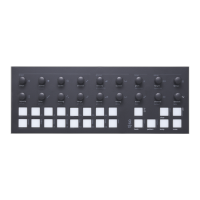
(KNOB)
Rounded parentheses represent the 16 endless rotary control
knobs. Where necessary, the command action will be presented
before the control and the actual function named in uppercase
inside the parenthesis.
Examples:
‘Press (STEPS)’ or ‘Turn (STEPS)’, ‘Turn (SUSTAIN)’.
[BANK]
Square parentheses contain functions that are selectable using
one of the 16 value buttons, the 2 performance buttons or one of
the 5 general control buttons. The command action is presented in
normal, partially capitalised text before the control function which
is labelled uppercase within the parenthesis.
Examples:
‘Press [MUTE]’, ‘Press [CTRL]’, ‘Press [VB1]’ for rst value button.
[CTRL] + (KNOB)
Button combinations are indicated with a ‘+’ between commands
when used together. The ‘ctrl’ button is commonly used as
secondary control function which allows access to additional
options. This button is held in conjunction with other buttons and
knobs. Secondary functions are labelled in grey, second row of
knobs and horizontally to the side of the buttons. The primary or
secondary function label name will be used in the descriptions
depending on the instruction context.
Examples:
‘Hold [CTRL] + Turn (OFFSET)’, ‘Hold [CTRL] + Press [SAVE]’
ORANGE ⬛
The value buttons are multi-coloured and act as a visual indicator
of the selected function. This is documented within these
instructions by the colour name in uppercase followed by an
appropriately coloured tag.
Value Buttons 1-16
[VBx]
The 16 Value buttons are located bottom left and are numbered 1-
8, left to right - top row, 9-16, left to right - bottom row. These by
default select tracks, but their function will change depending on
the mode selected. The function will be given after the button.
Example:
Press [VB1] Chrom - With respect to scales


 To Next Page
 Loading...