
 Need help?
Do you have a question about the Torso Electronics T-1 and is the answer not in the manual?
Explains T-1 as an algorithmic sequencer, not an instrument.
Explains the book's structure and conventions.
Details how to power on the T-1 sequencer using USB-C.
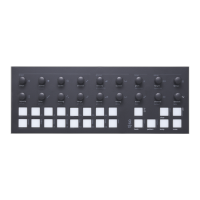
Provides a diagram and dimensions of the T-1 hardware.
Guides users through initial setup and workflow.
Step-by-step guide for creating a basic drum beat.
Defines terms used in the manual for T-1.
Explains the structural layout and data flow of the T-1.
Describes how parameters interact for complex sequences.
Details the T-1's knobs, buttons, and their functions.
Explains how banks organize patterns and their representation.
Instructions for saving a bank.
Instructions for loading a saved bank.
How to select a pattern within a bank.
Explains tempo settings and how to view/change them.
How to clear and copy banks, tracks, and patterns.
A table of T-1 sequencer commands and functions.
Explains the meaning of button colours for visual feedback.
Explains the relationship between patterns and tracks.
Describes the step and pulse sequencer views.
Explains the concept of Euclidean sequencing.
How to select and play patterns.
How to select tracks and their modes.
How to select multiple tracks for editing.
How to switch between track and pulse views.
Explains basic Euclidean parameters: Steps, Pulses, Rotate.
How to rotate the start point of Euclidean patterns.
How to adjust pattern length beyond 16 steps.
Detailed steps for extending step count.
How to manually edit patterns step-by-step.
Manual pulse editing per step.
Manual parameter editing per step.
How to set track time signatures using division.
Adjusting track length and creating loops.
Setting quantization for patterns.
How to mute and unmute tracks for performance.
Adding retrigger steps to reset functions.
How to clear patterns and tracks.
How to copy and paste patterns and tracks.
Copying parameters between tracks.
How to save patterns and tracks with banks.
Explains groove, velocity, timing, and delay parameters.
How note length is controlled by Sustain and Division.
Detailed steps for adjusting note length with Sustain.
How to adjust the base velocity of notes.
How accents control velocity variation.
Applying groove templates to velocity profiles.
Illustrates different wave shape groove profiles.
Shows the 8 preset groove profiles.
Explains Timing and Delay for rhythmic feel.
Adjusting timing shifts for specific notes.
Steps for applying micro-timing to a track.
How to adjust note delay for timing shifts.
Steps for applying note probability.
Explains the probability parameter for silencing notes.
Introduction to the note repeater function.
Setting the number of repeats and behaviour.
Setting the time division for note repeats.
Controls repeat behaviour when new triggers occur.
Controls velocity ramps for repeats.
Controls acceleration/deceleration of repeats.
How to stop note repeats.
Explains arpeggiation as a melodic pattern model.
Introduces Tonal parameters: Pitch, Harmony, Scale, Root.
How to create chords and groups using Pitch and Harmony.
Steps for adding/removing notes to chords.
How to transpose notes up or down an octave.
How the Harmony algorithm creates chord variations.
Steps to create chord variations using Harmony.
How to select scales and set the root note.
How to create and apply a user-defined scale.
How to select the root note for scales.
Setting melodic structures with scale, root, and pitch.
Explains Voicing and Style for melodic behaviour.
How Style creates inversions of pitch chords.
Adjusting transformation amount and note playback direction.
How Range and Phrase create melodic passages.
Using Phrase templates to generate melodic passages.
Explains cadences as rhythmic/pitch sequences.
How LFOs are used for repetitive modulation.
Controls note variation amount and phrase playback rate.
Steps to adjust note range and phrase rate.
How to change the phrase playback rate.
Using Mute and Temp buttons for live variations.
Explains the Cycles function for parameter automation.
How to edit cycles and their parameter values.
How to change the number of active cycles.
How to clear cycles and parameter automation.
How to copy and paste cycles between slots.
Notes on editing cycles and their behaviour.
Explains the Random function for variations.
Lists parameters that can be randomised.
Steps to apply randomisation to parameters.
Adjusting the probability of random events.
Describes parameter randomisation behaviour.
Defines key MIDI terminology.
Details physical MIDI connections for T-1.
How to set MIDI channels per track.
Explains T-1 Config for MIDI I/O settings.
Overview of MIDI CC tracks and their colours.
Steps to select CC mode for a track.
Applications of MIDI CC mode.
Manual control of CC parameters via knobs.
Steps to manually control CC from T-1.
How to change default CC assignments.
Steps to change CC knob assignments.
Using CC tracks to store presets.
Steps to create and store CC preset tracks.
How to clear CC preset values.
Applying random sequences to CC values.
Using FX tracks for MIDI effect processing.
Steps to create an FX track.
Using FX tracks as a MIDI keyboard controller.
Steps to use FX tracks as a MIDI keyboard.
How to route MIDI data between tracks.
Steps for routing tracks to output/input channels.
How Program Change messages work.
Connecting T-1 via WiFi and Hotspot setup.
Using Ableton Link for device synchronization.
Example of connecting T-1 to a DAW.
Example of connecting T-1 to a synth.
Using PC messages to change synth presets.
Connecting T-1 to iPad apps via AUM.
Connecting external MIDI controllers to T-1.
Basic concepts of analog signals: Trigger, Gate, CV, Clock.
Details the physical analog connections on T-1.
How to configure CV/Gate outputs.
Using CV input for modulation.
Analog clock sync options.
Understanding and compensating for latency.
Using T-1 as a primary analog clock source.
Using T-1 as a secondary analog clock follower.
Controlling a synth voice with T-1 CV/Gate.
Modulating effects parameters with T-1 CV.
How to connect and access T-1 Config.
Guide to updating T-1 firmware.
Steps for manual firmware updates.
Customizing UI elements like brightness and button behaviour.
Configuring MIDI choke behaviour on pattern change/stop.
Overview of the T-1 Config tool's menu and pages.
Reference for T-1 Config pages and functions.
Settings for WiFi connection and hotspot.
Settings for device synchronization (Link, Clock).
Settings for MIDI input/output connections.
Settings for CV/Gate output configurations.
Miscellaneous configuration options.
 General
| Brand | Torso Electronics |
|---|---|
| Model | T-1 |
| Category | Recording Equipment |
| Language | English |

 To Next Page

