Need help?
Do you have a question about the Toshiba GR-T39MBZ and is the answer not in the manual?
Explains the meaning of WARNING and CAUTION symbols for user safety.
Alerts users to the presence of flammable refrigerant (R600a) and related risks.
Details actions that must not be performed to prevent fire, shock, or injury.
Advises on correct electrical connections, grounding, and avoiding water near the appliance.
Warns against damaging the refrigerant circuit and outlines actions in case of leakage.
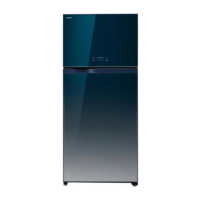
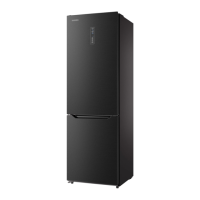
This document is an Owner's Manual for a Toshiba Refrigerator Freezer, designed for home use. It provides comprehensive instructions for safe and effective operation, maintenance, and troubleshooting of the appliance.
The Toshiba Refrigerator Freezer is designed to store food items at controlled temperatures, offering both refrigeration and freezing capabilities. It utilizes a refrigerant (R600a: iso-butane) for its cooling cycle. The appliance features a temperature control dial, typically set to "MID" for normal operation, allowing users to adjust the cooling intensity for both the freezer and refrigerator compartments. For instance, if the refrigerator seems too cold, especially in winter, the dial can be set to "MIN" to prevent food from freezing, particularly high-moisture items like tofu and vegetables. Conversely, if more cooling is needed, the dial can be turned towards "MAX." The refrigerator also includes a self-defrosting feature, which automatically removes frost from the evaporator, eliminating the need for manual defrosting. A Hybrid Bio Deodorizer Unit is integrated into the cool air circulation system to eliminate bacteria, deodorize, and keep vegetables and fruits fresh without requiring maintenance throughout its lifespan. The appliance is equipped with LED lighting for internal illumination.
The manual emphasizes several key usage features to ensure safety and optimal performance. When first opening the refrigerator, a plastic smell may be present, which is normal. For installation, the refrigerator should be placed on a strong, level floor, with adjust legs used to stabilize it horizontally. Adequate space around the refrigerator is crucial for proper air circulation: at least 10 cm (4 inches) at the top and rear, and 4 cm (1.6 inches) on the left and right sides. It should be used in a cool place, away from direct sunlight, gas ranges, or heaters to prevent reduced cooling efficiency or potential malfunction.
Users are advised that the compressor generates heat during normal operation, and the outer walls of the refrigerator may become warm due to the condenser radiating heat into the room, both of which are normal. Upon initial power-on or after a power outage, the refrigerator may run continuously for 9 to 14 hours to reach its normal operating temperature, after which it will enter automatic control mode. If the power plug is disconnected, users must wait at least 8 minutes before reconnecting to prevent compressor malfunction or rattling noises.
For ice making, the ice tray should be filled with water up to the marked level line; overfilling can make ice difficult to remove. To extract ice, the tray should be twisted as shown in the figures. The manual strictly prohibits storing inflammable substances like ether, benzene, alcohol, thinners, adhesives, spray, LP gas, or other chemicals, as they may explode. It also warns against blocking ventilation openings, placing heavy objects or liquid containers on the refrigerator, and damaging the refrigerant circuit. Eating discolored or strange-smelling food is discouraged due to the risk of food poisoning.
When moving the refrigerator, food should be removed, and the appliance should be held at designated positions, not by the door or handle. It should not be laid on its side during transport to avoid malfunction. The manual also provides instructions for removing accessory parts like shelves and crispers for easier cleaning, emphasizing caution to prevent falling objects.
The manual outlines essential maintenance practices to ensure the longevity and proper functioning of the Toshiba Refrigerator. Periodic cleaning of all parts is recommended. Before cleaning, the refrigerator's plug must be disconnected from the socket, and care should be taken not to pull the cord or get it caught under the machine. Water should not be poured directly onto the refrigerator.
For outside surfaces, polishing with a soft rag is recommended, with a cleanser solution used for heavy stains. The door handle should be wiped with a dry cloth. Door packing should be inspected occasionally and cleaned with a cleanser solution to prevent stains from shortening its lifespan. Interior plastic units, if stained or odorous, should be cleaned with a cleanser solution. Special attention is given to salad oil or other cooking oil smears, which should be wiped off immediately to prevent cracking of the plastic.
The manual also advises on specific actions for troubleshooting common issues. If the refrigerator is not cooling, checks include verifying the power plug connection, household fuse/breaker status, and power supply. For insufficient cooling, users should check the temperature control dial setting, ensure the refrigerator is not in direct sunlight or near heat sources, confirm the door is properly closed and not opened too frequently, avoid placing hot or excessive items inside, and ensure adequate air circulation around the unit. If food in the refrigerator compartment freezes, the temperature control dial setting, ambient temperature, and placement of high-moisture foods at the rear of the compartment should be checked. For loud noises, the stability of the floor, presence of trays or dishes around the refrigerator, and contact with walls should be verified. Moisture on the outside of the refrigerator, especially in high humidity, is explained as a normal phenomenon, similar to condensation on a cold glass, and should be wiped off with a dry cloth. Internal moisture or frost can be addressed by checking door opening frequency and ensuring high-moisture foods are covered.
Finally, for LED light replacement, users are instructed to contact a Toshiba-approved service agent, as the LED light should only be removed by qualified personnel. The manual stresses the importance of keeping warning labels and the user manual throughout the refrigerator's life, especially if it is transferred or recycled.
 General
| Category | Refrigerator |
|---|---|
| Type | Top Freezer |
| Gross Weight | 60 kg |
| Energy Star Certified | No |
| Weight | 55 kg |

 To Next Page