
 Need help?
Do you have a question about the Toshiba TOSVERT VF-A7 and is the answer not in the manual?
Describes the five modes for light-load high-speed operation selection via parameter F330.
Explains user interface operation using light-load detection signals for preset-speed commands.
Details automatic light-load high-speed operation modes, including continuous and enabled-terminal effective types.
Covers preset-speed mode operations for light-load high-speed function based on F330 settings.
Details the function of input terminals for enabling/disabling light-load high-speed operation.
Explains output terminal functions for light-load and heavy-load detection signals based on F330 settings.
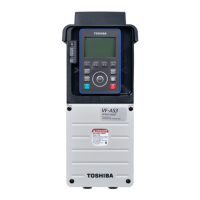
The TOSVERT VF-A7/P7 is an industrial inverter designed to enhance machine operating efficiency, particularly in applications involving light and heavy loads, such as elevators and conveyors. Its primary function is to increase motor speed during light-load conditions, optimizing performance and energy usage.
The inverter offers a "light-load high-speed operation" function, which allows the motor to run at higher speeds when the load is light. This function is managed through a series of adjustable parameters, enabling precise control over its behavior.
Key parameters for light-load high-speed operation include:
The inverter uses the absolute value of torque current to determine whether the load is light or heavy. Light-load detection is performed when the operation frequency is at or above the lower limit frequency (F331) after the motor has achieved its target speed. If a heavy load is detected, or if the directed speed value falls below the lower limit frequency (F331) during high-speed operation, the light-load high-speed operation is canceled, and the inverter returns to normal directed speed frequency operation.
The TOSVERT VF-A7/P7 offers flexible configuration options to suit various application requirements:
Multiple Operation Modes: Five distinct modes can be selected via F330:
Input/Output Terminal Functions:
Detailed Load Detection Logic: The system calculates the average load torque current during a specified detection time (F333) after a waiting period (F332). If this average is below the switching load torque current (F335/F338), it's classified as a light load, and high-speed operation commences. During acceleration, if the load torque current exceeds the heavy load torque current (F336/F339) for a duration longer than F334, it's deemed a heavy load, and high-speed operation is stopped. Similarly, during constant speed, if the average load torque current exceeds F337/F340 for the heavy load detection time (F334), high-speed operation is halted.
Frequency-based Control: If the directed frequency falls below the light-load high-speed operation switching lower limit frequency (F331), the inverter decelerates. If the operation frequency drops below F331, the light-load high-speed operation is reset. However, if the directed frequency is set back to F331 or higher before the operation frequency drops below F331, the high-speed operation will continue.
The manual focuses primarily on operational settings and functions, with less emphasis on explicit maintenance features. However, the detailed parameter descriptions and timing charts provide valuable information for troubleshooting and optimizing performance, which indirectly supports maintenance efforts. Understanding the various load detection thresholds and operational modes allows for precise tuning, which can prevent unnecessary wear and tear on the motor and mechanical components by ensuring the inverter operates efficiently under varying load conditions. The ability to monitor load outputs (106-109) can also aid in diagnosing load-related issues.
 General
| Series | VF-A7 |
|---|---|
| Frequency Range | 50/60 Hz |
| Output Frequency | 0-400 Hz |
| Output Voltage | Matches Input Voltage |
| Control Method | V/f control, Sensorless vector control |
| Communication Options | RS-485, Modbus RTU |
| Overload Capacity | 150% for 60 seconds |
| Braking Unit | Built-in, Optional external |
| Protection Features | Overcurrent, Overvoltage, Undervoltage, Overheat, Short circuit |
| Cooling Method | Forced air cooling |
| Humidity | 95% (non-condensing) |
| Altitude | Up to 1000m (above sea level) |
| Enclosure Rating | IP20 |


 To Next Page

