This document serves as an Owner's Manual for a TOSOT Split Air Conditioner, specifically models MTS2R-18HDI and MTS4R-28HDI, which utilize INVERTER technology. It provides original instructions for installation, operation, and maintenance, emphasizing safety and proper handling of the appliance.
Function Description
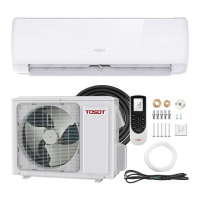
The TOSOT Split Air Conditioner is designed to provide cooling and heating (for heat pump models) for indoor spaces. It operates using a special refrigerant, R32, which is described as a non-polluting refrigerant with no harm to the ozonosphere and a lower influence on the greenhouse effect compared to common refrigerants. R32 also boasts good thermodynamic features, leading to high energy efficiency and requiring less refrigerant filling. The unit's primary function is to regulate indoor temperature and humidity, ensuring a comfortable environment.
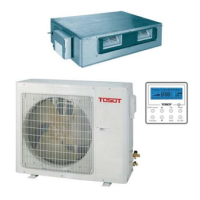
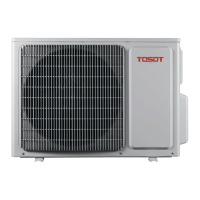
The appliance is designed for fixed wiring and requires an all-pole disconnection switch with a contact separation of at least 3mm in all poles. It also necessitates a circuit breaker with suitable capacity, including magnet buckle and heating buckle functions, to protect against circuit shorts and overloads. The system involves both indoor and outdoor units, with specific connection requirements for power and refrigerant lines.
Usage Features
The manual highlights several important usage features and safety precautions:
- Refrigerant Handling: The appliance is filled with flammable gas R32. Users are explicitly warned against accelerating the defrosting process or cleaning with means other than those recommended by the manufacturer. Repairs should only be carried out by authorized service centers, as unqualified personnel may pose dangers. The appliance must be stored and operated in a room with a floor area larger than a specified minimum (details provided in a table within the manual). Piercing or burning the unit is prohibited.
- Safety during Operation: Children aged 8 years and above, and persons with reduced physical, sensory, or mental capabilities, or lack of experience and knowledge, can use the appliance if they have been given supervision or instruction concerning its safe use and understand the hazards involved. Children must be supervised to ensure they do not play with the appliance.
- Electrical Safety: The air conditioner should not be connected to a multi-purpose socket to avoid fire hazards. Power supply must be disconnected when cleaning the unit to prevent electric shock. If the supply cord is damaged, it must be replaced by the manufacturer, its service agent, or similarly qualified persons. Washing the air conditioner with water or spraying water on the indoor unit is forbidden due to electric shock and malfunction risks. The unit must be properly grounded by a professional, and the yellow-green wire is designated solely for grounding. All wires of both indoor and outdoor units must be connected by a professional.
- Physical Safety: Users are warned not to touch fins after removing the filter to avoid injury. Using fire or a hair dryer to dry the filter is prohibited to prevent deformation or fire hazards. Fingers or objects should not be extended into the air inlet or outlet, as this may cause personal injury or damage. Blocking the air outlet or inlet can lead to malfunction. Spilling water on the remote controller may damage it.
- Abnormal Conditions: In case of overheating or damage to the power cord, abnormal sounds, frequent circuit breaker trips, burning smell, or indoor unit leakage, the air conditioner must be turned off immediately, power disconnected, and the dealer or qualified professionals contacted.
- Installation Location: The outdoor unit should be secured to a flat, solid floor or firmly mounted on a wall or roof to withstand vibrations and strong winds. It should not be installed in pits or air vents. The indoor unit should be installed close to the wall. A location out of reach of children and far from animals or plants is recommended; if unavoidable, a fence should be added for safety.
- Pipe Connections: Specific instructions are provided for connecting refrigerant pipes, including maximum pipe lengths and heights. All refrigerant pipes and joints must be wrapped, and connections tightened using two wrenches in opposite directions. Installation must comply with NEC/CEC requirements and be performed by authorized personnel.
Maintenance Features
The manual outlines critical maintenance procedures and safety considerations:
- Professional Maintenance: Maintenance must be performed by qualified professionals to avoid personal injury or damage. Users are explicitly warned against attempting to repair the air conditioner themselves.
- Cleaning: Before cleaning, the power supply to the air conditioner must be cut off to prevent electric shock. The unit should not be washed with water. Volatile liquids such as thinner or gasoline should not be used to clean the air conditioner's appearance; instead, a soft dry cloth or moist cloth should be used.
- Filter Maintenance: After removing the filter, users should avoid touching the fins to prevent injury. Fire or a hair dryer should not be used to dry the filter, as this can cause deformation or fire hazards.
- Refrigerant System Maintenance:
- Bleeding: After connecting indoor and outdoor units, air and humidity must be bled from the refrigerant circuit using a vacuum pump to prevent compressor malfunction. The process involves unscrewing and removing caps from 2-way and 3-way valves, connecting a vacuum pump hose to the service valve, operating the vacuum pump for 10-15 minutes until an absolute vacuum of 10 mm Hg is reached, closing the low-pressure knob, and then stopping the vacuum pump. The 2-way valve is opened by 1/4 turn and closed after 10 seconds, followed by leak checks using liquid soap or an electronic leak device. Finally, the body of the 2-way and 3-way valves are turned, the vacuum pump hose disconnected, and all caps replaced and tightened.
- Welding: If cutting or welding refrigerant system pipes, specific steps must be followed: shut down the unit, cut power supply, eliminate refrigerant, vacuum, clean with N2 gas, and then proceed with cutting or welding. The refrigerant should be recycled into a specialized storage tank. During welding, it's crucial to ensure no naked flame is near the vacuum pump outlet and that the area is well-ventilated.
- Refrigerant Filling: Only specialized appliances for R32 should be used for filling, ensuring different refrigerants do not contaminate each other. The refrigerant tank must be kept upright during filling. A label indicating filling status should be affixed to the system. Overfilling is prohibited. Leak detection must be performed after filling and again if the unit is removed.
- Regular Checks:
- Installation Reliability: Verify that the installation is reliable to prevent the unit from dropping, vibrating, or making noises.
- Gas Leakage: Ensure gas leakage has been checked to avoid unsatisfactory cooling/heating effects.
- Thermal Insulation: Confirm sufficient thermal insulation to prevent condensation and water dripping.
- Drainage: Verify smooth drainage to prevent condensation and water dripping.
- Power Supply: Check that the power supply voltage matches the rated voltage on the nameplate to prevent unit breakdown or component burnout.
- Wiring and Pipelines: Confirm correct installation of lines and pipelines to prevent unit breakdown or component burnout.
- Grounding: Ensure the unit is safely grounded to avoid electrical leakage.
- Line Conformity: Verify that line models conform to requirements to prevent unit breakdown or component burnout.
- Obstacles: Check for any obstacles near the air inlet and outlet of both indoor and outdoor units to prevent unit breakdown or component burnout.
- Refrigerant Record: Record the length of the refrigerating pipe and the refrigerant charge amount, as this information is crucial for future maintenance and troubleshooting.
- Maintenance Area: The maintenance area or room area must meet the requirements specified on the nameplate. It must be well-ventilated, with continuous ventilation during operation. Naked flames are prohibited, and "no smoking" warning boards should be displayed. Any vague or damaged warning marks on the appliance should be replaced.
- Transportation and Storage: Flammable gas detectors should be used before unloading and opening containers. No fire sources or smoking are allowed. All transportation and storage must comply with local rules and laws.

 Need help?
 General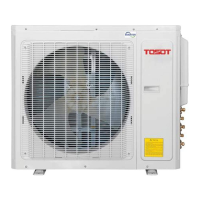


 To Next Page