
 Need help?
Do you have a question about the Total TBC1601 and is the answer not in the manual?
This document describes the TOTAL Battery Charger, models TBC1601, TBC1601-4, TBC1601-6, TBC1601-8, TBC1601-9, UTBC1601, and TBC1601S, designed as a one-stop tool for battery charging needs.
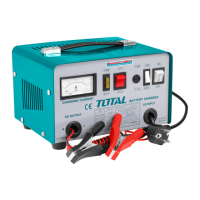
The TOTAL Battery Charger is designed to charge 12V and 24V lead-acid batteries. It features an output current switch, a current meter, a power switch, and a voltage switch to select between 12V and 24V charging. The device includes safety features such as output and input fuses, and a thermic protective device to prevent damage from polarity reversal, short-circuiting, and thermal overloading. The charger is equipped with a handle for portability and is intended for indoor use.
Before using the charger for the first time, it is crucial to read the instruction manual carefully. Safety is paramount when operating this device. Always wear goggles and gloves when charging batteries, as battery acid is corrosive and poses a high risk of injury. To prevent sparking due to electrostatic discharge, avoid wearing clothes made of synthetic materials during charging.
The charging environment must be well-ventilated to prevent the accumulation of explosive gases. Keep flames and sparks away from the charging area. The charger contains components like switches and fuses that can cause arcing and sparking, so proper ventilation is essential.
The charger is designed exclusively for 12V and 24V lead-acid batteries. Never attempt to charge non-rechargeable or defective batteries with this appliance. The charger should only be used indoors and must not be exposed to rain or placed on heated surfaces. Ensure that the ventilation slots are free of dirt to prevent overheating. Do not charge multiple batteries simultaneously or short-circuit the charging clamps. The power supply cable and charging leads must be in perfect condition.
Keep children away from both the battery and the charger. If a pungent smell of gas is detected, indicating an acute risk of explosion, immediately disconnect the charging clamps, ventilate the room thoroughly, and have the battery inspected by a customer service workshop.
When connecting the charger, always indicate the polarity correctly: the anode (positive pole) is red and marked with a "+" sign, while the cathode (negative pole) is black and marked with a "-" sign. Battery acid is corrosive; if any acid splashes on skin or clothes, wash it off immediately and consult a doctor if necessary.
To begin charging, first undo or remove the battery plug. Check the acid level in your battery and top it up with distilled water if necessary. Then, connect the red charging lead to the positive pole of the battery, followed by connecting the black charging lead to the negative pole. Once the battery is connected to the charger, you can connect the charger to a 220-240V~50/60Hz or 110-120V~60Hz socket-outlet. It is strictly prohibited to connect the charger to a socket-outlet with any other supply voltage.
The only reliable way to determine the exact condition of the battery (its level of charge) is to measure the acid density with an acidimeter. During charging, gases are released, so maintaining good ventilation is critical.
After charging, disconnect the power plug from the socket-outlet. Then, disconnect the black charging lead from the negative pole of the battery, followed by disconnecting the red charging lead from the positive pole. Finally, screw or press the battery plug back in place.
The flat fuse provides protection from polarity reversal and short-circuiting. If a fuse becomes defective, replace it with one of identical amperage. The automatic circuit-breaker will interrupt charging in the event of thermal overloading and will switch on again automatically after a cooling interval.
Motor vehicle manufacturers recommend disconnecting the battery from the vehicle's electric system before charging to prevent voltage peaks from damaging electronic components.
To ensure the longevity and safe operation of your battery charger and battery, regular maintenance is recommended.
First, always ensure that your battery is securely fitted in the vehicle. Regularly check that the battery is properly connected to the vehicle's electric system. Keep the battery clean and dry. Apply a small amount of acid-free and acid-resistant grease (Vaseline) to the battery terminals to protect them from corrosion.
For non-maintenance-free batteries, the acid level should be checked approximately every four weeks. Top up with distilled water as necessary to maintain optimal performance.
Store the charger in a dry room when not in use. Inspect the charging terminals regularly and remove any signs of corrosion to ensure good electrical contact.
If the fuse located alongside the charging current indicator becomes defective, it must be replaced with a fuse of identical amperage. This charger is not suitable for maintenance-free batteries.
Always disconnect the appliance from the power supply before performing any maintenance work. When connecting or charging the battery, or when filling in acid or topping up with distilled water, wear acid-proof safety gloves and goggles.
All repairs should only be carried out by a qualified electrician. If the power cord is damaged, it must be replaced by the manufacturer, its service agent, or a similarly qualified person to avoid hazards.
Disposal of unwanted batteries should be done responsibly, only via automotive workshops, special battery collection stations, or special waste collection centers. Consult your local authorities for specific details on battery disposal.
 General
| Input Voltage | 220-240V AC, 50/60Hz |
|---|---|
| Output Voltage | 12V |
| Battery Type | Lead-acid |
| Charging Time | Varies based on battery capacity |
| Protection Features | Reverse polarity protection, Short circuit protection |

 To Next Page
