7
3 Basic information about firewood
Totem fireplaces are high-performance appliances. Using good fuel is essential for optimal functioning of your fireplace. Wood is a
renewable form of energy when it comes from sustainably managed forests. In France, forests represent 30% of the country’s area.
French forests have been expanding for several centuries. (Fibra) Here is some basic information about firewood.
3.1 General points
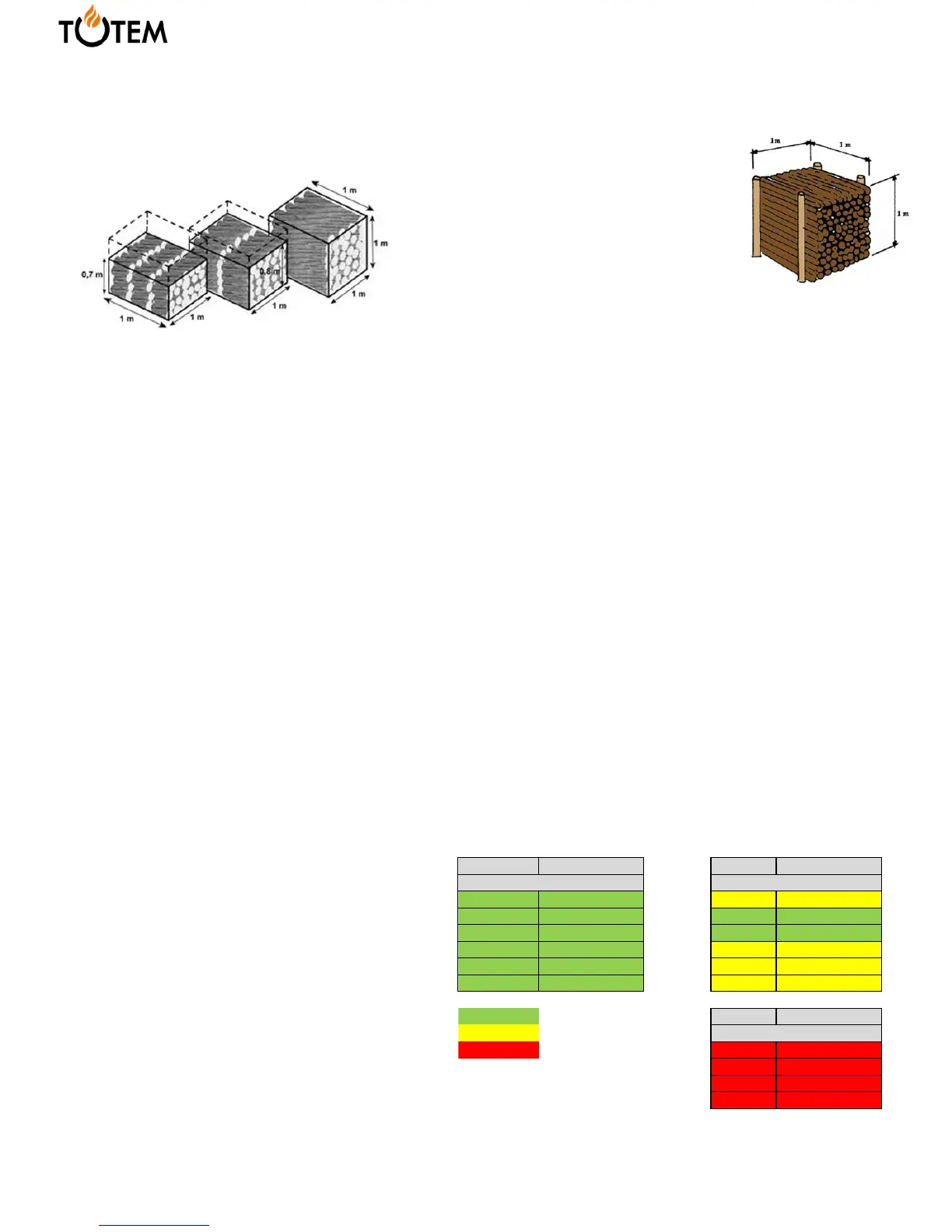
What is a stere of wood? A stere of wood corresponds to 1m
3
of wooden logs measuring 1 m stacked
parallel. However, since 1978, the legal sales unit is no longer the stere but the
m
3
. A stere is not always equivalent to one 1 m
3
, the
volume of the stere varies with the length of the logs.
With smaller logs, the volume in m
3
will decrease but
you still have the same amount of wood. The spaces
are filled better.
Below, 3 steres of wood in logs measuring 33, 50 and
100cm.
Which type of wood should I choose?
Birch: Birch burns quickly without its flames becoming too hot and leaves very little ash. It produces attractive, slightly bluish
flames. It is a wood liked by bakers. It produces good embers and is used for lighting the fire.
Beech: Beech is excellent firewood: it dries quickly and offers good heating power. For drying, it must be placed under a shelter as
soon as it has been resawn so that it does not rot. It is a wood which burns quickly, so it is easy to light. It emits pleasant odours
when burning. It is considered the idea firewood. It produces attractive flames and good embers.
Oak: It burns very slowly. It has to be left for 1 year in the rain in order to remove all traces of tannin before being stored under
shelter to dry. Oak produces the best embers. It burns slowly and produces a lot of heat.
Hornbeam: Hornbeam burns slowly which results in a good amount of heat production. Not much smoke is produced when
burning. Hornbeam produces excellent embers which distribute heat over time. The flames that it produces are attractive and
uniform.
Ash: Described as producing the most attractive flames, it is a wood which burns for a long time without projecting sparks and
produces a large amount of heat. It is difficult to cut.
Chestnut: Chestnut is a strong wood. It used to be used for manufacturing barrels. It is mediocre firewood because it explodes
and produces a lot of sparks when burning. When the fireplace door is lowered, it can be used without risk; when the door is raised
we recommend that you use a fire screen.
Coniferous trees: Coniferous trees should not be used. This type of wood releases large amounts of heat but burns very quickly.
When it burns it causes the projection of embers and the resins contained in the wood clog up the fireplaces and flues very quickly.
These very large deposits of soot encourage fires to start in the flues.
Important :
- Oak and chestnut contain tannins which affect burning. They must be stored for 6 – 9 months in a non-sheltered area to remove
the tannins before being stored in a sheltered area for a period of 2 years.
- Avoid burning too much bark as it creates 10% more ash.
- Also avoid using wood with knots in it as this reduces the appliance’s performance
- Wood which is too dry is not good for burning. Indeed, the wood heats too quickly, does not burn for long enough and
significantly increases the temperature of the smoke.
- Do not use wood gathered on beaches as it releases hydrogen chloride when burned.
There are 3 families of wood:
- hard hardwood (oak, beech, ash, chestnut, hornbeam, walnut…)
- soft hardwood (poplar, willow, alder, birch…)
- coniferous trees (pine, spruce, fir, larch, Douglas
fir…)
We recommend that you use firewood from the hard
hardwood family. It has better heating power for an equal
volume. I.e., it has greater heating power for the same
volume of wood burned. Here is a table presenting the
heating power, with equal humidity and volume, of the
different species of wood. The heating power is presented
on the basis of beech wood (set arbitrarily at 100).


 To Next Page