EasyManua.ls Logo

Toyota I Site DHU4 - User Manual

Toyota I Site DHU4
9 pages
Print Icon
To Next Page IconTo Next Page
Loading...
Page 1 of 9
DHU4 - User Manual
Toyota Material Handling Manufacturing Sweden AB
Svarvargatan 8
SE-595 81 Mjölby, Sweden
Tel: +46 142 860 00
www.toyota-forklifts.eu
Company No. 556198-2868
VAT. SE556198286801
Dat
e:
10
t
h of December
2021
DHU4 User Manual
Model Name: DHU4
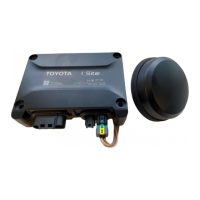
Picture showing the Toyota DHU4 unit to the left. Connected with a four-port mini-fakra to the
Smarteq antenna to the right.
General
DHU4 is a telematic node, intended to be mounted into a Toyota forklift. It is always stationary
installed in a forklift where it has several wired connections e.g., power, can buses etc.
It also communicates wireless with LTE, WiFi and Bluetooth technology. It has an external antenna
connected.
Question and Answer IconNeed help?

Do you have a question about the Toyota I Site DHU4 and is the answer not in the manual?

Summary

General

Information to the User

RF Exposure and Compliance

Mobile RF Exposure Environment

Device approved for mobile RF exposure; maintain 20cm separation from persons.

Co-located Modules

Module may co-locate with Quectel EG25 and FC20 radio modules.

List of Applicable FCC Rules

Operational Conditions and Co-location

Installation and Operation Distance

Installed by qualified personnel; minimum 20cm distance from radiator and persons.

Module Co-location

Modules evaluated for co-location in mobile configurations; specific modules listed.

RF Exposure Compliance

Device approved for mobile RF exposure; maintain 20cm separation from persons.

Antenna System

Smarteq Antenna Description

Smarteq Combination antenna P/N 550237, 200mm cable, four elements.

Antenna Element Functions

LTE1 (Tx/Rx), LTE2 (Rx), WiFi/BT (Tx/Rx), GNSS (Rx).

Label and Testing Information

Device Label Details

Contains HVIN, FCC ID, IC ID, P/N, S/N, and IMEI.

Test Mode Information

Testing performed in co-located configuration for interference.

Additional Test Requirements

Host manufacturer tests for Unintentional Radiator requirements.

Overview

The DHU4 is a telematic node designed for stationary installation in Toyota forklifts. It serves as a central communication hub, enabling various wired and wireless connections within the forklift's operational environment. The device is manufactured by Toyota Material Handling Manufacturing Sweden AB.

Function Description:

The primary function of the DHU4 is to provide telematics capabilities to Toyota forklifts. This includes facilitating communication via LTE, WiFi, and Bluetooth technologies. It acts as a telematic node, integrating with the forklift's existing systems through wired connections such as power and CAN buses. The DHU4 is always stationary installed within the forklift, ensuring a stable and reliable communication platform for various operational needs. It connects to an external Smarteq Combination antenna (P/N 550237) via a Quad Mini Fakra (QMF) cable, which is essential for its wireless communication capabilities. The antenna's shortest cable length is 200mm, used for certification tests to ensure the highest RF power transmission due to minimum cable loss.

Important Technical Specifications:

The DHU4 incorporates several radio modules for its wireless communication:

  • Cellular Module (Quectel EG25):
    • FCC ID: XMR201903EG25G
    • IC ID: 10224A-201903EG25G
  • WiFi/Bluetooth Module (Quectel FC20):
    • FCC ID: XMR201703FC20
    • IC ID: 10224A-201703FC20

The external Smarteq Combination antenna (P/N 550237) features four antenna elements, each with specific characteristics:

Cellular Antenna (LTE1 and LTE2):

  • Antenna 1 (LTE1 - Main LTE/cellular main antenna): Can receive and transmit.
    • Frequencies: 698-960MHz, 1710-2170MHz, 2500-2690MHz
    • Impedance: 50Ω
    • Polarization: Linear
    • VSWR* (Measured with 2m cable):
      • 698-790MHz: 5:1
      • 790-960MHz: 3.5:1
      • 1710-2170MHz: 2:1
      • 2500-2690MHz: 2:1
    • Gain Peak** (Averaged over frequency band, measured in free space 10cm cable):
      • 698-790MHz: -3.8dBi
      • 790-960MHz: -0.5dBi
      • 1710-2170MHz: 3.5dBi
      • 2500-2690MHz: 2dBi
    • Radiation Efficiency** (Measured in free space 10cm cable):
      • 698-790MHz: 17%
      • 790-960MHz: 34%
      • 1710-2170MHz: 67%
      • 2500-2690MHz: 42%
  • Antenna 2 (LTE2 - Main LTE/cellular diversity antenna): Can only receive.
    • Frequencies: 1710-2170MHz, 2500-2690MHz
    • Impedance: 50Ω
    • Polarization: Linear
    • VSWR* (Measured with 2m cable):
      • 1710-2170MHz: 2:1
      • 2500-2690MHz: 2:1
    • Gain Peak** (Averaged over frequency band, measured in free space 10cm cable):
      • 1710-2170MHz: 5dBi
      • 2500-2690MHz: 3.5dBi
    • Radiation Efficiency** (Measured in free space 10cm cable):
      • 1710-2170MHz: 77%
      • 2500-2690MHz: 75%

WiFi/Bluetooth Antenna: Can receive and transmit, supporting 2.4GHz WiFi/BT and 5GHz WiFi.

  • Frequencies: 2400-2485MHz / 4900-5900MHz
  • Impedance: 50Ω
  • Polarization: Linear
  • VSWR* (Measured with 2m cable):
    • 2400-2485MHz: < 1.5:1
    • 4900-5900MHz: < 1.5:1
  • Gain (Peak)** (Measured in free space 10cm cable):
    • 2400-2485MHz: 4.4dBi
    • 4900-5900MHz: 4.5dBi
  • Radiation efficiency** (Measured in free space 10cm cable):
    • 2400-2485MHz: 97%
    • 4900-5900MHz: 77%
  • Isolation* (Measured with 2m cable):
    • WiFi to LTE-1: >14.5dB
    • WiFi to LTE-2: >24.5dB
    • WiFi to LTE-1 (4900-5900MHz): >24dB
    • WiFi to LTE-2 (4900-5900MHz): >26dB

GNSS Antenna: Can only receive, supporting GPS, Galileo, Glonass, and Beidou.

  • Frequencies: 1559-1606MHz
  • Impedance: 50Ω
  • Polarization: RHCP
  • VSWR* (Measured with 2m cable): < 2.5:1
  • Gain Passive (peak gain):
    • GPS: 3.0dBic
    • GLONASS: 2.0dBic
    • BEIDOU: 1.5dBic
    • GALILEO: 2.0dBic
  • Gain Active: 30 ± 1 dB
  • Noise figure: < 2.5 dB with pre-filter
  • Out of band rejection:
    • < 960MHz: > 60dB
    • 1710MHz: > 60dB

  • Compression point: -20 dBm
  • Supply Voltage: 2.5 - 6V (voltage regulator in LNA)
  • Current Consumption: 8-10mA

The device complies with FCC Part 15 Class B digital device limits, ISED Canada licence-exempt RSS standard(s), and is approved for use in a mobile RF exposure environment. A minimum separation distance of 20 cm must be maintained between the antenna and nearby persons. The device for operation in the band 5150 – 5250 MHz is only for indoor use to prevent harmful interference to co-channel mobile satellite systems. High-power radars are allocated as primary users of the bands 5250 – 5350 MHz and 5650 – 5850 MHz, and these radars could cause interference and/or damage to LE-LAN devices.

Usage Features:

The DHU4 is designed for integration into Toyota forklifts, providing advanced telematics capabilities. Its primary usage is to enable wireless communication for various applications within the forklift's operational context. This includes data transmission via LTE, local area networking via WiFi, and short-range communication via Bluetooth. The device is always installed in a stationary manner within the forklift, ensuring consistent connectivity. The installation process is typically performed by qualified personnel at Toyota production facilities, though aftermarket installations also occur. The user does not directly operate the DHU4; rather, it functions as an embedded component of the forklift's system. The co-location of the Quectel EG25 and FC20 modules allows for simultaneous transmission, expanding the device's communication versatility.

Maintenance Features:

The manual does not explicitly detail maintenance features for the DHU4. However, it provides information relevant to compliance and operational integrity, which indirectly supports maintenance considerations:

  • Compliance Information: The device complies with FCC and ISED Canada regulations, indicating adherence to established standards for electronic equipment. This suggests that the device is designed for reliable operation within specified parameters.
  • Warning regarding modifications: "Changes or modifications not expressly approved by the party responsible for compliance could void the user's authority to operate the equipment." This emphasizes the importance of authorized servicing and discourages unauthorized modifications, which could impact the device's performance and regulatory compliance.
  • RF Exposure Guidelines: The requirement to maintain a minimum separation distance of 20 cm between the antenna and nearby persons is a safety guideline that should be considered during any maintenance or inspection activities involving the forklift and its integrated DHU4 unit.
  • Interference Troubleshooting: The manual provides general troubleshooting steps for harmful interference, such as reorienting/relocating the receiving antenna, increasing separation between equipment and receiver, connecting to a different outlet, or consulting a technician. While these are general guidelines, they can be applied if interference issues arise, potentially indicating a need for inspection or adjustment of the DHU4 or its antenna.

Given that the DHU4 is an embedded telematic node, its maintenance would likely be part of the overall forklift maintenance schedule, performed by trained technicians. The modular design, with identifiable FCC and IC IDs for its cellular and WiFi/Bluetooth components, suggests that individual modules could potentially be serviced or replaced if necessary, though this is not explicitly stated as a user-level maintenance feature.

Toyota I Site DHU4 Specifications

General IconGeneral
BrandToyota
ModelI Site DHU4
CategoryAutomobile Accessories
LanguageEnglish

Related product manuals